
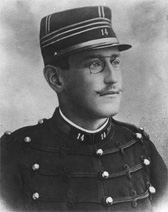
Alfred Dreyfus
French Jewish army officer who was falsely convicted of treason in 1894. His imprisonment and eventual exoneration became the central events of the Dreyfus Affair, a political and judicial controversy that divided France between 1894 and 1906.
Born on October 9, 1859
Died on July 12, 1935
Age at death: 76
Profession: Military Officer
Place of Birth: Mulhouse, Alsace, France
Place of Death: Paris, France
Alfred Dreyfus (October 9, 1859 – July 12, 1935) was a French military officer of Jewish descent whose wrongful conviction for treason in 1894 became known as the Dreyfus Affair. Accused of supplying French military secrets to Germany, he was sentenced to life imprisonment and deported to Devil's Island in French Guiana. The accusation relied on disputed handwriting evidence and secret documents withheld from his defense. Subsequent investigations identified another French officer, Ferdinand Walsin Esterhazy, as the author of the incriminating document. The affair divided French society and involved political figures, military officials, and writers, including Émile Zola, whose 1898 open letter J'Accuse…! demanded justice for Dreyfus. Although pardoned in 1899, Dreyfus was not officially exonerated until July 12, 1906, when his conviction was annulled and he was reinstated in the French Army.
Early Life and Education
Alfred Dreyfus was born on October 9, 1859, in Mulhouse, in the Alsace region of France. He was the youngest of nine children born to Raphaël Dreyfus and Jeannette Libmann, members of a prosperous Jewish family involved in the textile industry.
Following the Franco-Prussian War of 1870–1871, Germany annexed Alsace and part of Lorraine. The Dreyfus family chose to retain French nationality, and Alfred subsequently continued his education in France.
In 1878, he entered the École Polytechnique in Paris, a military and scientific institution. After graduating in 1880, he completed artillery training at the École d'Application de l'Artillerie et du Génie in Fontainebleau between 1880 and 1882.
He continued his military education and was promoted to captain in 1889. In 1890, he entered the École Supérieure de Guerre, where officers were trained for senior staff responsibilities.
His military assessments generally described him as intelligent, hardworking, disciplined, and proficient in German. In 1893, he received an appointment to the French Army General Staff.
Military Career and Antisemitism
Alfred Dreyfus served as an artillery officer during a period of political tension between France and Germany. His familiarity with the German language and his Alsatian background were relevant to his military duties.
Despite his professional qualifications, he encountered antisemitic attitudes within sections of the French officer corps.
During his studies at the École Supérieure de Guerre, his marks were affected by assessments from officers who held prejudices against Jewish candidates. Nevertheless, he completed the course and obtained a position with the General Staff.
These circumstances later became relevant to the investigation that resulted in his arrest.
Arrest and Treason Charges in 1894
In September 1894, French military intelligence obtained a handwritten memorandum, known as the *bordereau*, which listed confidential military information offered to the German military attaché in Paris, Maximilian von Schwartzkoppen.
Military investigators concluded that the document had been written by Alfred Dreyfus, although the handwriting evidence was uncertain.
On October 15, 1894, Dreyfus was arrested on suspicion of supplying military secrets to Germany.
Officer Armand du Paty de Clam conducted the preliminary interrogation. Major Hubert-Joseph Henry, who worked in military intelligence, also became involved in the case.
Dreyfus consistently denied the allegations. His Jewish background contributed to the hostility surrounding the investigation, particularly as antisemitic publications portrayed him as disloyal to France.
The 1894 Trial and Conviction
Alfred Dreyfus appeared before a military court in Paris in December 1894. His trial began on December 19, and on December 22 he was convicted of treason.
The prosecution relied heavily on handwriting comparisons and confidential intelligence documents.
A secret dossier was supplied to the judges without being disclosed to Dreyfus or his defense counsel. This violated basic principles of a fair trial and prevented the defense from examining the evidence.
He was sentenced to permanent deportation and military degradation.
On January 5, 1895, Dreyfus was publicly stripped of his military rank and insignia in the courtyard of the École Militaire in Paris.
He maintained his innocence throughout the ceremony.
The event was witnessed by journalists, military personnel, and members of the public, including antisemitic demonstrators.
Journalist and political thinker Theodor Herzl, then working as a correspondent for the Vienna newspaper Neue Freie Presse, covered the affair in Paris.
Imprisonment on Devil's Island
In February 1895, Alfred Dreyfus was deported to French Guiana and imprisoned on Devil's Island, part of the French penal colony off the South American coast.
He was held in isolation under severe conditions, with restricted communication and constant surveillance.
His letters to his wife, Lucie Hadamard, were closely monitored, and contact with his family was limited.
During his imprisonment, Dreyfus continued insisting that he was innocent and requested a review of his conviction.
His family, particularly his brother Mathieu Dreyfus, worked to obtain evidence and organize support for a new investigation.
Discovery of the Real Spy
In 1896, Lieutenant Colonel Georges Picquart, head of French military intelligence, discovered evidence linking the original incriminating memorandum to Major Ferdinand Walsin Esterhazy.
Picquart concluded that Esterhazy, rather than Alfred Dreyfus, was responsible for supplying military information to Germany.
Instead of reopening the case, senior military officials sought to prevent the findings from becoming public. Picquart was transferred away from his position and later imprisoned.
Meanwhile, Major Hubert-Joseph Henry fabricated additional evidence intended to support Dreyfus's conviction.
In November 1897, Mathieu Dreyfus publicly accused Esterhazy of writing the original memorandum.
Esterhazy was tried by a military court in January 1898 but was acquitted.
Émile Zola and J'Accuse…!
On January 13, 1898, French novelist Émile Zola published an open letter titled J'Accuse…! in the newspaper L'Aurore.
Addressed to French president Félix Faure, the article accused military and government officials of concealing evidence and protecting those responsible for the wrongful conviction of Alfred Dreyfus.
Zola's article brought wider public attention to the case and intensified political debate throughout France.
He was prosecuted for criminal defamation and sentenced to one year in prison. To avoid imprisonment, he traveled to England.
Other writers and political figures who supported a review of the case included Georges Clemenceau, Anatole France, Joseph Reinach, Charles Péguy, and Jean Jaurès.
The controversy divided public opinion between supporters of Dreyfus, commonly known as *Dreyfusards*, and opponents who defended the original conviction.
Debates over the case involved antisemitism, military authority, freedom of the press, judicial procedure, and the institutions of the French Republic.
Exposure of Forged Evidence
In August 1898, military officials discovered that a document used to support the case against Alfred Dreyfus had been forged by Hubert-Joseph Henry.
Henry admitted fabricating the evidence and was arrested. He died by suicide in his prison cell shortly afterward.
The discovery weakened the prosecution's case and increased demands for a judicial review.
Ferdinand Walsin Esterhazy subsequently left France and lived in England.
In June 1899, the original conviction was annulled, and Dreyfus was brought back from Devil's Island to face a second military trial.
Second Trial and Presidential Pardon
In August 1899, Alfred Dreyfus appeared before a military court in Rennes.
Despite the evidence undermining the original accusations, the court convicted him again on September 9, 1899, this time recognizing what it described as mitigating circumstances.
He was sentenced to ten years of detention.
On September 19, French president Émile Loubet granted Dreyfus a pardon, allowing him to leave prison.
The pardon did not overturn the conviction or formally establish his innocence. Dreyfus and his supporters continued seeking complete judicial exoneration.
Exoneration and Return to the French Army
On July 12, 1906, the French Court of Cassation annulled the military conviction of Alfred Dreyfus without ordering another trial.
He was officially exonerated and reinstated in the French Army with the rank of major.
Shortly afterward, he was appointed a Knight of the Legion of Honour.
Dreyfus subsequently served in the military reserve and returned to active service during the First World War.
He participated in wartime duties as an artillery officer and completed his military career with the rank of lieutenant colonel.
Although his legal innocence was established in 1906, the affair continued to be discussed in French political and historical writing.
Marriage and Family
Alfred Dreyfus married Lucie Hadamard on April 18, 1890.
The couple had two children, Pierre and Jeanne.
Lucie supported her husband throughout his imprisonment and worked with other family members to secure a review of his case.
His brother Mathieu Dreyfus played a central role in organizing the campaign to overturn the conviction.
Death
Alfred Dreyfus died on July 12, 1935, in Paris, France, at the age of 75.
He was buried at the Montparnasse Cemetery in Paris.
His death occurred exactly twenty-nine years after the Court of Cassation annulled his conviction on July 12, 1906.
Source: Biyografiler.com
Frequently asked questions about Alfred Dreyfus
Who is Alfred Dreyfus?, Alfred Dreyfus biography, Alfred Dreyfus life story, Alfred Dreyfus age, Alfred Dreyfus facts, Alfred Dreyfus birthplace, Alfred Dreyfus photos, Alfred Dreyfus videos, Alfred Dreyfus career
Related Biographies

Lamine Yamal
Professional footballer

Erling Haaland
Professional footballer

Keanu Reeves
Actor

Kylian Mbappe
Professional footballer

Bad Bunny
Rapper, Songwriter

Leonardo DiCaprio
Actor

Andre Rieu
Musician, Composer

Andriy Shevchenko
Former Professional Footballer, Football Manager

Andy Wachowski
Film Director, Screenwriter

Andy Rubin
Computer Scientist, Entrepreneur, Investor

Andy Serkis
Actor, Film Director

Andy Burnham
Former Prime Minister, Politician

Amy Ryan
Actress

Andy Garcia
Actor, Film Director

Ali Larter
Actress, Former Model
Andy Serkis
Actor, Film Director

Sydney Sweeney
Actress

Ursula von der Leyen
Politician, Physician