
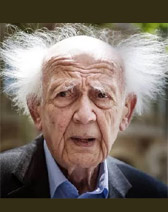
Zygmunt Bauman
The Thinker of Liquid Modernity
Born on November 19, 1925
Died on January 9, 2017
Age at death: 92
Profession: Sociologist, Philosopher
Place of Birth: Poznań, Poland
Place of Death: Leeds, England
Zygmunt Bauman was a Polish-born sociologist and philosopher of Jewish origin, widely regarded as one of the most influential European intellectuals of the late twentieth and early twenty-first centuries. His work reshaped contemporary social theory by offering penetrating analyses of modernity, postmodernity, ethics, consumer society, globalization, and social exclusion. Bauman played a pioneering role in translating postmodern philosophy into sociological inquiry, developing concepts that captured the moral and structural transformations of contemporary life.
Early Life and Historical Trauma
Zygmunt Bauman was born on 19 November 1925 in Poznań, Poland. He spent his early childhood there until the Nazi invasion of Poland in 1939 radically altered the course of his life. Because of his Jewish identity, Bauman and his family were forced to flee to the Soviet Union, beginning a prolonged experience of exile, displacement, and insecurity that would later become central themes in his intellectual work.
During the Second World War, Bauman served in a Polish military unit under Soviet command and participated in the Battle of Berlin in 1945. The direct encounter with war, state violence, and bureaucratic power left a lasting imprint on his thinking. These formative experiences shaped his lifelong concern with the ethical consequences of modern political and administrative systems.
Academic Formation in Postwar Poland
After the war, Zygmunt Bauman returned to Poland and completed his higher education at the University of Warsaw. He earned his doctorate, passed his habilitation examination, and began teaching sociology at the same institution in 1954. During this period, he was affiliated with the Polish Communist Party and held several academic and administrative roles, including leadership positions within the Polish Sociological Association.
His early academic work reflected the intellectual constraints of the socialist system, yet it also demonstrated a growing independence of thought. Over time, Bauman’s writings increasingly questioned rigid ideological frameworks and emphasized the ethical responsibilities of individuals within social structures.
Exile and Intellectual Reinvention
In 1968, amid an officially sanctioned antisemitic campaign in Poland, Zygmunt Bauman was stripped of his professorship and forced into exile. He left the country and relocated first to Israel, where he taught briefly in Tel Aviv and Haifa. This second displacement reinforced his reflections on belonging, identity, and the fragility of social inclusion.
In 1971, he accepted an invitation to move to the United Kingdom and settled in England. At the University of Leeds, Bauman became head of the sociology department, a position he held while producing much of his most influential work. He remained academically active there until the 1990s, establishing Leeds as a major center for critical social theory.
Modernity, Totalitarianism, and the Holocaust
From the 1980s onward, Zygmunt Bauman gained international recognition for his examination of the relationship between modernity and totalitarian violence. His landmark book Modernity and the Holocaust (1989) challenged conventional interpretations of the Holocaust as a historical anomaly. Instead, Bauman argued that it was deeply rooted in modern rationality, bureaucratic organization, and industrial efficiency.
This work had a profound impact across sociology, philosophy, and political theory, forcing scholars to reconsider the moral foundations of modern civilization and the dangers inherent in technocratic governance.
Liquid Modernity and Global Recognition
Zygmunt Bauman achieved global prominence with Liquid Modernity (2000), in which he introduced the concept of “liquid modernity.” He described contemporary society as fluid, unstable, and marked by constant change, where social forms no longer solidify long enough to provide lasting orientation. Identities, relationships, labor, and values, he argued, had become increasingly fragile and temporary.
Through this framework, Bauman analyzed the vulnerability of individuals in a world defined by uncertainty, mobility, and perpetual insecurity. The concept of liquid modernity became one of the most widely cited and influential ideas in contemporary social thought.
Ethics, Exclusion, and the Human Condition
Across his later works, Zygmunt Bauman explored postmodern ethics, individualization, poverty, social exclusion, surveillance, migration, and fear. He examined how consumer culture reshapes moral responsibility and how globalization produces both unprecedented connectivity and widespread human disposability.
Notably, Bauman’s writing style—clear, accessible, and morally engaged—allowed him to reach audiences far beyond academia. He became a rare public intellectual whose ideas resonated with students, activists, and general readers worldwide.
Personal Life
Zygmunt Bauman was married twice. His first marriage was to writer Janina Bauman, whom he married in 1948. They had three daughters: Lydia Bauman, Irena Bauman, and Anna Sfard. Janina Bauman died in 2009.
In 2015, he married sociologist Aleksandra Jasińska-Kania. Their marriage lasted until 2017.
Awards and International Recognition
Throughout his career, Zygmunt Bauman received numerous international honors, including the 1989 Amalfi European Prize for Sociology and Social Sciences, the 1998 Theodor W. Adorno Award, and the 2010 Prince of Asturias Award for Communication and Humanities. These distinctions reflected the global significance and enduring relevance of his work.
Death and Intellectual Legacy
Zygmunt Bauman died on 9 January 2017 in Leeds, England, at the age of 91. He left behind a vast and enduring intellectual legacy that continues to shape debates on modernity, ethics, and the future of social life. His writings remain essential reference points for understanding the complexities, anxieties, and moral challenges of contemporary society.
Selected Works
- Modernity and the Holocaust
- Liquid Modernity
- Postmodern Ethics
- Globalization: The Human Consequences
- Individualized Society
- Wasted Lives: Modernity and Its Outcasts
- Liquid Love
- Liquid Surveillance
- Strangers at Our Door
Source: Biyografiler.com
Frequently asked questions about Zygmunt Bauman
Who is Zygmunt Bauman?, Zygmunt Bauman biography, Zygmunt Bauman life story, Zygmunt Bauman age, Zygmunt Bauman facts, Zygmunt Bauman birthplace, Zygmunt Bauman photos, Zygmunt Bauman videos, Zygmunt Bauman career

Lamine Yamal
Professional footballer

Kylian Mbappe
Professional footballer

Sam Altman
Entrepreneur, Investor, CEO

Erling Haaland
Professional footballer

Alice Weidel
Politician, Economist

Giorgia Meloni
Politician, Journalist


Hongjoong
Singer, Rapper, Songwriter, Composer

Ludacris
Rapper, Actor

Kwon Eunbi
Singer

Sarah Wayne Callies
Actress, Screenwriter, Producer, Director

LaTavia Roberson
Singer, Actress, Entrepreneur

Snoop Dogg
Rapper, Singer, Actor

John Healey
Politician

Florence Pugh
Actress

Austin Abrams
Actor

Eliezer Yudkowsky
Researcher, Writer

Josh Duhamel
Actor