
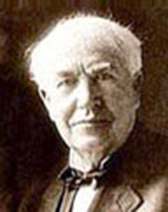
Thomas Alva Edison
Born on February 11, 1847
Died on October 18, 1931
Age at death: 84
Profession: Inventor, Businessperson
Place of Birth: Milan, Ohio, United States
Place of Death: New Jersey, United States
Thomas Alva Edison was an American inventor and businessman who created many important devices and machines. He is considered one of the three individuals in history to hold the highest number of patents worldwide. Edison produced a total of 1,093 inventions, including the motion picture camera, carbon microphone, phonograph, and concepts related to the electric automobile.
Thomas Alva Edison was born on February 11, 1847, in Milan, Ohio, United States, as the youngest of seven children. His father was Samuel Edison and his mother was Nancy Matthews Elliott. Like Albert Einstein, Edison began speaking much later than his peers. When he was seven years old, his family moved to Port Huron, Michigan. Although he began elementary school there, he was dismissed after about three months because teachers believed he was slow to comprehend and unlikely to succeed. For the next three years, he was educated at home by his mother, a former teacher, and a private tutor. With his mother’s encouragement, Edison developed a strong habit of reading and began to read almost every book he could find. At his mother’s suggestion, he focused especially on books about chemistry and physics.
As a highly curious and creative child, Edison devoted himself to physics and chemistry books by the age of ten. He set up a chemistry laboratory in the basement of his home, where he conducted experiments, particularly in chemistry and electricity using Volta cells. He eventually built his own telegraph device and learned Morse code. During this period, he suffered from scarlet fever and middle ear infections, which caused him to become hard of hearing.
At the age of twelve, Edison began selling newspapers and candy on trains running between Port Huron and Detroit to help support his family. He moved his home laboratory to the baggage car of the train and continued his experiments there. He published a small newspaper called Weekly Herald and used his earnings to establish a chemistry laboratory. After a fire caused by spilled phosphorus during an experiment, he was thrown off the train. Around this time, Edison read Michael Faraday’s Experimental Research in Electricity and was deeply influenced. He began repeating Faraday’s experiments while conducting his own more systematically and keeping detailed notes.
In 1863, Edison saved the child of a train stationmaster from being run over by a train, and in gratitude, the stationmaster taught him how to operate a telegraph. Edison soon began working as a telegraph operator and, at the age of sixteen, made his first invention: a device that recorded messages when the telegraph operator was away. He was later dismissed from another job after an experiment damaged equipment.
In 1868, Edison established his own workshop and obtained a patent for an electric vote-recording machine. Although the device attracted interest, it found no buyers. Between 1863 and 1868, he worked at several telegraph offices. Unable to sell the patent for his recording device, Edison left Boston deeply in debt and moved to New York with only thirty-five dollars borrowed money.
Edison’s fortune changed in 1869 when a telegraph used to regulate the gold exchange malfunctioned. Edison repaired it skillfully at the request of exchange officials and was offered work by Western Union Telegraph Company to improve telegraphic recording devices. While employed there, he invented a machine capable of transmitting four telegraph messages simultaneously. He sold the patent for forty thousand dollars, earning his first significant fortune.
With a partner, Edison founded the Edison Universal Stock Printer engineering company and soon accumulated considerable wealth through patent sales. Using this money, he established a manufacturing facility in Newark, New Jersey, producing telegraph and telegraph-related devices. In 1874, he closed the factory and founded a research laboratory in Menlo Park, New Jersey, dedicating himself entirely to invention.
In the 1880s, Edison purchased land in Fort Myers, Florida, where he built a winter home. Around the same time, automobile industrialist Henry Ford moved nearby, and the two developed a lifelong friendship.
Edison married Mary Stilwell in 1871. They had three children: Marion Estelle Edison, Thomas Alva Edison Jr., and William Leslie Edison. Mary Edison died in 1884 at the age of twenty-nine, possibly due to a brain tumor or morphine overdose. In 1886, Edison married Mina Miller, with whom he had three more children: Madeleine Edison, Charles Edison—who later became Governor of New Jersey—and Theodore Miller Edison.
In 1876, Edison began working on the speaking telegraph developed by Alexander Graham Bell. By adding a carbon transmitter, he significantly improved the telephone. Building on his research into sound waves, he developed the phonograph in 1877, an invention that brought him international fame.
Inspired by a high-power arc lamp developed by William Wallace, Edison began working on a safer and more economical electric lamp. He founded Edison Electric Light Company with financial support from prominent businessmen. After thirteen months of experimentation, Edison successfully demonstrated a carbon-filament incandescent lamp on October 21, 1879. By 1882, New York City streets were illuminated using Edison’s system, as he owned the patents and power stations.
In 1882, a young inventor named Nikola Tesla began working at Edison’s Continental Edison company in Paris and later joined Edison’s firm in New York. Due to disagreements—particularly after Edison failed to honor a promised payment—Tesla left the company and later founded Tesla Electric Company, developing the alternating current induction motor.
In 1887, Edison moved from Menlo Park to West Orange, New Jersey, where he established a laboratory ten times larger than his previous ones. During the 1890s, alternating current became favored for long-distance transmission. Edison, a strong advocate of direct current, campaigned against alternating current, claiming it was dangerous. In 1892, he lost control of Edison General Electric Company, which merged into General Electric Company.
Until the end of his life, Edison continued to pursue new inventions. He held a total of 1,093 patents and was known as the “Wizard of Menlo Park.” He famously remarked that genius was “one percent inspiration and ninety-nine percent perspiration.”
Thomas Alva Edison died on October 18, 1931, at the age of eighty-four in his home in New Jersey due to complications from diabetes.
Edison invented the carbon microphone in 1877, significantly improving telephone sound quality. Although he did not invent the light bulb, he perfected a long-lasting version after years of experimentation and established the first light bulb factory. He built the first electric power station in 1881, developed the motion picture camera in 1891, the steel alkaline battery in 1910, and numerous military and industrial technologies, leaving an enduring legacy in science and industry.
Interesting and Unsuccessful Inventions:
When Thomas Edison was 21 years old, he created an electronic voting machine for Parliament and obtained a patent for it, but he was unable to sell it. In manual voting, members had the opportunity to change their votes, whereas in the electronic system there was no time for this. The commission chairman reportedly said, “If there is an invention we do not want, this is it.” After Wilhelm Röntgen discovered X-rays in 1895, Edison had a glassworker named Clarence Dally produce X-ray tubes and invented the device known as the Fluoroscope. Hospitals liked the device, but the glassworker, who was exposed to carcinogenic X-rays, died of cancer. Deeply saddened by this, Edison abandoned further work with X-rays. In 1907, he entered the cement industry with the Poured Concrete House project. He even cast household furniture and pianos out of concrete, but when the houses failed to sell, he suffered financial losses. He developed a technique to separate iron using magnets and produced iron from low-grade ore, but this venture also resulted in losses. He created miniature phonographs small enough to fit inside toys and produced singing dolls in 1877, but they did not sell. In 1883, Edison failed to recognize the importance of a discovery he made in the field of physics. He added an additional metal electrode next to the incandescent filament of the light bulb. When he connected a galvanometer between the metal and the filament, he discovered that electricity flowed from the metal. This discovery, known as the Edison Effect, later enabled others to develop diodes and triodes, which facilitated the invention of radio. Subsequently, this led to the discovery of the transistor and the silicon chip. In 1920, Edison announced that he had invented a device that allowed communication with spirits, but this is believed to have been a joke. His most forward-looking invention was the electric automobile powered by a special battery he developed in 1899. However, because petroleum was cheap, this project also resulted in financial loss.
Source: Biyografiler.com
Frequently asked questions about Thomas Alva Edison
Who is Thomas Alva Edison?, Thomas Alva Edison biography, Thomas Alva Edison life story, Thomas Alva Edison age, Thomas Alva Edison facts, Thomas Alva Edison birthplace, Thomas Alva Edison photos, Thomas Alva Edison videos, Thomas Alva Edison career
Related Biographies

Lamine Yamal
Professional footballer

Kylian Mbappe
Professional footballer

Erling Haaland
Professional footballer

Sam Altman
Entrepreneur, Investor, CEO

Bad Bunny
Rapper, Songwriter

Brad Pitt
Actor


Hongjoong
Singer, Rapper, Songwriter, Composer

Ludacris
Rapper, Actor

Kwon Eunbi
Singer

Sarah Wayne Callies
Actress, Screenwriter, Producer, Director

LaTavia Roberson
Singer, Actress, Entrepreneur
Erling Haaland
Professional footballer

Tim Berners Lee
Computer Scientist, Professor

Amber Heard
Actress, Model

Tim Roth
Actor, Director
Brad Pitt
Actor

Delcy Rodriguez
Politician, Lawyer, Diplomat