
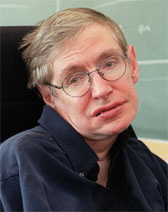
Stephen Hawking
One of the greatest theoretical physicists after Albert Einstein; a pioneer of black hole physics and cosmology.
Born on January 8, 1942
Died on March 14, 2018
Age at death: 76
Profession: Theoretical Physicist, Professor, Author
Place of Birth: Oxford, England
Place of Death: Cambridge, England
Stephen William Hawking was an English theoretical physicist and professor, widely regarded as the most important theoretical physicist since Albert Einstein. In the early 1960s, he was diagnosed with Amyotrophic Lateral Sclerosis (ALS), a progressive motor neuron disease that eventually paralyzed almost all voluntary muscle movement. Despite this condition, Hawking continued his scientific work and achieved groundbreaking results by combining General Relativity and quantum physics to describe the theoretical properties of black holes, theories that had a profound impact on modern physics.
Stephen William Hawking was born on January 8, 1942, in Oxford, England, as the son of Frank Hawking, a biological researcher, and Isobel Hawking. Shortly after his birth, the family returned to London. At the age of eight, Hawking moved with his family to St Albans, Hertfordshire. When he was eleven, he began studying at the local independent school St Albans School, where he later maintained a lifelong connection by giving lectures and attending conferences. Although his grades were good, he was not considered an outstanding student during his early years.
His interest in science developed early. Hawking enrolled at Oxford University College, where his father had also studied, intending to pursue mathematics. Since the university did not offer a mathematics degree at the time, he switched to physics. During this period, his interests focused on thermodynamics, quantum physics, and relativity. He graduated from Oxford University in 1962.
After graduation, Hawking remained at Oxford to conduct research in astronomy, but soon realized that he was more interested in developing theories than in observational work. He then transferred to Trinity Hall, Cambridge, where he began research in theoretical astronomy and cosmology.
During his early years at Cambridge, Hawking was diagnosed with Amyotrophic Lateral Sclerosis, an incurable motor neuron disease. Although the illness progressed rapidly, Hawking continued his academic work with the support of his doctoral advisor Dennis William Sciama. Living with the belief that he might die young, Hawking later stated that his 1965 marriage to language student Jane Wilde marked a turning point in his life, giving him renewed motivation and purpose.
As the disease progressed, Hawking gradually lost the ability to walk and later the ability to speak. From 1985 onward, he communicated using a computer system that converted typed text into synthesized speech, allowing him to continue teaching, writing, and lecturing from his wheelchair.
Hawking and Jane Wilde had three children: Robert Hawking (born 1967), Lucy Hawking (born 1970), and Timothy Hawking (born 1979). The couple divorced in 1995 due to increasing pressures caused by Hawking’s illness and global fame, as well as his relationship with caregiver Elaine Mason. Hawking married Elaine Mason in 1995; the marriage ended in divorce in 2006.
Hawking became world-famous through his research on black holes and quantum gravity. His discovery of what is now known as Hawking radiation demonstrated that black holes emit radiation, fundamentally changing scientific understanding of these cosmic objects. His books were translated into more than forty languages, making him one of the most recognizable scientists of modern times.
He achieved global fame with A Brief History of Time, which sold more than ten million copies worldwide. He continued expanding and refining his ideas in A Briefer History of Time and The Universe in a Nutshell. In these works, Hawking explored topics ranging from quantum theory and superstring theory to time travel, supersymmetry, and the unification of physical laws. He aimed to combine Albert Einstein’s General Theory of Relativity with Richard Feynman’s multiple histories approach in order to develop a single, unified theory of the universe.
For his contributions to physics, Hawking received twelve honorary degrees. In 1974, he became one of the youngest members of the Royal Society. In 1979, he was appointed to the Lucasian Chair of Mathematics, a position once held by Isaac Newton. He was awarded a CBE by Queen Elizabeth II in 1982 and appointed Companion of Honour in 1989. Hawking was also a member of the United States National Academy of Sciences.
In January 2007, Hawking announced his desire to travel into space with the sponsorship of an aerospace company. In January 2017, during events marking his 75th birthday, he warned in a BBC interview that Earth could eventually become uninhabitable due to extreme greenhouse effects similar to conditions on Venus, and argued that humanity must colonize other planets to ensure its survival.
Stephen William Hawking died on March 14, 2018, in Cambridge, England, at the age of seventy-six, due to complications from ALS.
Books
Source: Biyografiler.com
Frequently asked questions about Stephen Hawking
Who is Stephen Hawking?, Stephen Hawking biography, Stephen Hawking life story, Stephen Hawking age, Stephen Hawking facts, Stephen Hawking birthplace, Stephen Hawking photos, Stephen Hawking videos, Stephen Hawking career
Related Biographies

Lamine Yamal
Professional footballer

Kylian Mbappe
Professional footballer

Erling Haaland
Professional footballer

Sam Altman
Entrepreneur, Investor, CEO

Austin Abrams
Actor

Bad Bunny
Rapper, Songwriter


Hongjoong
Singer, Rapper, Songwriter, Composer

Ludacris
Rapper, Actor

Kwon Eunbi
Singer

Sarah Wayne Callies
Actress, Screenwriter, Producer, Director

LaTavia Roberson
Singer, Actress, Entrepreneur

Adam Sandler
Actor

Cillian Murphy
Actor

Pedro Sanchez
Politician
Lamine Yamal
Professional footballer
Austin Abrams
Actor

Brad Pitt
Actor