
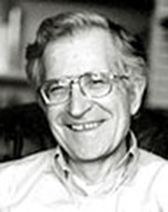
Noam Chomsky
Born on December 7, 1928
Age: 98
Profession: Linguist, Philosopher, Cognitive Scientist, Political Activist
Place of Birth: Philadelphia, Pennsylvania, United States
Noam Chomsky is a renowned American linguist and one of the most influential intellectuals of the twentieth century. Born in 1928 in Philadelphia to a Jewish family, Chomsky is widely regarded as the founder of modern linguistics. His revolutionary ideas transformed the study of language by demonstrating that human language is not merely a learned behavior but is rooted in innate biological structures.
Noam Chomsky was born into a family deeply engaged with intellectual and cultural life. He was strongly influenced in the field of linguistics by Zellig Harris. Chomsky studied mathematics and philosophy at the University of Pennsylvania, where he earned the title of Doctor of Philosophy. Although he received his doctorate there, he completed a significant portion of his academic research between 1951 and 1955 at Harvard University. From 1955 onward, he began teaching at the Massachusetts Institute of Technology, and since 1976 he has served as an Institute Professor.
Considered one of the most important and influential linguists of the twentieth century, Noam Chomsky was trained in a tradition shaped by Leonard Bloomfield, who had dominated American linguistics in the 1930s and 1940s with experimental and behaviorist approaches, and by Zellig Harris, whom Chomsky admired not only for his linguistic work but also for his political stance.
Through his linguistic expertise, Noam Chomsky demonstrated that language possesses far more than a simple structural dimension. He introduced a radically new understanding of language, arguing that the ability to use language creatively and freely is not something acquired solely through experience, but rather an innate human capacity. In terms of language formation, Chomsky adopted a structuralist approach, emphasizing that studying language use from within a culture makes it impossible to examine that culture from the outside. Thinkers associated with related perspectives include post-structuralists such as Jacques Derrida and structural anthropologists like Claude Levi-Strauss.
Chomsky’s first book, Syntactic Structures, was published in 1957. This work criticized the prevailing theories of contemporary structural linguistics and argued that existing linguistic theories needed to be fundamentally reconsidered. The book became one of the most influential texts in the history of linguistics.
During the 1960s, Noam Chomsky actively participated in protests against the United States government, particularly opposing the Vietnam War. He took part in demonstrations and marches, and although his anti-American writings provoked strong reactions, they also played a major role in making him widely known to large audiences.
In the mid-1960s, while rising to prominence through his linguistic research, Noam Chomsky surprised many of his colleagues by openly criticizing and opposing the United States’ policies in the Vietnam War. In his 1966 essay titled The Responsibility of Intellectuals, he criticized U.S. foreign policy, stating that “The United States sees itself as entitled to expand its power and unlimited control as much as possible,” and condemned American policies in China.
From that period onward, while continuing his work in linguistics, Noam Chomsky became one of the most prominent intellectuals criticizing U.S. foreign policy and the media. After the United States withdrew from Vietnam in 1975, he devoted himself extensively to writing books and articles. Among his many important works, particular attention was drawn to the two-volume book The Political Economy of Human Rights, co-authored with Edward Herman in 1979. This work exposed U.S. support for Indonesia’s war against East Timor, the rise of Pol Pot in Cambodia, and violent dictatorship regimes in Latin America.
Throughout the 1980s, Noam Chomsky continued to produce sharp critiques of U.S. foreign policy, condemning U.S. military interventions in Haiti and Bosnia, as well as the United Nations arms embargo imposed on Bosnia. He also criticized the media for uncritically supporting state political power.
Despite widespread recognition, Noam Chomsky was frequently criticized—particularly by conservative circles—for what they viewed as an overly soft stance toward communism and for focusing his intellectual energy on American policy and those harmed by it. Although many anarchists argue that “direct action” is the only viable political method, Chomsky does not believe that anarchist political philosophy dictates a fixed set of tactics. As a member of the Democratic Socialists of America, he summarized his view as follows: “The simplest anarchist idea is that authority must justify itself. If it cannot, it should be dismantled. Sometimes authority can justify itself; if it cannot, and if it matters enough, then it should be undermined. How this is done depends entirely on the circumstances. There is nothing within anarchism that tells you how to proceed.”
From the 1980s onward, with the development of communication technologies, Noam Chomsky increasingly focused on media studies. In 1988, he co-authored Manufacturing Consent: The Political Economy of the Mass Media with Edward S. Herman. Following its publication, Chomsky became one of the leading representatives of the anti-media movement.
Noam Chomsky has received honorary awards from numerous universities, including institutions in Massachusetts, Pennsylvania, Georgetown, Buenos Aires, McGill, Cambridge, Rovira i Virgili, Tarragona, Columbia, Western Ontario, Toronto, Harvard, Calcutta, and Pisa. He is also a member of many professional organizations in the United States and abroad, including the American Academy of Arts and Sciences and the National Academy of Sciences.
Professor Chomsky has received many prestigious awards, including the American Psychological Association’s Distinguished Scientific Contribution Award, the Kyoto Prize in Basic Sciences, the Helmholtz Medal, the Dorothy Eldridge Peacemaker Award, and the Benjamin Franklin Medal in the field of information science.
Accepted as the father of modern linguistics, Noam Chomsky has also written more than 100 books on Middle Eastern conflicts and geopolitical issues.
Evlilikleri / Marriages:
1st wife: Carol Chomsky (m. 1949; d. 2008)
2nd wife: Valeria Wasserman (m. 2014)
Since 2023, Noam Chomsky has experienced speech difficulties and limited movement on the right side of his body. He was discharged on 18 June 2024 from the private Beneficência Portuguesa Hospital in São Paulo, Brazil, where he had been receiving treatment, and it was announced that his medical care would continue at home.
Source: Biyografiler.com
News about Noam Chomsky

Epstein Files Released: Politicians, Royals, Celebrities and Business Leaders Named in Newly Unsealed Documents
The US Department of Justice has released the first batch of long-awaited Jeffrey Epstein documents, revealing a wide-ranging network of politicians, ...
Frequently asked questions about Noam Chomsky
Who is Noam Chomsky?, Noam Chomsky biography, Noam Chomsky life story, Noam Chomsky age, Noam Chomsky facts, Noam Chomsky birthplace, Noam Chomsky photos, Noam Chomsky videos, Noam Chomsky career

Lamine Yamal
Professional footballer

Erling Haaland
Professional footballer

Kylian Mbappe
Professional footballer

Austin Abrams
Actor

Bad Bunny
Rapper, Songwriter

Sam Altman
Entrepreneur, Investor, CEO


Hongjoong
Singer, Rapper, Songwriter, Composer

Ludacris
Rapper, Actor

Kwon Eunbi
Singer

Sarah Wayne Callies
Actress, Screenwriter, Producer, Director

LaTavia Roberson
Singer, Actress, Entrepreneur

Amber Heard
Actress, Model
Lamine Yamal
Professional footballer
Bad Bunny
Rapper, Songwriter
Erling Haaland
Professional footballer
Kylian Mbappe
Professional footballer
Austin Abrams
Actor