
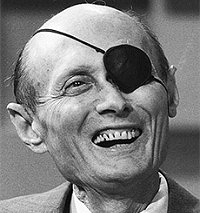
Moshe Dayan
Israeli military commander and politician who served as the fourth Chief of the General Staff of the Israel Defense Forces from 1953 to 1958, Minister of Defense from 1967 to 1974, and Minister of Foreign Affairs from 1977 to 1979.
Born on May 20, 1915
Died on October 16, 1981
Age at death: 66
Profession: Military Commander, Politician
Place of Birth: Degania Alef, near the Sea of Galilee, Ottoman Palestine (now Israel)
Place of Death: Tel Aviv, Israel
Moshe Dayan (May 20, 1915 – October 16, 1981) was an Israeli military commander and politician. He served as the fourth Chief of the General Staff of the Israel Defense Forces from December 1953 to January 1958, Minister of Agriculture from 1959 to 1964, Minister of Defense from 1967 to 1974, and Minister of Foreign Affairs from 1977 to 1979. He commanded Israeli forces during the 1956 Suez Crisis and was defense minister during the 1967 Six-Day War and the 1973 Yom Kippur War. As foreign minister, he participated in negotiations that led to the 1978 Camp David Accords and the 1979 peace treaty between Israel and Egypt. He lost his left eye during a military operation in 1941 and subsequently wore a black eye patch.
Early Life and Family Background
Moshe Dayan was born on May 20, 1915, at Degania Alef, a Jewish agricultural settlement near the Sea of Galilee, in what was then Ottoman Palestine. His parents, Shmuel Dayan and Devorah Dayan, were Jewish immigrants from Eastern Europe who participated in the development of agricultural settlements.
His family later moved to Nahalal, an agricultural cooperative settlement in the Jezreel Valley. Dayan grew up in the farming community, where he worked in agriculture and attended school.
His first name, Moshe, is the Hebrew form of Moses. He was named after Moshe Barsky, a member of Degania who had been killed in an attack shortly before Dayan's birth.
Joining the Haganah
Moshe Dayan joined the Haganah, the Jewish paramilitary organization operating in British Mandatory Palestine, during his teenage years. He became involved in armed security activities during a period of growing conflict between Jewish settlers, Palestinian Arabs and the British authorities.
During the Arab Revolt of 1936–1939, Dayan served in Jewish auxiliary police units organized with British authorization. He participated in operations in Galilee and the Jezreel Valley.
He also served in the Special Night Squads established by British officer Orde Wingate in 1938. These units combined British soldiers and Jewish fighters and carried out night operations against Arab insurgents. Dayan learned reconnaissance, small-unit tactics and surprise-attack methods during this period.
In 1939, British authorities arrested Dayan and other Haganah members for participating in an unauthorized military training course and possessing illegal weapons. He was sentenced to ten years in prison but was released in 1941 as British authorities sought cooperation with Jewish forces during World War II.
World War II and the Loss of His Eye
Following his release, Moshe Dayan joined an Allied military operation against Vichy French forces in Syria and Lebanon in June 1941.
While conducting reconnaissance near the Lebanese border, he was looking through binoculars when a bullet struck the equipment and severely injured his left eye.
He permanently lost the sight in that eye. Medical treatment, including later surgery, could not restore it. He subsequently began wearing a black eye patch, which remained a recognizable feature of his appearance.
After recovering from his injury, Dayan continued military and intelligence work, including assignments associated with the Haganah and the British war effort.
The 1948 Arab–Israeli War
When the State of Israel was established in May 1948, Moshe Dayan joined the newly formed Israel Defense Forces. He commanded the 89th Battalion of the 8th Armored Brigade during the war that followed Israel's declaration of independence.
His unit participated in operations around Lydda and Ramle in July 1948. These operations were accompanied by the displacement and expulsion of large numbers of Palestinian Arab residents.
Dayan was later appointed commander of Israeli forces in the Jerusalem area. He participated in negotiations with Jordanian representatives concerning military positions, ceasefires and arrangements around Jerusalem.
He also took part in the armistice negotiations held on the Greek island of Rhodes in 1949.
Chief of the General Staff
Following the 1948 war, Moshe Dayan occupied several senior military positions. He became commander of Southern Command in 1949 and Northern Command in 1952, before assuming responsibilities within the army's General Staff.
On December 6, 1953, he was appointed the fourth Chief of the General Staff of the Israel Defense Forces.
During his tenure, he emphasized mobile combat units, offensive operations and rapid military responses. Israeli forces carried out numerous cross-border raids, including operations against Palestinian armed groups and neighboring states. Some of these operations caused civilian casualties and drew international criticism.
In 1956, Dayan directed Israeli military operations during the Suez Crisis, known in Israel as the Sinai Campaign. The conflict began after Egypt's nationalization of the Suez Canal and the development of a secret military plan involving Israel, Britain and France.
Israeli forces advanced across the Sinai Peninsula. Under international pressure, Israel subsequently withdrew from the territory.
Dayan's term as chief of staff ended on January 29, 1958, after which he left active military service and entered national politics.
Minister of Agriculture and Political Career
Moshe Dayan was elected to the Knesset in 1959 as a member of Mapai, the political party led by Prime Minister David Ben-Gurion.
He served as Minister of Agriculture from 1959 to 1964. His responsibilities included agricultural policy, rural development and farming settlements.
Following political disagreements within Mapai, Dayan joined Ben-Gurion and other politicians in establishing Rafi in 1965.
He later became associated with the Israeli Labor Party, which emerged from the consolidation of several labor-oriented political organizations.
Minister of Defense and the Six-Day War
On June 1, 1967, shortly before the outbreak of the Six-Day War, Moshe Dayan was appointed Minister of Defense in the government of Prime Minister Levi Eshkol.
The war began on June 5, 1967, with Israeli airstrikes against Egyptian airfields. Israel subsequently fought Egypt, Jordan and Syria.
During the six-day conflict, Israeli forces captured the Sinai Peninsula and Gaza Strip from Egypt, the West Bank and East Jerusalem from Jordan, and the Golan Heights from Syria.
Dayan was responsible for the defense ministry during the campaign, although operational planning and military command were carried out by the armed forces under Chief of Staff Yitzhak Rabin.
Following the war, Israel established military administration over territories occupied during the conflict. Dayan supported arrangements allowing certain forms of movement and economic contact between the West Bank and Jordan, often described as the open bridges policy.
His decisions regarding the administration of occupied territories and Israeli security policy became subjects of political debate.
Yom Kippur War and Political Criticism
Moshe Dayan remained Minister of Defense under Prime Minister Golda Meir, who took office in 1969.
On October 6, 1973, Egyptian and Syrian forces launched coordinated attacks against Israeli positions in the Sinai Peninsula and Golan Heights. The attacks began during Yom Kippur, a Jewish religious holiday.
Egyptian forces crossed the Suez Canal, while Syrian forces advanced into the Golan Heights. Israel had not fully mobilized its reserves, and the initial attacks exposed failures in military intelligence assessments and preparedness.
Dayan and other senior officials faced public criticism over the government's response before the outbreak of war. Israeli forces subsequently conducted counteroffensives, and ceasefire agreements brought the major fighting to an end later that month.
The Israeli government established the Agranat Commission to investigate military and political decisions before and during the war.
In its interim findings, the commission held several senior military officers responsible for failures in preparedness but did not assign direct personal responsibility to Dayan or Prime Minister Golda Meir.
The findings did not end public criticism of the government. Protests continued, and Meir announced her resignation in April 1974.
Dayan's term as Minister of Defense ended in June 1974 when a new government was formed under Yitzhak Rabin.
Foreign Minister in Menachem Begin's Government
In 1977, Moshe Dayan accepted an offer to become Minister of Foreign Affairs in the government of Menachem Begin, leader of Likud.
His decision to join a government led by a party opposed to his former Labor political associates caused controversy within the Israeli political establishment.
Dayan left the Labor parliamentary faction and continued his political activities as a member of the new governing coalition.
As foreign minister, he participated in diplomatic initiatives intended to establish negotiations between Israel and Egypt.
Negotiations with Egypt and the Camp David Accords
Moshe Dayan was involved in contacts with Egyptian representatives that preceded President Anwar Sadat's visit to Jerusalem in November 1977.
He participated in diplomatic meetings, including contacts facilitated through Morocco, which helped establish communication between Israeli and Egyptian officials.
In 1978, negotiations continued with mediation by United States President Jimmy Carter. Meetings took place at several locations, including Leeds Castle in England, before the leaders met at Camp David in Maryland.
From September 5 to September 17, 1978, Carter, Sadat and Begin negotiated agreements concerning relations between Israel and Egypt and a broader framework for Middle East peace.
On September 17, 1978, the Camp David Accords were signed by Anwar Sadat and Menachem Begin, with Jimmy Carter participating as mediator.
The agreements provided a framework for an Egyptian–Israeli peace treaty, Israeli withdrawal from the Sinai Peninsula and further discussions concerning Palestinian self-government.
Dayan continued taking part in diplomatic negotiations that led to the signing of the Egypt–Israel Peace Treaty in Washington on March 26, 1979.
The treaty established formal peace between Israel and Egypt and provided for Israel's withdrawal from the Sinai Peninsula.
Resignation and the Telem Party
In October 1979, Moshe Dayan resigned as Foreign Minister because of disagreements with Prime Minister Menachem Begin over the direction of negotiations concerning Palestinian autonomy in the West Bank and Gaza Strip.
He believed that the government was restricting diplomatic negotiations and reducing the foreign minister's role in discussions about Palestinian self-government.
In 1981, Dayan established the Telem political party, which advocated a political settlement involving Israel and its Arab neighbors.
The party won two seats in the 1981 Knesset election, one of which was occupied by Dayan.
Personal Life
Moshe Dayan married Ruth Dayan, born Ruth Schwartz, in 1935. The couple had three children: Yael Dayan, Assi Dayan and Ehud Dayan.
Yael became a writer and politician, while Assi worked as an actor and film director. Ehud was involved in farming and the arts.
Moshe and Ruth divorced in 1971 after approximately 36 years of marriage.
In 1973, Dayan married Rachel Korem.
He also developed an interest in archaeology and collected archaeological artifacts. His excavations and collecting practices became controversial because of questions concerning archaeological permits, ownership and the removal of objects from historical sites.
Books and Publications
Moshe Dayan wrote several books about military affairs, politics and his personal experiences.
His publications included Diary of the Sinai Campaign (1966), an account of the 1956 war, and Story of My Life (1976), an autobiography covering his early years, military career and political activities.
In Breakthrough: A Personal Account of the Egypt–Israel Peace Negotiations (1981), he discussed diplomatic contacts and negotiations leading to the peace agreement between Israel and Egypt.
Death
Moshe Dayan underwent treatment for intestinal cancer in 1979. His health declined during the following years.
He died of heart failure on October 16, 1981, in Tel Aviv, Israel, at the age of 66.
He was buried at the cemetery in Nahalal, the agricultural settlement where he had grown up. His funeral was attended by Israeli political and military figures.
Source: Biyografiler.com
Frequently asked questions about Moshe Dayan
Who is Moshe Dayan?, Moshe Dayan biography, Moshe Dayan life story, Moshe Dayan age, Moshe Dayan facts, Moshe Dayan birthplace, Moshe Dayan photos, Moshe Dayan videos, Moshe Dayan career
Related Biographies

Lamine Yamal
Professional footballer

Brad Pitt
Actor

Erling Haaland
Professional footballer

Kylian Mbappe
Professional footballer

Leonardo DiCaprio
Actor

Sam Altman
Entrepreneur, Investor, CEO

Milo Manara
Painter, Cartoonist, Illustrator

Mikhail Mishustin
Politician, Economist, Prime Minister

Milla Jovovich
Actress, Model

Millie Bobby Brown
Actress

Moshe Dayan
Military Commander, Politician


Jensen Huang
Entrepreneur, CEO, Engineer
Lamine Yamal
Professional footballer

Taylor Swift
Singer, Musician, Songwriter
Erling Haaland
Professional footballer
Sam Altman
Entrepreneur, Investor, CEO
Leonardo DiCaprio
Actor