
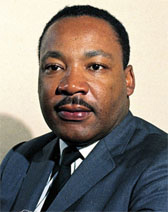
Martin Luther King
The Voice of Nonviolent Resistance and Racial Equality
Born on January 15, 1929
Died on April 4, 1968
Age at death: 39
Profession: Civil Rights Leader
Place of Birth: Atlanta, Georgia, United States
Place of Death: Memphis, Tennessee, United States
Martin Luther King Jr. was an American Baptist minister, thinker, and civil rights leader whose actions, marches, and campaigns for racial equality and equal citizenship rights for Black Americans directly contributed to the passage of the Civil Rights Act of 1964 in the United States.
Martin Luther King Jr. was born on January 15, 1929, in Atlanta, Georgia, the largest city in the state, as the middle child of Martin Luther King Sr. and Alberta Williams King. His birth name was Michael Luther King Jr., but his first name was later changed to Martin. His grandfather served as senior pastor of the Ebenezer Baptist Church between 1914 and 1931, and following this tradition, King also became a Baptist minister. He had an older sister and a younger brother.
Martin Luther King Jr. attended elementary school in Atlanta and graduated from high school at the age of 15. In 1948, he graduated with high honors from Morehouse College, the same institution attended by both his father and grandfather. During his university years, he became actively involved in Black civic organizations and met civil rights leader Benjamin Mays, whose ideas deeply influenced him. After studying theology for three years, he enrolled in the Crozer Theological Seminary in Pennsylvania in 1951, graduating first in his class. He later continued his academic work in Boston, earning a master’s degree in Systematic Theology from Boston University. During his time in Boston, he met Coretta Scott, whom he married shortly thereafter. The couple had four children—two daughters and two sons.
In 1954, Martin Luther King Jr. was appointed pastor of the Dexter Avenue Baptist Church in Montgomery, Alabama. On December 1, 1955, Rosa Parks, an African American woman, was arrested for refusing to give up her seat to a white passenger under the Jim Crow laws. In response, King helped organize the Montgomery Bus Boycott, which lasted more than a year and brought national attention to his leadership. During the boycott, he was arrested, and the protest continued until the U.S. Supreme Court ruled that racial segregation on interstate buses and public transportation was unconstitutional.
Following this success, Martin Luther King Jr. played a key role in uniting Black churches and encouraging collective action for civil rights reform. In 1957, he was instrumental in founding the Southern Christian Leadership Conference (SCLC). Inspired by Mahatma Gandhi, King became the foremost advocate of nonviolent resistance and equality between Black and white citizens.
In 1961, Martin Luther King Jr. became the subject of surveillance by the Federal Bureau of Investigation (FBI), which feared communist influence within the civil rights movement. Information obtained through wiretaps was later used as leverage in attempts to pressure him into stepping down from leadership.
Martin Luther King Jr. was a central figure in organizing nonviolent protests aimed at ending racial segregation in the southern United States under Jim Crow laws. Media coverage of these protests amplified their impact, and public support for King grew rapidly. By the early 1960s, the civil rights movement had become one of the most important political issues in the country.
In 1963, Martin Luther King Jr. organized the “March on Washington for Jobs and Freedom.” Initially opposed by then-President John F. Kennedy, the march was led by a committee that included Roy Wilkins, Whitney Young Jr., A. Philip Randolph, John Lewis, and James Farmer. Although King briefly considered canceling the march out of concern that it might lose focus, the committee insisted on proceeding.
The march aimed to present the demands and grievances of Black citizens from the southern United States to the federal government, culminating in a major address in Washington, D.C. To avoid provoking violent backlash, organizers adopted a strictly peaceful approach. The march called for equal education in public schools, equal citizenship rights, an end to racial discrimination in employment, protection from police brutality, and voting rights for Black Americans. Civil rights activist Malcolm X criticized the event as insufficient, famously referring to it as a “farce in Washington.”
Approximately 250,000 people from diverse ethnic backgrounds participated, making it the largest demonstration in Washington’s history. Martin Luther King Jr. delivered his historic “I Have a Dream” speech at the Lincoln Memorial, which is widely regarded as one of the most important speeches in American history. As a result of these efforts, the Civil Rights Act of 1964 and the Voting Rights Act of 1965 were enacted and incorporated into U.S. law.
For his leadership in the civil rights movement and his commitment to nonviolence, Martin Luther King Jr. was awarded the Nobel Peace Prize in 1964, becoming the youngest recipient of the award at that time.
In his speeches, King frequently argued that the American people owed moral and financial reparations to Black citizens for generations of economic and psychological oppression. In his 1964 book Why We Can’t Wait, he proposed a $50 billion compensation program to be distributed over ten years as restitution for unpaid wages during slavery.
On March 25, 1965, with the participation of the Southern Christian Leadership Conference, King sought to organize a march from Selma to the state capital, Montgomery. An earlier attempt on March 7 had been violently suppressed by police and counter-protesters in an event known as “Bloody Sunday,” resulting in deaths and injuries. After meeting with President Lyndon B. Johnson, King postponed the march, which ultimately succeeded on March 25 and significantly strengthened national support for voting rights.
In 1966, following gains in the southern United States, Martin Luther King Jr. and other activists attempted to expand the movement to the North. The Coordinating Council of Community Organizations, founded by Albert Raby Jr., joined with the Southern Christian Leadership Conference to form the Chicago Freedom Movement. Resistance in the North proved more violent, and King ultimately halted the marches to prevent further escalation.
Returning to the South, King and his associates appointed Jesse Jackson to lead organizational efforts and organized a major boycott against A&P Stores for discriminatory hiring practices. The boycott was highly successful and attracted media support. Jackson later founded Operation Breadbasket, which promoted Black-owned businesses and contributed to the establishment of enterprises such as Johnson Publishing Company, Parker House Sausage, and Seaway National Bank.
During this period, the United States was engaged in the Vietnam War. On April 4, 1967, at Riverside Church in New York City, Martin Luther King Jr. delivered his speech “Beyond Vietnam: A Time to Break Silence,” condemning the war as unjust. This stance provoked widespread criticism from both the public and the media.
Increasingly targeted by segregationists and criticized by the press, Martin Luther King Jr. delivered his final speech, “I’ve Been to the Mountaintop,” on April 3, 1968, at the Mason Temple. The following day, April 4, 1968, he was assassinated by gunfire while standing on the balcony of the Lorraine Motel in Memphis, Tennessee. President Lyndon B. Johnson declared a national day of mourning, and approximately 300,000 people attended King’s funeral.
Investigations into the assassination led to the arrest of James Earl Ray at an airport in the United Kingdom. Extradited to the United States, Ray confessed to the crime and was sentenced to 99 years in prison.
Martin Luther King Jr. received numerous honors during and after his lifetime. In addition to the Nobel Peace Prize, he received awards from the American Jewish Committee in 1965 and from the Government of Jamaica in 1966. In 1977, he was posthumously awarded the Presidential Medal of Freedom by President Jimmy Carter. Many cities named streets after him, and the third Monday of January was declared National Martin Luther King Jr. Day. He was ranked sixth on Time Magazine’s list of the “100 Most Important People of the Century” and received honorary degrees and doctorates from nearly twenty universities.
Source: Biyografiler.com
Frequently asked questions about Martin Luther King
Who is Martin Luther King?, Martin Luther King biography, Martin Luther King life story, Martin Luther King age, Martin Luther King facts, Martin Luther King birthplace, Martin Luther King photos, Martin Luther King videos, Martin Luther King career
Related Biographies

Lamine Yamal
Professional footballer

Erling Haaland
Professional footballer

Austin Abrams
Actor

Keanu Reeves
Actor

Kylian Mbappe
Professional footballer

Bad Bunny
Rapper, Songwriter


Hongjoong
Singer, Rapper, Songwriter, Composer

Ludacris
Rapper, Actor

Kwon Eunbi
Singer

Sarah Wayne Callies
Actress, Screenwriter, Producer, Director

LaTavia Roberson
Singer, Actress, Entrepreneur
Kylian Mbappe
Professional footballer
Lamine Yamal
Professional footballer

Maria Corina Machado
Politician, Political Activist

Luiz Inacio Lula da Silva
Politician, President

Nicki Minaj
Rapper, Singer, Songwriter, Actress

Zhang Yiming
Entrepreneur, Software Developer