
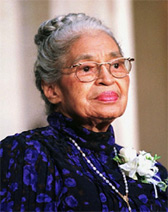
Rosa Parks
Symbol of Civil Rights Resistance
Born on February 4, 1913
Died on October 24, 2005
Age at death: 92
Profession: Activist
Place of Birth: Tuskegee, Alabama, United States
Place of Death: Detroit, Michigan, United States
Rosa Parks was an American civil rights activist.
Rosa Parks was born on February 4, 1913, in Tuskegee, Alabama, United States, as the daughter of Leona McCauley and James McCauley. Her full name was Rosa Louise McCauley. She was African American. After her parents separated, she began living with her mother in the Pine Level area. Her early education was provided at home by her mother, who was a teacher, until the age of eleven. After graduating from the Industrial School for Girls, she enrolled in the state school for Black students but was forced to leave her education unfinished due to the illness of her mother and grandmother. Working as a seamstress, Rosa married Raymond Parks in 1932 and, with her husband’s support, completed her high school education in 1933.
Her husband Raymond Parks was a barber and also an active member of the National Association for the Advancement of Colored People (NAACP). Rosa Parks likewise became an active member of the NAACP. She married Raymond Parks in 1932.
During the 1950s, racial segregation was widespread and clearly enforced both by law and within society. City buses separated white and African American passengers by seating arrangement. White passengers sat in the front seats, while African American passengers were required to sit in the rear. Although everyone paid the same fare, when the bus became crowded and white passengers were left standing, Black passengers were required to give up their seats upon request.
The driver could move the “colored” sign further back to create additional seating for white passengers. If Black passengers objected, the driver had the authority to stop the bus and refuse to continue driving.
This cruel and unjust public order caused African American citizens to be treated as second-class people.
On December 1, 1955, after finishing her workday, Rosa Parks boarded the Cleveland Avenue bus in Montgomery on her way home from the tailoring shop where she worked.
When the first four rows of the bus filled up and some white passengers were left standing, the driver James Blake stopped the bus and moved the “colored” sign two rows back, ordering the African American passengers to move further to the rear.
While the three men standing near Rosa complied and moved back, Rosa Parks instead shifted to the newly vacated window seat and looked at the driver with defiant eyes. She was tired of the dual system, of being pushed around, and of being ignored.
When the driver asked, “Why don’t you stand up?”
she calmly replied, “Because I do not believe I should have to give up my seat to someone else.”
In an interview, she later described that moment by saying:
“I wanted to know once and for all what rights I had as a human being and as a citizen. People keep saying that I refused to give up my seat because I was tired. That is not true. I was not physically tired. I was not old; I was forty-two years old. I was tired of giving in. I was tired of being humiliated and accepting it.”
The driver called the police and had Rosa Parks forcibly removed from the bus and arrested, claiming to uphold public order. He did not consider that he was violating the most basic right of a woman who simply refused to give up her seat.
In another interview, Rosa Parks defended her actions by stating: “I did not want to be humiliated. I did not want to be forced out of a seat I had paid for. I had no desire to be arrested. I already had enough work to do. But when I reached that crossroads, I did not hesitate to choose resistance. I felt that we had endured enough. The more we gave in and stayed silent, the more the oppression increased.”
At first, Rosa’s arrest went largely unnoticed. The president of the NAACP’s Montgomery chapter, labor activist Edgar Nixon, along with a friend of Parks, paid a $100 bail from their own pockets, securing her release pending trial.
Jo Ann Robinson, a member of the Women’s Political Council and a professor at Alabama State University, was consulted, and overnight 35,000 leaflets were printed to call the public to a boycott.
On the night the boycott began, a decision was made at a church to continue until “humane treatment was guaranteed, Black drivers were hired, and the middle seats with flexible status were assigned on a ‘first come, first served’ basis.”
Throughout the 381-day boycott, no African American rode the city buses. Those who owned cars supported one another by offering rides in exchange for bus fare, many people walked everywhere, and some white women also helped by driving African American citizens to their destinations.
As a result of her trial, Rosa Parks was fined fourteen dollars for disobeying public order.
Despite growing public awareness and the effectiveness of the boycott, many Black citizens were subjected to violence in an attempt to intimidate them. Rosa and a group of activists gathered at Mt. Zion Church and decided to establish the “Montgomery Improvement Association,” electing the 26-year-old preacher Martin Luther King Jr. as its president.
The 381-day boycott and the call of “enough is enough” ultimately led to victory. Under the leadership of Martin Luther King Jr., the continuing civil rights movement resulted in the passage of the Civil Rights Act of 1964, ending legalized discrimination against Black Americans and granting them equal rights. During this period, Rosa Parks endured many hardships, including being denied employment by white employers and facing violent threats. Due to unjust dismissal from work and ongoing harassment, she and her husband Raymond were forced to leave Montgomery and move to Detroit.
From 1965 to 1988, Rosa Parks worked as a secretary for African American Democratic Congressman John Conyers in the United States House of Representatives. In 1987, she founded a personal development institute and traveled across America to raise awareness among young people. As a symbol of resistance against discrimination, Rosa Parks was awarded the NAACP Spingarn Medal in 1979 and received the Martin Luther King Jr. Award in 1980.
Martin Luther King Jr. was awarded the Nobel Peace Prize in Stockholm, Sweden, in 1964.
Rosa Parks was selected by Time Magazine in 1999 as one of the leading human rights defenders of the 20th century. She received the Presidential Medal of Freedom in 1996 and, at the beginning of 1999, was awarded the Congressional Gold Medal, which she received from Bill Clinton.
Rosa Parks died on October 24, 2005, in Detroit, Michigan, United States, at the age of ninety-two.
Source: Biyografiler.com
Frequently asked questions about Rosa Parks
Who is Rosa Parks?, Rosa Parks biography, Rosa Parks life story, Rosa Parks age, Rosa Parks facts, Rosa Parks birthplace, Rosa Parks photos, Rosa Parks videos, Rosa Parks career
Related Biographies


Lamine Yamal
Professional footballer

Erling Haaland
Professional footballer

Kylian Mbappe
Professional footballer

Austin Abrams
Actor

Bad Bunny
Rapper, Songwriter

Sam Altman
Entrepreneur, Investor, CEO


Hongjoong
Singer, Rapper, Songwriter, Composer

Ludacris
Rapper, Actor

Kwon Eunbi
Singer

Sarah Wayne Callies
Actress, Screenwriter, Producer, Director

LaTavia Roberson
Singer, Actress, Entrepreneur
Bad Bunny
Rapper, Songwriter

Margot Robbie
Actress
Kylian Mbappe
Professional footballer

Neymar
Professional footballer

Pedro Sanchez
Politician

Ronaldinho
Professional footballer