
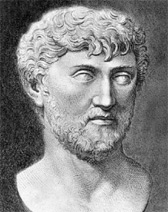
Lucretius
Roman poet and Epicurean philosopher, author of the six-book philosophical poem De rerum natura (On the Nature of Things), which examines atomism, the infinite universe, the mortality of the soul, and natural explanations of physical phenomena.
Born on -
Age: -
Profession: Poet, Philosopher
Place of Birth: Pompeii,İtalya
Lucretius, whose full name was Titus Lucretius Carus, was a Roman poet and philosopher who lived during the first century BC. He is known for De rerum natura (On the Nature of Things), a six-book philosophical poem explaining the teachings of Epicurus. Written in Latin, the work examines the nature of matter, the structure of the universe, human perception, the soul, and the causes of natural phenomena. It is one of the principal surviving sources of ancient Epicurean philosophy and atomism.
Early Life and Historical Background
Lucretius is generally believed to have been born between 99 and 94 BC, during the final decades of the Roman Republic. His birthplace remains unknown, although some biographical accounts have associated him with Pompeii or Rome. His family background, education, and social standing cannot be established with certainty.
Very little contemporary information about his personal life survives. His knowledge of Greek philosophy and Latin literature indicates an extensive education, but there is no reliable evidence concerning his teachers or professional activities.
Lucretius lived during a period of political conflict in Rome, including struggles between rival aristocratic factions and the expansion of Roman power around the Mediterranean. His poem emphasizes freedom from anxiety, ambition, and fear, consistent with the philosophy of Epicurus.
De rerum natura (On the Nature of Things)
Lucretius wrote De rerum natura in Latin hexameter verse. The work consists of six books and presents a systematic explanation of Epicurean philosophy. It is addressed to a Roman aristocrat generally identified as Gaius Memmius.
The first two books explain the fundamental structure of matter, arguing that everything consists of atoms moving through empty space. The third book examines the nature of the mind and soul, while the fourth discusses sensation, perception, dreams, and desire.
The fifth book considers the formation of the universe, the development of life, and the origins of human society, language, and religion. The sixth examines natural events such as thunder, lightning, earthquakes, clouds, atmospheric phenomena, and disease. The poem ends with an account of the plague of Athens.
Lucretius used poetry to communicate philosophical arguments that had originally been developed in Greek. His explanations frequently combine observations of nature with examples from everyday experience.
Atomism and the Nature of Matter
Lucretius followed the atomist tradition associated with Democritus and Epicurus. He argued that the fundamental constituents of reality are atoms and void. Atoms are indivisible, eternal particles that differ in shape, size, and weight. Their combinations produce the physical objects perceived by human beings.
He defended two central principles: nothing comes into existence from nothing, and nothing is reduced to absolute nothingness. According to this view, natural changes occur through the movement, combination, and separation of atoms rather than the creation or destruction of their fundamental substance.
Lucretius distinguished between the properties of atoms and those of complex objects. Colors, tastes, smells, and sounds belong to the experience of compound bodies rather than to individual atoms themselves.
He also defended the Epicurean concept of the atomic "swerve," a small deviation in atomic motion that helped explain how collisions and complex physical processes could arise without every movement being determined by an unchanging sequence of causes.
The Universe and Natural Phenomena
Unlike Aristotle, who described a finite and ordered cosmos, Lucretius argued that the universe is infinite and has no absolute center. He maintained that countless atoms exist throughout unlimited space and that many worlds can emerge and eventually disappear through natural processes.
His universe did not depend on continual intervention by gods. Earthquakes, storms, eclipses, lightning, and other phenomena were explained through natural causes rather than divine punishment.
The poem also discusses the development of living organisms, human communities, agriculture, language, and technology. Although these explanations differ from modern scientific theories, they form part of his attempt to account for nature without appealing to supernatural intervention.
The Soul, Death, and Religion
Lucretius maintained that the human body and soul are both composed of atoms. He described the soul as consisting of finer and more mobile particles than those making up most of the body.
He rejected the idea that the soul survives bodily death. According to his argument, body and soul develop together, remain dependent on one another during life, and cease to function together at death.
His discussion of mortality was intended to challenge the fear of death and punishment in an afterlife. Following Epicurus, he argued that death should not be feared because consciousness and sensation end when life ends.
Lucretius criticized religious practices based on fear and superstition. He did not entirely deny the existence of gods, but he rejected the belief that divine beings continuously controlled natural events or intervened in human affairs.
Cicero and the Publication of His Work
One of the few ancient references to Lucretius appears in a letter written by Marcus Tullius Cicero to his brother Quintus Tullius Cicero in 54 BC. Cicero commented on the literary qualities of Lucretius's poetry, providing evidence that his work was already circulating at that time.
The fourth-century Christian scholar Saint Jerome later claimed that Cicero had edited Lucretius's poem after the poet's death. Modern scholarship treats this account cautiously because no contemporary evidence confirms Cicero's editorial involvement.
The surviving text of De rerum natura appears largely complete in its six-book structure, although scholars have questioned whether Lucretius finished its final revision.
Later Reception
Lucretius's poetry was known to Roman writers including Virgil and Ovid. His arguments about matter, nature, and mortality were subsequently discussed by philosophers and writers in later centuries.
During the Renaissance, renewed study of De rerum natura contributed to interest in ancient atomism. Italian humanist Poggio Bracciolini discovered a manuscript of the poem in 1417, helping restore its circulation among European scholars.
French essayist Michel de Montaigne quoted Lucretius extensively in his Essays. Later thinkers, including Pierre Gassendi, examined Epicurean atomism while developing their own philosophical explanations of nature.
Death
The circumstances of Lucretius's death remain uncertain. Ancient chronological accounts place his death around the middle of the first century BC, but the exact year and location are unknown.
Saint Jerome, writing several centuries later, claimed that Lucretius had suffered mental illness after consuming a love potion, composed his poetry during periods of lucidity, and eventually died by suicide. Historians generally consider this story unreliable because it lacks contemporary confirmation.
Major Work
- First century BC – De rerum natura (On the Nature of Things), a philosophical poem in six books explaining Epicurean atomism, cosmology, perception, mortality, and natural phenomena.
Source: Biyografiler.com
Frequently asked questions about Lucretius
Who is Lucretius?, Lucretius biography, Lucretius life story, Lucretius age, Lucretius facts, Lucretius birthplace, Lucretius photos, Lucretius videos, Lucretius career
Related Biographies

Lamine Yamal
Professional footballer

Kylian Mbappe
Professional footballer

Erling Haaland
Professional footballer

Brad Pitt
Actor

Keanu Reeves
Actor

Leonardo DiCaprio
Actor

Luigi Delneri
Football Manager, Professional footballer

Ludwig Wittgenstein
Philosopher

Ludwig Deutsch
Painter

Lucy Liu
Actress

Lucy Lawless
Actress

Lucretius
Poet, Philosopher
Brad Pitt
Actor
Lucy Liu
Actress
Lucy Lawless
Actress

Jensen Huang
Entrepreneur, CEO, Engineer
Lucretius
Poet, Philosopher

Nayib Bukele
Politician, Business Leader