
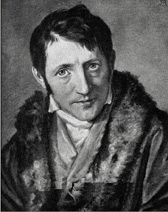
Ludwig Deutsch
Austrian-born French Orientalist painter known for detailed depictions of Egyptian architecture, palace guards, merchants, and daily life in Cairo. He received a gold medal at the 1900 Paris Exposition Universelle.
Born on May 13, 1855
Died on April 9, 1935
Age at death: 80
Profession: Painter
Place of Birth: Vienna, Austria
Place of Death: Paris, France
Ludwig Deutsch was born on May 13, 1855, in Vienna, Austria. He was an Austrian-born painter who settled in France and became known for his Orientalist paintings of Egyptian architecture, daily life, merchants, guards, and religious interiors. His work was characterized by detailed representations of clothing, decorative objects, architectural surfaces, and lighting. After studying at the Vienna Academy of Fine Arts, he established his career in Paris, where he received a gold medal at the 1900 Exposition Universelle. He acquired French citizenship in 1919 and subsequently used the name Louis Deutsch.
Early Life and Education
Ludwig Deutsch was born into a prosperous Jewish family in Vienna, then part of the Austrian Empire. His father, Ignaz Deutsch, was a financier associated with the Austrian imperial court, and his mother was Charlotte Löwit.
Between 1872 and 1875, he studied at the Academy of Fine Arts Vienna, initially receiving instruction from Anselm Feuerbach. He subsequently studied in the artistic environment associated with Leopold Carl Müller, whose paintings of Egyptian and North African subjects influenced a generation of Austrian Orientalist painters.
In 1878, Deutsch moved to Paris, where he continued his artistic education under the French history painter Jean-Paul Laurens. His early paintings concentrated on historical subjects, but during the early 1880s he increasingly turned toward Orientalist themes.
Artistic Career in Paris
In 1880, Ludwig Deutsch established a studio on Rue Le Peletier in Paris. He began exhibiting at the Salon des Artistes Français, where his paintings reached collectors and the French art establishment.
In Paris, he became acquainted with Orientalist painters including Rudolf Ernst, Arthur von Ferraris, and Jean Discart. His friendship with Rudolf Ernst continued for many years, and both artists developed detailed representations of architecture, interiors, and figures associated with the Middle East and North Africa.
Although his early Orientalist paintings appeared around 1881, before his first documented visit to Egypt, his later work increasingly concentrated on subjects associated with Cairo.
Travels to Egypt and Orientalist Painting
Ludwig Deutsch traveled to Egypt in 1886 and made further visits in 1890 and 1898. He studied the architecture, streets, clothing, and decorative arts of Cairo. During his travels, he collected photographs and objects that could be used as references for his paintings.
His collection included textiles, costumes, weapons, furniture, metalwork, ceramic tiles, and other objects associated with Egyptian and Middle Eastern interiors. These materials were used to construct detailed compositions in his Paris studio, where most of his paintings were produced.
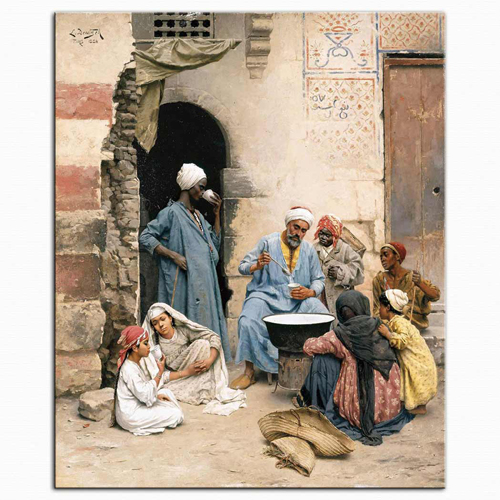
His 1886 painting The Sahleb Vendor, Cairo depicts a street vendor preparing and selling a hot drink. The composition combines observations of everyday activity with architectural and costume details.
Painting Style and Major Works
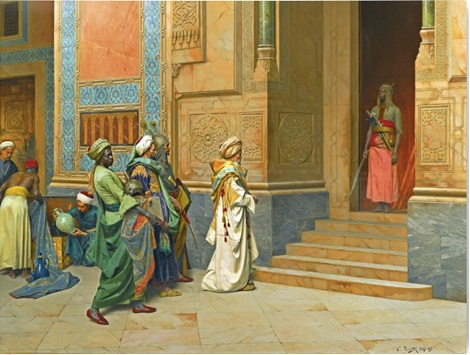
Ludwig Deutsch developed an academic painting style based on precise drawing, controlled lighting, and carefully arranged compositions. His paintings often depicted a single figure or a small group of people within richly decorated architectural settings.
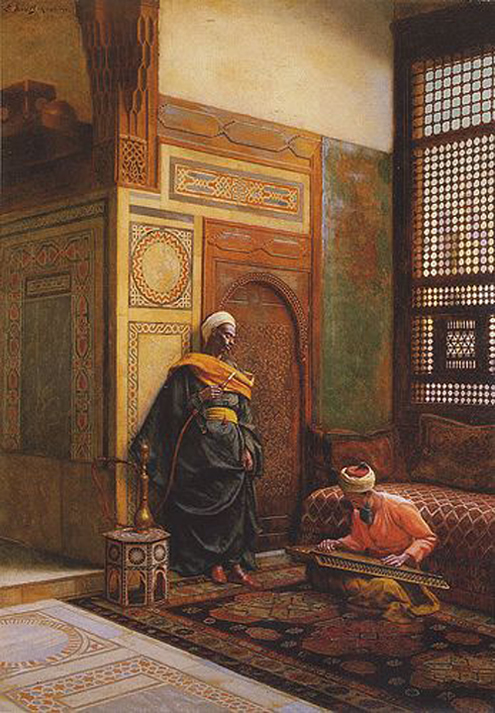
Palace guards, scribes, scholars, merchants, musicians, and religious figures appeared frequently in his work. He paid particular attention to the textures of fabrics, polished metal, weapons, carved wood, and stone surfaces.
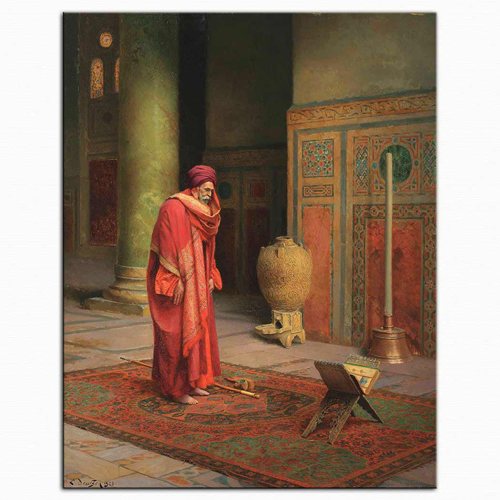
Among his works are The Sentinel (1885), The Hour of Prayer (1887), The Palace Guard (1892), The Scribe (1894), The Scholar (1895), and The Offering (1897).
His paintings combine subjects drawn from nineteenth-century European Orientalism with visual information collected during his travels. Some architectural details were based on photographs of Cairo rather than direct painting on location.
Awards and French Citizenship
Ludwig Deutsch received an honorable mention at the Salon des Artistes Français in 1898. In 1900, he was awarded a gold medal at the Paris Exposition Universelle for his paintings. He also received the rank of Chevalier in the Legion of Honour.
He continued exhibiting in Paris throughout the early twentieth century. In 1919, he became a French citizen and began using the name Louis Deutsch in Salon exhibition catalogues.
His later paintings continued to feature North African and Middle Eastern subjects. Musical Interlude (1932) is among the works from the final years of his career.
Death
Ludwig Deutsch died on April 9, 1935, in Paris, France, at the age of 79. He had spent most of his professional life in Paris, maintaining an artistic practice focused on Orientalist scenes.
Major Paintings
- 1878 – The Scribe
- 1882 – The Domino Players
- 1883 – An Orientalist Amateur (presumed lost)
- 1883 – The Musician
- 1885 – The Sentinel
- 1885 – News from Sudan
- 1886 – The Answer
- 1886 – The Sahleb Vendor, Cairo
- 1887 – The Hour of Prayer
- 1888 – The Snake Charmers
- 1890 – Court of El Azhar University, Cairo
- 1891 – The Healer
- 1892 – The Orange Seller
- 1892 – The Palace Guard
- 1893 – The Emir's Guard
- 1894 – The Scribe
- 1895 – The Scholar
- 1896 – The Chess Game
- 1897 – The Philosopher
- 1897 – The Offering
- 1898 – Prayer at the Tomb
- 1900 – Leaving the Mosque
- 1900 – The Learned
- 1900 – The Furniture Maker
- 1902 – Interior of a Mosque
- 1903 – The Harem Watchman
- 1905 – The Koran School
- 1906 – Morning Prayer
- 1907 – The Narghile Smoker
- 1907 – Le Maître
- 1909 – The Procession of the Mahmal through the Streets of Cairo
- 1911 – At Prayer
- 1911 – The Scribe
- 1920 – The Water Carrier
- 1920 – The Treasure Chest
- 1923 – At Prayer
- 1927 – The Fortune Teller
- 1932 – Musical Interlude
2013 Sotheby's Auction
On April 23, 2013, Ludwig Deutsch's painting The Offering (1897) was sold at a Sotheby's auction in London for £2,154,500. The painting was purchased by a private collector, exceeding its pre-sale estimate of £500,000–£700,000. The result established an auction record for the artist at that time.
Source: Biyografiler.com
Frequently asked questions about Ludwig Deutsch
Who is Ludwig Deutsch?, Ludwig Deutsch biography, Ludwig Deutsch life story, Ludwig Deutsch age, Ludwig Deutsch facts, Ludwig Deutsch birthplace, Ludwig Deutsch photos, Ludwig Deutsch videos, Ludwig Deutsch career

Lamine Yamal
Professional footballer

Kylian Mbappe
Professional footballer

Erling Haaland
Professional footballer

Brad Pitt
Actor

Keanu Reeves
Actor

Leonardo DiCaprio
Actor

Luigi Delneri
Football Manager, Professional footballer

Ludwig Wittgenstein
Philosopher

Ludwig Deutsch
Painter

Lucy Liu
Actress

Lucy Lawless
Actress

Lucretius
Poet, Philosopher
Brad Pitt
Actor
Lucy Liu
Actress
Lucy Lawless
Actress

Jensen Huang
Entrepreneur, CEO, Engineer
Lucretius
Poet, Philosopher

Nayib Bukele
Politician, Business Leader