
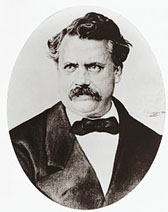
Louis Vuitton
The Trunk Maker Who Invented Modern Luxury
Born on August 4, 1821
Died on February 27, 1892
Age at death: 71
Profession: Entrepreneur, Designer
Place of Birth: Anchay, France
Place of Death: Paris, France
Louis Vuitton, whose full name was Louis Vuitton Malletier, was born on August 4, 1821, in Anchay, France. At the age of 14, he left his hometown and began traveling across France on foot. While the men in his family traditionally worked as gardeners, he chose a different path and entered the craft of trunk making. Within one to two years, he became a highly skilled trunk maker. He later received formal training in this craft and successfully graduated. After completing his education, he set his sights on Paris and arrived there in 1837.
When Louis Vuitton arrived in Paris in 1837, France was undergoing major transformation. King Louis Philippe had just survived an assassination attempt, the Industrial Revolution was underway, and interest in fashion—especially among women—was rapidly increasing. Clothing of the era was wide and voluminous, and as travel became more common, the need to pack these garments carefully into trunks grew significantly. This changing world would define Vuitton’s future. He became an apprentice to a respected trunk maker named Mr. Marechal and spent the next 17 years crafting trunks for Marechal and the wealthy elite of Paris.
In 1854, Louis Vuitton opened his first store on one of Paris’s most fashionable streets of the time, now known as Rue des Capucines. Beyond building trunks, he personally folded his clients’ garments and arranged them inside the trunks. His wife played a crucial role in assisting him with this work. One day, a letter arrived addressed to Monsieur Louis. His wife opened it and discovered it was from Napoleon III and his wife Eugenie de Montijo, who were planning a long journey and requested fifty trunks.
While designing the trunks, Vuitton realized that traditional rounded-top trunks would not fit efficiently into a single train wagon. During a conversation with his wife, he conceived a revolutionary idea: flattening the rounded lids. He redesigned the trunks with flat tops so they could be stacked. He covered them with a special gray canvas and designed interiors not only for clothing but also for gloves and accessories. With this innovation, Louis Vuitton effectively invented the modern travel trunk.
The fifty square trunks fit perfectly into one train wagon. As he continued working for the emperor and Parisian elites, his reputation grew rapidly. He later opened a trunk factory and expanded his boutiques. During this period, he transformed traditionally rounded bags into square designs, creating an iconic form that would become legendary. Over time, his stores expanded to include watches, bags, accessories, scarves, and shoes, all of which evolved into globally recognized luxury products.
In 1854, Louis Vuitton met the 17-year-old Clémence-Émilie Parriaux, and only a few months later, on April 22, 1854, they were married. In 1859, he moved his workshop to Asnières, and in 1871, he opened a new store opposite the Grand Hotel, a major lodging place for international travelers. During this period, the “Wardrobe Trunk” was introduced. His son Georges Vuitton had also begun working alongside him.
Louis Vuitton participated in the International Paris Exposition in 1867. By 1885, he had opened his first international branch in London, gaining global recognition. Today, the brand stands as one of the world’s most prestigious luxury labels, with stores in major luxury districts across the globe.
Louis Vuitton passed away on February 27, 1892, in Paris at the age of 71. After his death, his son Georges Vuitton took over the business, officially turning it into a family company. Georges successfully continued the brand’s growth and development. Over the following century, after periods of fluctuation, the company ultimately became one of the most respected luxury fashion houses in the world.
The popularity of the trunks led to widespread counterfeiting. When the gray canvas was heavily copied, a striped version was introduced. Once that too was imitated, Georges Vuitton decided a geometric pattern was necessary. After many experiments, the famous monogram design was created. For the first time, a company established such a powerful visual identity and officially registered it. Contrary to popular belief, the Damier pattern featuring the “L” and “V” initials was developed later. Louis Vuitton passed away before ever seeing this design.
In 1987, the Louis Vuitton brand was sold to the luxury conglomerate LVMH – Louis Vuitton Moët Hennessy. In 2017, the globally renowned French brand Louis Vuitton acquired another luxury giant, Christian Dior, for $13.2 billion. Since 1989, Bernard Arnault has served as Chairman and CEO of LVMH – Louis Vuitton Moët Hennessy, as well as its principal shareholder.
Source: Biyografiler.com
Frequently asked questions about Louis Vuitton
Who is Louis Vuitton?, Louis Vuitton biography, Louis Vuitton life story, Louis Vuitton age, Louis Vuitton facts, Louis Vuitton birthplace, Louis Vuitton photos, Louis Vuitton videos, Louis Vuitton career
Related Biographies


Lamine Yamal
Professional footballer

Erling Haaland
Professional footballer

Sam Altman
Entrepreneur, Investor, CEO

Kylian Mbappe
Professional footballer

Giorgia Meloni
Politician, Journalist

Alice Weidel
Politician, Economist


Hongjoong
Singer, Rapper, Songwriter, Composer

Ludacris
Rapper, Actor

Kwon Eunbi
Singer

Sarah Wayne Callies
Actress, Screenwriter, Producer, Director

LaTavia Roberson
Singer, Actress, Entrepreneur

Elena Andreyevna Rybakina
Professional Tennis Player
Alice Weidel
Politician, Economist
Sam Altman
Entrepreneur, Investor, CEO

Lady Gaga
Singer, Musician, Songwriter, Actress, Producer
Lamine Yamal
Professional footballer

Vin Diesel
Actor, Producer, Screenwriter