
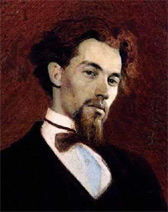
Konstantin Savitsky
Russian realist painter and member of the Peredvizhniki art movement, known for his depictions of everyday life and his collaboration with Ivan Shishkin.
Born on May 25, 1844
Died on January 31, 1905
Age at death: 61
Profession: Painter
Place of Birth: Taganrog, Russia
Place of Death: Penza, Russia
Konstantin Savitsky, whose full name was Konstantin Apollonovich Savitsky, was born on 25 May 1844 in Taganrog, Russia, into the family of a military doctor. His family lived in the building of the Taganrog Boys' Gymnasium, where his father worked as a physician. From an early age, Savitsky showed an interest in drawing and sketching. He produced his first drawings while spending holidays with his family on the shores of the Sea of Azov. Drawing was also one of his favorite subjects at school. When he was in the fifth grade, both of his parents died unexpectedly.
Early Life and Art Education
Following the deaths of his parents, Konstantin Savitsky was placed under the guardianship of his uncle, who lived in what is now Latvia. He attended a private boarding school there and graduated in 1862. He subsequently moved to Saint Petersburg and entered the Imperial Academy of Arts, where he studied painting.
During his academic years, Savitsky became acquainted with the work of Russian painters including Ilya Repin, Ivan Shishkin and Viktor Vasnetsov. He also developed a close relationship with painter Ivan Kramskoi, who influenced his artistic development. Savitsky received several awards during his education, including six silver medals for his drawings and paintings. In 1871, he was awarded a small gold medal for his painting Cain and Abel.
After his studies at the Imperial Academy of Arts, Savitsky continued his artistic training in Paris, where he spent time studying European painting techniques. He also traveled through other parts of France before returning to Russia in 1876.
The Peredvizhniki Movement
In 1863, a group of Russian realist artists who opposed the strict academic requirements of the Imperial Academy of Arts established an independent artistic cooperative known as the Artists' Artel. This movement preceded the formation of the Association of Traveling Art Exhibitions, commonly known as the Peredvizhniki or the Wanderers, in 1870.
Konstantin Savitsky began exhibiting with the Peredvizhniki in the 1870s and became a member of the association in 1878. The group organized traveling exhibitions across Russia and encouraged artists to depict contemporary society, ordinary people and everyday life rather than concentrating exclusively on traditional academic subjects.
Major Paintings and Artistic Career
One of Konstantin Savitsky's early paintings, Repair Work on the Railway (1874), depicts railway laborers engaged in physically demanding work. The painting portrays the working conditions and daily experiences of laborers in nineteenth-century Russia. It was among his first major works devoted to the lives of working-class people.
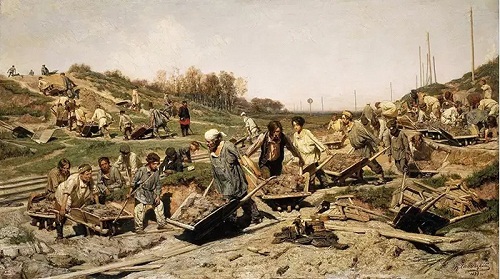
Savitsky's paintings frequently addressed the experiences of peasants, workers and ordinary Russian families. His works include Rye Harvest (1878), Meeting the Icon (1878), The Fugitive (1883), News from Home (1896) and The Monk (1897). Many of his compositions depicted groups of people engaged in everyday activities or responding to difficult circumstances.
In 1897, Konstantin Savitsky was elected an academician of the Imperial Academy of Arts. His paintings are held in Russian museum collections, including galleries in Moscow and Saint Petersburg. His works have also been represented in collections in Kyiv.
Collaboration with Ivan Shishkin
Konstantin Savitsky maintained a personal and professional relationship with Russian landscape painter Ivan Shishkin. Their best-known collaboration was the painting Morning in a Pine Forest (1889). Shishkin painted the forest landscape, while Savitsky contributed the bears depicted in the foreground.
The painting was acquired by art collector Pavel Tretyakov, the founder of the Tretyakov Gallery. Although Savitsky had contributed to the composition and signed the canvas, his signature was subsequently removed. According to an account by a former Tretyakov Gallery employee, Tretyakov objected to seeing two signatures because he had purchased the work as a painting by Shishkin. Other accounts differ about the circumstances of the signature's removal. The painting subsequently became widely attributed to Ivan Shishkin alone.
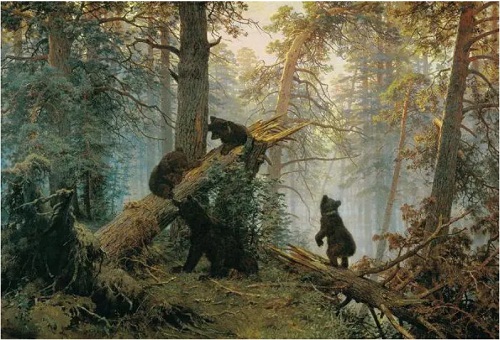
Morning in a Pine Forest depicts a misty pine forest in the early morning. In the foreground, a mother bear and her three cubs appear among fallen trees. Two cubs play on the trunk of a broken pine tree, while another stands on its hind legs. The mother bear remains nearby. The forest landscape was painted by Shishkin, while the four bears were painted by Konstantin Savitsky. The original painting is held in the Tretyakov Gallery in Moscow.
The Monk and Other Works
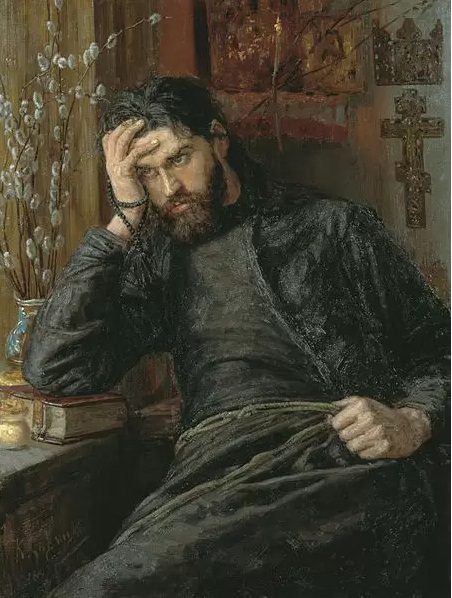
In 1897, Konstantin Savitsky completed The Monk, a painting depicting a religious figure. The work belongs to the later period of his artistic career, when he continued producing paintings focused on individual figures and scenes from Russian society.
Teaching Career
Konstantin Savitsky worked as an art educator for more than twenty years, teaching in Saint Petersburg, Moscow and Penza. Between 1883 and 1889, he taught at the Central School of Technical Drawing established by Baron Alexander Stieglitz in Saint Petersburg. From 1891 to 1897, he taught at the Moscow School of Painting, Sculpture and Architecture.
In 1897, Savitsky became the first director of the Penza Art School. He also participated in establishing the city's public art museum, which opened in 1898. He continued his educational work in Penza until his death in 1905. Among his students was his son, Georgy Savitsky, who also became a painter.
To War (1888)
One of Konstantin Savitsky's major paintings was To War (1888), also known as Going to War. The monumental canvas measures 207.5 × 303.5 centimeters and took the artist approximately ten years to complete.
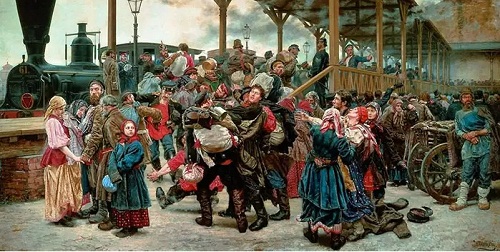
Inspired by the Russo-Turkish War of 1877–1878, the painting depicts soldiers departing for military service as their relatives gather to say farewell. The large composition includes numerous figures expressing grief, anxiety and uncertainty. Savitsky worked on the painting over several years, revising its composition before completing the final version in 1888. The work is held in the State Russian Museum in Saint Petersburg.
Death
Konstantin Savitsky died on 31 January 1905 in Penza, Russia, at the age of 60. At the time of his death, he was serving as director of the Penza Art School.
Source: Biyografiler.com
Frequently asked questions about Konstantin Savitsky
Who is Konstantin Savitsky?, Konstantin Savitsky biography, Konstantin Savitsky life story, Konstantin Savitsky age, Konstantin Savitsky facts, Konstantin Savitsky birthplace, Konstantin Savitsky photos, Konstantin Savitsky videos, Konstantin Savitsky career

Lamine Yamal
Professional footballer

Kylian Mbappe
Professional footballer

Keanu Reeves
Actor

Erling Haaland
Professional footballer

Brad Pitt
Actor

Leonardo DiCaprio
Actor

Konstantin Kacev
Painter

Konstantin Stanislavski
Actor, Director

Konstantin Savitsky
Painter

Konstantin Karamanlis
Former President, Lawyer

Konstantinos Tasoulas
President, Politician

Kelly LeBrock
Actress, Model

Khabane Lame
Social Media Influencer

Jensen Huang
Entrepreneur, CEO
Kylian Mbappe
Professional footballer

Kevin Warsh
Economist
Lamine Yamal
Professional footballer

Penelope Cruz
Actress