
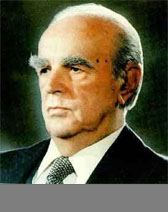
Konstantin Karamanlis
Former Prime Minister and two-term President of Greece. Founder of the New Democracy Party.
Born on March 8, 1907
Died on April 23, 1998
Age at death: 91
Profession: Former President, Lawyer
Place of Birth: Proti (Küpköy), Serres, Greece
Place of Death: Athens, Greece
Konstantin Karamanlis served as President of Greece from 5 May 1990 to 10 March 1995. He had previously held the presidency from 1980 to 1985 and served as Prime Minister of Greece during several terms between 1955 and 1963 and again from 1974 to 1980. Following the collapse of military rule in 1974, Karamanlis led the restoration of parliamentary democracy in Greece and played a central role in the country's accession to the European Economic Community.
Early Life and Education
Konstantin Karamanlis was born on 8 March 1907 in the village of Proti (Küpköy), in the Serres region of northern Greece, which was then under the administration of the Ottoman Empire. His father, Georgios Karamanlis, was a teacher and farmer who participated in the Greek nationalist movement in Macedonia.
Karamanlis completed his primary education in Proti and continued his studies in Serres and Athens. He graduated from the Law School of the University of Athens in 1929 and practiced law in Serres between 1930 and 1935.
Early Political Career
Konstantin Karamanlis entered the Hellenic Parliament in 1935 after being elected as a representative of Serres for the People's Party. Following World War II, he was re-elected to Parliament in 1946.
In 1947, he was appointed Minister of Labour. In May 1948, he became Minister of Transport and subsequently served as Minister of Social Welfare. He was appointed Minister of National Defence in 1950 and became Minister of Public Works in 1952 under Prime Minister Alexandros Papagos. He held the latter position until 1955.
During his tenure as Minister of Public Works, Karamanlis oversaw public investment projects involving roads, energy facilities, irrigation systems and tourism infrastructure. Following the death of Prime Minister Alexandros Papagos in 1955, King Paul of Greece appointed him to form a new government.
Prime Minister and Relations with Turkey
Konstantin Karamanlis became Prime Minister of Greece on 6 October 1955. In 1956, he founded the National Radical Union (ERE), a conservative political party. The party secured parliamentary majorities in the general elections of 1956, 1958 and 1961, allowing Karamanlis to remain prime minister until 1963.
Karamanlis pursued a policy of dialogue with Turkey and participated in diplomatic negotiations during several periods of Greek-Turkish relations. He was particularly involved in discussions concerning the political future of Cyprus.
In 1959, he met Turkish Prime Minister Adnan Menderes in Zurich, Switzerland. During the negotiations, the two prime ministers reached an agreement on the establishment of an independent Republic of Cyprus. The Zurich talks were followed by negotiations in London involving representatives of the British government, Archbishop Makarios III, the leader of the Greek Cypriot community, and Fazıl Küçük, the leader of the Turkish Cypriot community.
The Zurich and London Agreements of 1959 established the political and legal framework for the creation of the independent Republic of Cyprus. Later that year, Karamanlis visited Turkey as the guest of Prime Minister Adnan Menderes, holding meetings in Ankara and Istanbul. Under international agreements involving Turkey, the United Kingdom and Greece, the Republic of Cyprus formally gained independence on 16 August 1960.
Relations with the European Economic Community
During his first period as prime minister, Konstantin Karamanlis pursued closer economic and political relations between Greece and Western Europe. In September 1959, his government initiated negotiations for an association agreement with the European Economic Community (EEC).
The association agreement was signed in Athens on 9 July 1961 and entered into force on 1 November 1962. It established a framework for closer commercial relations between Greece and the European Economic Community and provided for the country's eventual preparation for full membership.
Resignation and Years in Paris
In 1963, Konstantin Karamanlis resigned as prime minister following disagreements with King Paul of Greece. One of their disputes concerned the king's planned visit to the United Kingdom, which Karamanlis had recommended postponing. After the general election later that year, he moved to Paris, France.
Karamanlis lived in Paris from 1963 to 1974, remaining outside Greece for approximately eleven years. Following the military coup of 21 April 1967, which brought the Regime of the Colonels to power, he opposed military rule and advocated the restoration of democratic government in Greece.
Return to Greece and Restoration of Democracy
In July 1974, the military dictatorship in Greece collapsed amid the crisis caused by the coup in Cyprus and the subsequent Turkish military intervention. Konstantin Karamanlis returned from Paris to Athens on 24 July 1974 and formed a government of national unity, becoming prime minister once again.
Later that year, he founded the New Democracy party. In the general election held on 17 November 1974, the party received approximately 54 percent of the vote and formed the government. On 8 December 1974, a national referendum was held in which Greek voters rejected the restoration of the monarchy and supported the continuation of the republic.
During Karamanlis's premiership, members of the former military junta were prosecuted, political prisoners were released, and the Communist Party of Greece was permitted to operate legally again. Amnesty measures were introduced, and the 1952 Constitution was temporarily restored, excluding provisions concerning the monarchy. A new Greek Constitution was adopted in June 1975.
Konstantin Karamanlis also led New Democracy to victory in the 1977 general election and remained prime minister until 10 May 1980.
Relations with Turkey and the Cyprus Dispute
Following the Turkish military intervention in Cyprus in 1974 and the intensification of disputes over the continental shelf in the Aegean Sea, Konstantin Karamanlis sought to reduce tensions between Greece and Turkey. In 1975, he met Turkish Prime Minister Süleyman Demirel in Brussels to discuss bilateral relations.
During their meeting in May 1975, held alongside a NATO summit, the two leaders agreed that disputes between their countries should be resolved through peaceful means. They also discussed the possibility of referring the continental shelf dispute to the International Court of Justice if bilateral negotiations failed to produce a settlement.
On 10–11 March 1978, Karamanlis met Turkish Prime Minister Bülent Ecevit in Montreux, Switzerland. Their discussions addressed disagreements in the Aegean Sea, including the continental shelf dispute, and other outstanding issues between the two countries. The two prime ministers agreed to continue diplomatic dialogue and seek peaceful solutions.
Karamanlis maintained personal relations with Süleyman Demirel in subsequent years. Both politicians led their respective governments during different periods and participated in diplomatic exchanges concerning Greek-Turkish relations.
Greece's Accession to the European Economic Community
Following his return to power in 1974, Konstantin Karamanlis renewed efforts to secure Greece's full membership in the European Economic Community. Greece formally submitted its application for membership on 12 June 1975.
On 28 May 1979, the Treaty of Accession was signed in Athens, establishing the terms of Greece's entry into the European Economic Community. The country officially became the organization's tenth member on 1 January 1981. Karamanlis was serving as Prime Minister of Greece when the accession treaty was signed.
Presidency of Greece
Konstantin Karamanlis was elected President of Greece on 5 May 1980. He resigned as prime minister and assumed the presidency on 10 May 1980. During his first presidential term, he carried out his constitutional responsibilities under Greece's restored parliamentary democratic system.
In the 1981 general election, the Panhellenic Socialist Movement (PASOK), led by Andreas Papandreou, came to power. Karamanlis continued serving as president while the socialist government held office. However, in March 1985, he resigned after Papandreou withdrew support for his re-election and backed another presidential candidate. Karamanlis left office on 10 March 1985.
On 4 May 1990, Konstantin Karamanlis was elected president for a second time and assumed office on 5 May 1990. During his second presidency, Konstantinos Mitsotakis and Andreas Papandreou served as prime ministers.
Karamanlis remained President of Greece from 5 May 1990 until 10 March 1995. After completing his second presidential term, he retired from active political life and withdrew to his residence in Politeia, a suburb of Athens.
Terms as Prime Minister and President
Konstantin Karamanlis served as Prime Minister of Greece during the following periods: 6 October 1955 – 5 March 1958, 17 May 1958 – 20 September 1961, 4 November 1961 – 17 June 1963, and 24 July 1974 – 10 May 1980.
He served as President of Greece from 10 May 1980 to 10 March 1985 and again from 5 May 1990 to 10 March 1995. Throughout his political career, he was elected to the Hellenic Parliament on twelve occasions and served for approximately fourteen years as prime minister and ten years as president.
Personal Life
Konstantin Karamanlis married writer Amalia Megapanou in 1951. She was the niece of Greek politician Panagiotis Kanellopoulos. The couple remained married during part of Karamanlis's years in Paris before divorcing in 1972.
Death
Konstantin Karamanlis died on 23 April 1998 in Athens, Greece, at the age of 91. He had retired from political life three years earlier after completing his second presidential term.
Source: Biyografiler.com
Frequently asked questions about Konstantin Karamanlis
Who is Konstantin Karamanlis?, Konstantin Karamanlis biography, Konstantin Karamanlis life story, Konstantin Karamanlis age, Konstantin Karamanlis facts, Konstantin Karamanlis birthplace, Konstantin Karamanlis photos, Konstantin Karamanlis videos, Konstantin Karamanlis career

Lamine Yamal
Professional footballer

Kylian Mbappe
Professional footballer

Keanu Reeves
Actor

Erling Haaland
Professional footballer

Brad Pitt
Actor

Leonardo DiCaprio
Actor

Konstantin Kacev
Painter

Konstantin Stanislavski
Actor, Director

Konstantin Savitsky
Painter

Konstantin Karamanlis
Former President, Lawyer

Konstantinos Tasoulas
President, Politician

Kelly LeBrock
Actress, Model

Khabane Lame
Social Media Influencer

Jensen Huang
Entrepreneur, CEO
Kylian Mbappe
Professional footballer

Kevin Warsh
Economist
Lamine Yamal
Professional footballer

Penelope Cruz
Actress