
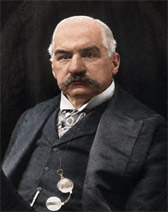
J.P. Morgan
One of the Most Powerful Architects of American Finance Capitalism
Born on April 17, 1837
Died on March 31, 1913
Age at death: 76
Profession: Entrepreneur
Place of Birth: Hartford, Connecticut, United States
Place of Death: Rome, Italy
J.P. Morgan, born John Pierpont Morgan, was an American banker, financier, and industrialist who became one of the most powerful figures in the financial history of the United States. Active during the late 19th and early 20th centuries, J.P. Morgan helped shape modern American capitalism through his influence over banking, railroads, steel, electricity, industrial consolidation, and capital markets. His role in stabilizing financial crises and organizing large-scale corporate mergers made him one of the defining figures of Wall Street.
Early Life and Family Background
J.P. Morgan was born on April 17, 1837, in Hartford, Connecticut, United States. He was the son of Junius Spencer Morgan, a successful international banker, and Juliet Pierpont Morgan. Growing up in a wealthy and financially connected family, J.P. Morgan was exposed early to banking, trade, international finance, and the movement of capital between America and Europe.
His father’s position in the banking world gave J.P. Morgan access to an elite financial education and business network. He studied in both the United States and Europe, developing foreign language skills, commercial discipline, and a sophisticated understanding of international money markets. This background prepared him for a career that would eventually place him at the center of American finance.
Early Banking Career
J.P. Morgan began his career in New York banking circles, where he quickly built a reputation for discipline, caution, and strategic judgment. Unlike many speculative financiers of his era, Morgan focused on control, structure, and long-term financial stability.
In 1871, he partnered with Anthony J. Drexel to establish Drexel, Morgan & Co.. This banking house became the foundation of Morgan’s financial empire. After Anthony J. Drexel’s death, the firm became known as J.P. Morgan & Co., one of the most influential financial institutions on Wall Street.
Railroads and Industrial Reorganization
J.P. Morgan became deeply involved in the American railroad industry, which was one of the most important sectors of the 19th-century economy. At the time, many railroad companies were heavily indebted, poorly managed, and trapped in destructive competition.
In 1885, J.P. Morgan helped arrange agreements involving William H. Vanderbilt and competing New York railroad interests. He later became involved with major railroad systems including the Pennsylvania Railroad, Erie Railroad, Southern Railway, and Northern Pacific Railway.
Through refinancing, consolidation, and management control, J.P. Morgan reorganized struggling railroad companies and became one of the most powerful figures in the sector. Supporters viewed his interventions as stabilizing and efficient, while critics argued that they concentrated excessive economic power in private financial hands.
Financial Crises and Market Stabilization
J.P. Morgan was especially known for his role during financial crises. During the Panic of 1893, he helped organize a major financing arrangement to strengthen the gold reserves of the United States Treasury. This intervention showed the extraordinary influence private bankers could exercise over national financial stability.
His most famous crisis intervention came during the Panic of 1907. As banks, trusts, and financial institutions faced collapse, J.P. Morgan gathered leading financiers and forced coordinated action to prevent a broader breakdown of the financial system. His leadership during the crisis was widely credited with helping stop the panic.
The events of 1907 also exposed the risks of relying on a single private banker to stabilize the economy. The crisis helped accelerate debates that eventually led to the creation of the Federal Reserve System in 1913.
U.S. Steel and Corporate Consolidation
One of J.P. Morgan’s most important industrial achievements was the creation of U.S. Steel. In 1901, he played a central role in buying Andrew Carnegie’s steel company and combining it with other major steel interests.
The result was the formation of United States Steel Corporation, the first billion-dollar corporation in American history. This deal symbolized the rise of large-scale corporate capitalism and marked a turning point in the organization of American industry.
Morgan also financed and reorganized companies in electricity, manufacturing, and other major sectors. His influence extended into firms connected with figures such as Thomas Edison and the development of modern electric power infrastructure.
Art, Collecting, and Cultural Patronage
Beyond finance, J.P. Morgan was one of the most important art collectors and cultural patrons of his era. He collected European paintings, manuscripts, rare books, historical objects, decorative arts, and religious artifacts.
His collections later became closely associated with institutions such as The Morgan Library & Museum and The Metropolitan Museum of Art. This cultural activity shaped Morgan’s public image not only as a hard-driving financier, but also as a collector who invested heavily in artistic and historical heritage.
Public Image and Controversies
J.P. Morgan was one of the most powerful and controversial business figures of the Gilded Age and Progressive Era. His supporters saw him as a stabilizing force who brought order to chaotic industries, financed national growth, and helped rescue the economy during moments of panic.
His critics, however, viewed him as a symbol of concentrated private power. His influence over banks, railroads, industrial corporations, and even government finance raised concerns about whether democratic institutions could adequately control financial elites.
These debates made J.P. Morgan one of the central figures in discussions about trusts, monopolies, banking reform, and the limits of private capital in American public life.
Personal Life
J.P. Morgan married Amelia Sturges in 1861, but she died in 1862 shortly after their marriage. In 1865, he married Frances Tracy Morgan, with whom he remained married until his death.
He had four children: Louisa Pierpont Morgan, J. P. Morgan Jr., Juliet Morgan, and Anne Morgan. His son J. P. Morgan Jr. later continued the family’s banking influence, while Anne Morgan became known for philanthropy and social work.
Death
J.P. Morgan died on March 31, 1913, in Rome, Italy, at the age of 76. His death marked the end of one of the most influential careers in American financial history.
After his death, the financial structures, banking practices, and corporate models associated with his name continued through J.P. Morgan & Co. and later institutions bearing the Morgan name. J.P. Morgan remains one of the key historical figures in the development of modern investment banking, corporate consolidation, and global finance.
Source: Biyografiler.com
Frequently asked questions about J.P. Morgan
Who is J.P. Morgan?, J.P. Morgan biography, J.P. Morgan life story, J.P. Morgan age, J.P. Morgan facts, J.P. Morgan birthplace, J.P. Morgan photos, J.P. Morgan videos, J.P. Morgan career

Lamine Yamal
Professional footballer

Sam Altman
Entrepreneur, Investor, CEO

Kylian Mbappe
Professional footballer

Erling Haaland
Professional footballer

Alice Weidel
Politician, Economist

Giorgia Meloni
Politician, Journalist


Hongjoong
Singer, Rapper, Songwriter, Composer

Ludacris
Rapper, Actor

Kwon Eunbi
Singer

Sarah Wayne Callies
Actress, Screenwriter, Producer, Director

LaTavia Roberson
Singer, Actress, Entrepreneur
Lamine Yamal
Professional footballer

Austin Abrams
Actor

Eliezer Yudkowsky
Researcher, Writer

Charles Leclerc
Formula 1 Driver
Giorgia Meloni
Politician, Journalist

Recep Tayyip Erdogan
Politician