
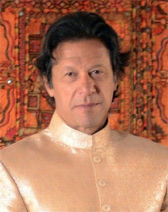
İmran Han
Former Prime Minister of Pakistan (2018–2022), founder of Pakistan Tehreek-e-Insaf (PTI), and legendary cricket captain who led Pakistan to victory in the 1992 Cricket World Cup.
Born on October 5, 1952
Age: 74
Profession: Former Prime Minister
Place of Birth: Lahore, Punjab, Pakistan
Imran Khan, born Imran Ahmed Khan Niazi on October 5, 1952, is a Pakistani politician, former professional cricketer, and philanthropist who served as the 22nd Prime Minister of Pakistan from August 18, 2018, until April 10, 2022. Before entering politics, he achieved international recognition as one of cricket's leading all-rounders and captained the Pakistan national team to its first Cricket World Cup victory in 1992. In 1996, he founded Pakistan Tehreek-e-Insaf (PTI), a political party that eventually became one of the country's largest political organizations. His premiership ended following a parliamentary vote of no confidence in April 2022. Since August 2023, he has been imprisoned amid a series of criminal proceedings involving corruption allegations, state gifts, and other legal disputes. Several convictions have been overturned or suspended, while other sentences and appeals remain in effect.
Early Life and Family Background
Imran Khan was born on October 5, 1952, in Lahore, Pakistan, into a Pashtun family belonging to the Niazi tribe. His father, Ikramullah Khan Niazi, was a civil engineer, while his mother, Shaukat Khanum, was a homemaker.
He grew up with four sisters and was the family's only son. His upbringing combined traditional Pakistani family values with an education influenced by British institutions.
Khan attended Aitchison College in Lahore before continuing his education at Royal Grammar School Worcester in England.
In 1972, he entered Keble College at the University of Oxford, where he studied Philosophy, Politics and Economics (PPE). He graduated in 1975.
During his education, he developed a strong interest in cricket, which eventually became the foundation of his international career.
Cricket Career
Imran Khan made his Test cricket debut for Pakistan against England in June 1971, beginning an international career that would continue for more than two decades.
While studying in England, he played county cricket for Worcestershire County Cricket Club and later Sussex County Cricket Club. He became known as a right-arm fast bowler and a powerful batsman, developing into one of the leading all-rounders in international cricket.
Throughout his career, Khan represented Pakistan in 88 Test matches and 175 One Day Internationals (ODIs). He scored 3,807 Test runs and took 362 Test wickets, while his ODI record included 3,709 runs and 182 wickets.
He became captain of the Pakistan national cricket team in 1982 and held the position during several periods. His leadership was associated with the development of a competitive team that included players such as Javed Miandad, Wasim Akram, and Inzamam-ul-Haq.
1992 Cricket World Cup Victory
The most significant achievement of Imran Khan's sporting career came during the 1992 Cricket World Cup, hosted by Australia and New Zealand.
Pakistan initially struggled during the tournament but recovered to qualify for the knockout stages. Under Khan's captaincy, the team defeated New Zealand in the semifinal and advanced to the final against England.
On March 25, 1992, Pakistan defeated England by 22 runs at the Melbourne Cricket Ground, winning its first men's ODI Cricket World Cup.
Khan scored 72 runs in the final and became a national sporting figure associated with one of Pakistan's most celebrated international victories.
He retired from international cricket following the tournament, completing a career that began in 1971. In 2009, he was inducted into the ICC Cricket Hall of Fame in recognition of his achievements.
Philanthropy and Social Projects
After the death of his mother, Shaukat Khanum, from cancer in 1985, Imran Khan began raising funds to establish a specialized cancer treatment hospital in Pakistan.
His efforts resulted in the opening of the Shaukat Khanum Memorial Cancer Hospital and Research Centre in Lahore in December 1994.
The hospital was established to provide modern cancer treatment, including financial assistance and free care for patients unable to afford medical services.
A second Shaukat Khanum hospital opened in Peshawar in 2015, expanding access to specialized cancer treatment in northwestern Pakistan.
Khan also supported education initiatives, including Namal University in Mianwali, an institution developed to increase access to higher education.
His charitable activities contributed to his public reputation before he entered national politics.
Founding Pakistan Tehreek-e-Insaf
On April 25, 1996, Imran Khan founded Pakistan Tehreek-e-Insaf (PTI), commonly translated as the Pakistan Movement for Justice.
The party promoted political accountability, anti-corruption policies, institutional reform, and improvements in public services.
During its early years, PTI struggled to gain significant electoral representation against Pakistan's established political parties, including the Pakistan Muslim League and the Pakistan Peoples Party.
In the 2002 general election, Khan won a seat in the National Assembly representing Mianwali, serving as a member of parliament from 2002 to 2007.
He initially supported the 1999 military takeover led by General Pervez Musharraf, but subsequently became an opponent of Musharraf's administration.
In 2007, during a period of emergency rule, Khan was detained briefly following his opposition to the government.
Rise to National Political Prominence
During the following decade, Imran Khan transformed PTI from a relatively small organization into a major political party.
His political campaigns emphasized corruption allegations against established politicians, economic inequality, judicial independence, and the need for institutional reform.
In the 2013 general election, PTI became one of the country's largest parties and established a provincial government in Khyber Pakhtunkhwa.
Khan was also elected to the National Assembly, where he continued criticizing the government of Prime Minister Nawaz Sharif.
His political movement attracted support among sections of Pakistan's urban middle class, younger voters, and citizens dissatisfied with traditional political leadership.
2018 Election and Appointment as Prime Minister
Pakistan held parliamentary elections on July 25, 2018. PTI won the largest number of seats in the National Assembly but did not secure an outright parliamentary majority.
With the support of independent lawmakers and smaller political parties, Imran Khan formed a coalition government.
On August 17, 2018, the National Assembly elected him Prime Minister of Pakistan. He formally took office after taking the oath on August 18, 2018.
His election represented a significant political transition, as PTI replaced the established parties that had dominated much of Pakistan's parliamentary politics.
Prime Minister of Pakistan (2018–2022)
During his premiership, Imran Khan promoted government accountability, economic reforms, social welfare programs, and measures intended to address corruption.
His administration expanded the Ehsaas Programme, a social protection initiative designed to provide financial assistance and other support to low-income households.
The government also introduced the Kamyab Jawan Programme to support youth entrepreneurship and employment, while expanding healthcare initiatives and environmental programs such as the Ten Billion Tree Tsunami Programme.
Economic difficulties remained a major challenge. Pakistan faced inflation, currency depreciation, public debt pressures, and negotiations with the International Monetary Fund concerning financial assistance.
In foreign policy, Khan emphasized relations with China, cooperation with regional countries, and Pakistan's position on developments in Afghanistan and Kashmir.
His administration also faced criticism from opposition parties over economic management, press freedom, political polarization, and relations between civilian institutions and the military.
Removal Through a Vote of No Confidence
In early 2022, opposition parties introduced a parliamentary motion of no confidence against Imran Khan's government.
On April 3, 2022, Deputy Speaker Qasim Suri rejected the motion without allowing a vote. This was followed by a process intended to dissolve the National Assembly.
On April 7, Pakistan's Supreme Court ruled that the rejection of the no-confidence motion and the subsequent dissolution of parliament were unconstitutional.
The court ordered the National Assembly to reconvene and hold the vote.
During the night of April 9–10, 2022, the motion passed with the support of 174 lawmakers, ending Khan's premiership.
He became the first Pakistani prime minister to be removed from office through a parliamentary vote of no confidence.
On April 11, 2022, Shehbaz Sharif was elected Prime Minister of Pakistan, receiving 174 votes in the National Assembly.
Khan rejected the circumstances surrounding his removal and alleged that political opponents and foreign interests had contributed to the collapse of his government. These allegations remained politically contested.
Opposition Activities and Assassination Attempt
Following his removal, Imran Khan organized political rallies and protest marches demanding early parliamentary elections.
His speeches attracted large gatherings of PTI supporters across Pakistan and intensified political tensions between his party and the government.
On November 3, 2022, he was wounded in the leg during a shooting at a political march in Wazirabad, Punjab.
Several people were injured, and one supporter was killed during the attack.
Khan survived and continued participating in political activities while receiving medical treatment.
On May 9, 2023, he was arrested while attending proceedings at the Islamabad High Court in connection with an investigation conducted by the National Accountability Bureau (NAB).
His arrest triggered widespread protests and violent confrontations in several Pakistani cities. Some demonstrators attacked military and government facilities, leading to additional arrests and criminal investigations.
Criminal Cases and Imprisonment
Since 2023, Imran Khan has faced multiple criminal proceedings involving allegations of corruption, misuse of state gifts, disclosure of classified information, and other offenses.
On August 5, 2023, he was sentenced to three years in prison in the first Toshakhana case, concerning the declaration and handling of gifts received while he was prime minister. The Islamabad High Court suspended the sentence on August 29, 2023.
On January 30, 2024, a special court sentenced Khan and former Foreign Minister Shah Mahmood Qureshi to ten years in prison in a case involving a classified diplomatic communication. On June 3, 2024, the Islamabad High Court overturned their convictions and acquitted both defendants.
On January 31, 2024, Khan and his wife Bushra Bibi received fourteen-year prison sentences in a separate state gifts case. The Islamabad High Court suspended those sentences on April 1, 2024, pending further proceedings.
On February 3, 2024, Khan and Bushra Bibi were each sentenced to seven years in prison over allegations that their marriage violated the Islamic waiting period following divorce. The convictions were overturned on July 13, 2024, and both were acquitted.
Khan and PTI have described many of the proceedings as politically motivated, while Pakistani authorities have maintained that the cases concern alleged violations of the law.
Al-Qadir Trust Corruption Case
On January 17, 2025, an accountability court sentenced Imran Khan to fourteen years in prison in the Al-Qadir Trust corruption case, also known as the £190 million case.
His wife, Bushra Bibi, received a seven-year prison sentence.
The prosecution alleged that the couple obtained improper financial benefits connected with transactions involving land and funds returned to Pakistan following proceedings in the United Kingdom.
Khan and his wife denied the allegations and challenged the verdict through the appeals process.
On May 4, 2026, the Islamabad High Court rejected their requests to suspend their sentences, observing that their principal appeals were already scheduled for consideration.
On October 5, 2026, the court adjourned the appeals without announcing a new hearing date. The fourteen-year conviction therefore remained in effect while the appeal was unresolved.
Second Toshakhana Conviction
On December 20, 2025, another Pakistani court sentenced Imran Khan and Bushra Bibi to seventeen years in prison each in the Toshakhana-II case.
The case concerned allegations involving a valuable jewelry set given to the couple by Saudi Arabia during Khan's premiership.
Prosecutors argued that the jewelry had been retained at a price substantially below its assessed market value, in violation of applicable rules.
The court imposed sentences comprising ten years under provisions concerning criminal breach of trust and seven years under anti-corruption legislation.
Khan and Bushra Bibi denied wrongdoing and appealed the verdict.
As of October 2026, Khan remained imprisoned at Adiala Jail in Rawalpindi, with the Al-Qadir Trust conviction and the second Toshakhana conviction among the major outstanding legal cases against him.
Personal Life and Marriages
Imran Khan has married three times.
In 1995, he married British producer and journalist Jemima Goldsmith, daughter of businessman James Goldsmith. The couple had two sons, Sulaiman Isa Khan and Kasim Khan, before divorcing in 2004.
In January 2015, Khan married journalist and television presenter Reham Khan. Their marriage ended in divorce later that year.
In 2018, he married Bushra Bibi, who had been associated with his interest in Islamic spirituality and religious guidance.
Khan has publicly discussed the importance of religion in his personal life, particularly the influence of Islam on his political and social views.
Marriages and Children
First Wife: Jemima Goldsmith (1995–2004)
Children: Sulaiman Isa Khan and Kasim Khan
Second Wife: Reham Khan (2015)
Third Wife: Bushra Bibi (married 2018)
Cricket Career Statistics
International Career: 1971–1992
Test Matches: 88
Test Runs: 3,807
Test Wickets: 362
One Day Internationals: 175
ODI Runs: 3,709
ODI Wickets: 182
Major Achievement: 1992 Cricket World Cup Champion
ICC Cricket Hall of Fame: Inducted in 2009
Major Dates and Career Milestones
1952 – Born in Lahore, Pakistan
1971 – Made his Test cricket debut against England
1975 – Graduated from the University of Oxford
1982 – Became captain of the Pakistan national cricket team
1985 – Death of his mother, Shaukat Khanum
1992 – Captained Pakistan to victory in the Cricket World Cup
1992 – Retired from international cricket
1994 – Opened the Shaukat Khanum Memorial Cancer Hospital in Lahore
1996 – Founded Pakistan Tehreek-e-Insaf (PTI)
2002 – Elected to Pakistan's National Assembly
2007 – Detained during the emergency rule of Pervez Musharraf
2009 – Inducted into the ICC Cricket Hall of Fame
2013 – Elected to the National Assembly as PTI expanded its political influence
2018 – Became the 22nd Prime Minister of Pakistan
April 2022 – Removed from office through a parliamentary vote of no confidence
November 2022 – Wounded in a shooting during a political march in Wazirabad
May 2023 – Arrested in connection with the Al-Qadir Trust investigation
August 2023 – Imprisoned following the first Toshakhana conviction
January 2024 – Sentenced in the diplomatic cipher and state gifts cases
June 2024 – Acquitted in the diplomatic cipher case
July 2024 – Acquitted in the marriage-related case
January 2025 – Sentenced to fourteen years in the Al-Qadir Trust case
December 2025 – Sentenced to seventeen years in the Toshakhana-II case
May 2026 – Requests to suspend the Al-Qadir Trust sentences rejected
October 2026 – Continued imprisonment at Adiala Jail while appeals remained pending
Source: Biyografiler.com
Frequently asked questions about İmran Han
Who is İmran Han?, İmran Han biography, İmran Han life story, İmran Han age, İmran Han facts, İmran Han birthplace, İmran Han photos, İmran Han videos, İmran Han career

Lamine Yamal
Professional footballer

Erling Haaland
Professional footballer

Kylian Mbappe
Professional footballer

Keanu Reeves
Actor

Bad Bunny
Rapper, Songwriter

Austin Abrams
Actor

Alan Moore
Novelist, Screenwriter, Musician

Alan Jones
Formula 1 Driver

Ingvar Kamprad
Businessperson, Entrepreneur

Inge Lehmann
Mathematician

Inga Ibsdotter Lilleaas
Actress

İndira Gandhi
Former Prime Minister

Adewale Akinnuoye-Agbaje
Actor, Former Model
Alan Moore
Novelist, Screenwriter, Musician
Inge Lehmann
Mathematician

Christine Lagarde
Lawyer, Politician
Ingvar Kamprad
Businessperson, Entrepreneur
Alan Jones
Formula 1 Driver