
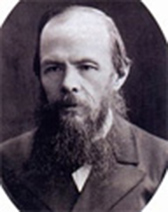
Dostoevsky
One of the greatest psychological novelists in world literature
Born on October 30, 1821
Died on February 9, 1881
Age at death: 60
Profession: Novelist, Essayist
Place of Birth: Moscow, Russian Empire
Place of Death: Saint Petersburg, Russian Empire
Fyodor Mikhailovich Dostoyevsky was the last and most radical of the three great Russian literary masters—alongside Leo Tolstoy and Anton Chekhov—to rise to international fame in the second half of the 19th century. A literary genius whose influence profoundly shaped modern Western literature, Dostoyevsky is the author of immortal classics such as Crime and Punishment and The Brothers Karamazov, works that probe the darkest depths of the human soul, moral responsibility, faith, guilt, freedom, and redemption.
Early Life and Family Background
Fyodor Dostoyevsky was born on 30 October 1821 in Moscow. His father, Mikhail Andreyevich Dostoyevsky, was a military doctor—an authoritarian, violent, and deeply alcoholic man who ruled his household with near-military discipline. His mother, Maria Fyodorovna, was gentle and religious; she and the children spent summers in Tula, where young Fyodor formed close bonds with peasants serving his family. These early encounters with the Russian poor would later shape his lifelong empathy for society’s outcasts.
His father’s cruelty left deep psychological scars. He forbade his daughters from leaving the house unaccompanied even as adults and treated his sons with relentless severity. Despite the family’s relative wealth, he was obsessively stingy, denying his children even pocket money well into adolescence.
In 1837, Dostoyevsky’s mother died. Soon after, his father—having retreated to his estate—was murdered by peasants driven to desperation by his brutality. This traumatic event would echo throughout Dostoyevsky’s fiction, particularly in his recurring theme of patricide.
Education and Early Disillusionment
Following his mother’s death, Fyodor Dostoyevsky entered the Military Engineering Academy in Saint Petersburg. He graduated in 1843 and joined the army, but the rigid, mechanical life of military service filled him with despair. In a letter to his brother, he famously wrote that he hated military life “as much as potatoes.”
Though he received a steady salary and income from family land, Dostoyevsky lived perpetually in debt. He frequented bohemian circles, developed a passion for billiards—at which he consistently lost—and cultivated habits of compulsive self-destruction that would haunt him for the rest of his life.
Literary Awakening and First Success
While still in the army, Fyodor Dostoyevsky began translating Honoré de Balzac’s *Eugénie Grandet* into Russian. By 1844, he resigned from military service entirely, declaring his intention to become a writer.
In 1846, he published his first novel, Poor Folk. The book was an immediate sensation. Influential critic Vissarion Belinsky hailed Dostoyevsky as a new literary force, writing to him: “You have penetrated to the deepest core of the matter… You may become a great writer.”
Fame came overnight, but Dostoyevsky’s sudden arrogance and abrasive behavior alienated literary circles. His subsequent works failed to match the success of his debut, and ridicule replaced praise. Financial pressure and isolation followed.
Political Radicalism, Arrest, and Near Execution
Rejected by the literary establishment, Fyodor Dostoyevsky gravitated toward radical intellectual circles advocating social reform and the abolition of serfdom. On 23 April 1849, he was arrested by Tsarist police and imprisoned.
On 22 December 1849, Dostoyevsky and fellow prisoners were taken to Semyonovsky Square and lined up for execution. At the final moment—rifles raised—the death sentence was commuted to hard labor in Siberia. This staged execution permanently altered Dostoyevsky’s worldview.
He spent four years in a prison camp in Omsk, an experience later transformed into Notes from a Dead House. Afterward, he served as a common soldier, gradually returning to writing.
Marriage, Travel, and Gambling
After marrying the widowed Maria Isayeva, Fyodor Dostoyevsky returned to Saint Petersburg. His wife fell ill with tuberculosis, prompting him to travel across Europe in the early 1860s—Paris, London, Geneva, Rome, Germany, and Denmark.
During this period, Dostoyevsky developed a severe gambling addiction, particularly to roulette. He won and lost fortunes overnight, deepening his financial instability. In 1864 alone, he lost his wife, his brother Mikhail, and close friend Apollon Grigoryev.
Major Works and Artistic Maturity
In the midst of grief and debt, Fyodor Dostoyevsky entered his greatest creative period. Notes from Underground marked the birth of modern existential literature. In 1866, he published Crime and Punishment, a revolutionary psychological novel far ahead of its time.
Pressed by deadlines, Dostoyevsky hired a young stenographer, Anna Snitkina. They met on 4 October 1866, became engaged a month later, and married in 1867. Anna proved indispensable—managing finances, negotiating with publishers, and shielding him from creditors. For the first time, Dostoyevsky experienced domestic stability.
Living abroad for four years, he wrote three of his five greatest novels: The Idiot, The Eternal Husband, and Demons. His debts were slowly paid, and his reputation solidified.
Final Masterpiece and Death
Plagued by epilepsy since childhood, Fyodor Dostoyevsky nevertheless undertook his most ambitious project: The Brothers Karamazov. Serialized beginning in 1879, the novel was completed in November 1880 and stands as one of the supreme achievements of world literature.
On 25 January 1881, Dostoyevsky suffered a severe hemorrhage. As he lay dying, he asked his wife to read the parable of the Prodigal Son from the Bible. He died peacefully on 9 February 1881 at the age of 59.
Legacy
Fyodor Dostoyevsky transformed the novel into a battlefield of conscience, faith, and moral freedom. His influence extends across philosophy, psychology, theology, and modern literature—shaping thinkers from Sigmund Freud to Jean-Paul Sartre. He remains not only a pillar of Russian literature but one of the most profound explorers of the human soul in history.
Complete Works
Below is the most comprehensive and canonically accepted list of works by Fyodor Mikhailovich Dostoyevsky, covering novels, novellas, short stories, essays, journalism, and diaries. Dates reflect first publication in Russian; English titles follow their standard canonical translations.
Novels
Poor Folk (1846)
The Double (1846)
Netochka Nezvanova (1849, unfinished)
Humiliated and Insulted (1861)
Notes from a Dead House (1861–1862)
Crime and Punishment (1866)
The Idiot (1869)
Demons (also published as *The Devils* or *The Possessed*) (1872)
The Adolescent (also known as *A Raw Youth*) (1875)
The Brothers Karamazov (1879–1880)
Novellas and Short Novels
White Nights (1848)
A Weak Heart (1848)
The Landlady (1847)
Uncle’s Dream (1859)
The Village of Stepanchikovo (1859)
The Gambler (1867)
The Eternal Husband (1870)
Short Stories
Mr. Prokharchin (1846)
The Honest Thief (1848)
The Christmas Tree and a Wedding (1848)
Another Man’s Wife (1848)
A Faint Heart (1848)
Polzunkov (1848)
A Little Hero (1849)
The Crocodile (1865)
Bobok (1873)
The Meek One (1876)
The Dream of a Ridiculous Man (1877)
Philosophical Works and Essays
Notes from Underground (1864)
Winter Notes on Summer Impressions (1863)
Pushkin Speech (also known as *Speech at the Pushkin Monument*) (1880)
Journalism and Diaries
A Writer’s Diary (1873–1881)
Plays and Dramatic Works
Mary Stuart in Russia (unfinished)
The Jew Yankel (unfinished dramatic fragment)
Translations
Eugénie Grandet by Honoré de Balzac (Russian translation, 1843)
Unfinished / Fragmentary Works
Various notebooks, drafts, philosophical fragments, and correspondence published posthumously in collected editions.
This body of work established Fyodor Dostoyevsky as one of the foundational figures of modern literature. His writings anticipated existentialism, depth psychology, and modernist narrative techniques, influencing thinkers and writers across philosophy, theology, psychoanalysis, and fiction worldwide.
Source: Biyografiler.com
Frequently asked questions about Dostoevsky
Who is Dostoevsky?, Dostoevsky biography, Dostoevsky life story, Dostoevsky age, Dostoevsky facts, Dostoevsky birthplace, Dostoevsky photos, Dostoevsky videos, Dostoevsky career
Related Biographies

Lamine Yamal
Professional footballer

Erling Haaland
Professional footballer

Sam Altman
Entrepreneur, Investor, CEO

Kylian Mbappe
Professional footballer

Giorgia Meloni
Politician, Journalist

Alice Weidel
Politician, Economist


Hongjoong
Singer, Rapper, Songwriter, Composer

Ludacris
Rapper, Actor

Kwon Eunbi
Singer

Sarah Wayne Callies
Actress, Screenwriter, Producer, Director

LaTavia Roberson
Singer, Actress, Entrepreneur

Elena Andreyevna Rybakina
Professional Tennis Player
Alice Weidel
Politician, Economist
Sam Altman
Entrepreneur, Investor, CEO
Lamine Yamal
Professional footballer

Lady Gaga
Singer, Musician, Songwriter, Actress, Producer
Kylian Mbappe
Professional footballer