
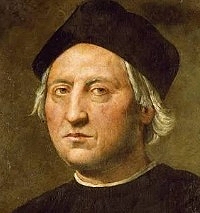
Christopher Columbus
Genoese navigator who crossed the Atlantic Ocean in 1492 under the Spanish Crown and completed four voyages to the Americas between 1492 and 1504.
Born on ?? ??, 1451
Died on May 20, 1506
Age at death: 55
Profession: Navigator, Explorer
Place of Birth: Genoa, Republic of Genoa (present-day Italy)
Place of Death: Valladolid, Spain
Christopher Columbus, known in Italian as Cristoforo Colombo and in Spanish as Cristóbal Colón, was born in 1451 in Genoa, then an independent republic in present-day Italy. He was a navigator and explorer who completed four transatlantic voyages between 1492 and 1504 under the sponsorship of the Spanish monarchs Ferdinand II of Aragon and Isabella I of Castile. On October 12, 1492, his expedition reached an island in the Bahamas, beginning sustained European contact with the Caribbean. Columbus believed that the islands he encountered belonged to Asia and never fully recognized that they were part of a continent previously unknown to Europeans. His expeditions also initiated Spanish colonization in the Caribbean, including the enslavement and forced labor of Indigenous peoples.
Early Life and Family
Christopher Columbus was born in 1451 in Genoa, an independent maritime republic in present-day Italy. His exact date of birth is unknown. His father, Domenico Colombo, was a wool weaver and merchant, while his mother was Susanna Fontanarossa.
He was the eldest of five children. His brothers included Bartolomeo Colombo, who later became a cartographer and participated in his expeditions, and Giacomo Colombo, also known as Diego, who assisted with colonial administration in the Caribbean.
Columbus received a limited formal education. Growing up in Genoa, a commercial port with maritime connections throughout the Mediterranean, he became interested in navigation, geography, and mapmaking.
He began working aboard ships while still young. His early voyages included journeys through the Mediterranean, and he is believed to have visited the Greek island of Chios while participating in commercial maritime activities.
Early Voyages and Life in Portugal
In 1476, Christopher Columbus sailed with a Genoese commercial convoy traveling toward northern Europe. The convoy was attacked by an armed fleet near the Portuguese coast, and Columbus survived the destruction of his vessel.
He reached Portugal and subsequently settled in Lisbon, where his brother Bartolomeo also lived. The brothers worked with maps and nautical charts, while Columbus continued participating in maritime trade.
During the following years, he traveled along Atlantic trading routes and gained practical experience of winds, currents, and ocean navigation. His journeys included voyages connected with Madeira and the Portuguese trading settlements on the western coast of Africa.
In 1479, he married Filipa Moniz Perestrelo, a Portuguese woman from a family connected with Atlantic exploration and administration. Their son, Diego Columbus, was born around 1480.
Through his maritime activities and contacts in Portugal, Columbus became increasingly interested in the possibility of reaching Asia by sailing west across the Atlantic Ocean.
The Idea of Reaching Asia by Sailing West
During the fifteenth century, European merchants sought maritime routes to Asian markets, particularly those associated with spices, silk, and other valuable products. Portuguese navigators were exploring the African coastline in search of a sea route to the Indian Ocean.
Christopher Columbus proposed an alternative: sailing west across the Atlantic to reach the eastern regions of Asia.
The idea that Earth was spherical was already known among educated Europeans. Columbus's principal error concerned its size and the distance separating Europe from Asia across the Atlantic.
He believed that the ocean between the Canary Islands and eastern Asia was much narrower than it actually was. His calculations underestimated the Earth's circumference and overestimated the eastward extent of Asia.
His geographical studies included works associated with the Roman author Pliny the Elder, the Greek geographer Claudius Ptolemy, the travels of Marco Polo, and Imago Mundi by French theologian and geographer Pierre d'Ailly.
Columbus was also familiar with ideas attributed to the Florentine mathematician and cosmographer Paolo dal Pozzo Toscanelli, who had considered the possibility of reaching Asia by crossing the Atlantic westward.
Although Columbus had accumulated knowledge of navigation and earlier geographical writings, he did not know that the American continents lay between Europe and eastern Asia.
Seeking Financial Support for His Expedition
In 1484, Christopher Columbus sought financial and political support from John II of Portugal. The Portuguese court rejected his proposal to reach Asia by sailing west.
Columbus subsequently traveled to Castile and approached the Spanish monarchs Ferdinand II of Aragon and Isabella I of Castile in 1486.
His proposal was examined over several years. After repeated negotiations and unsuccessful requests, he obtained royal sponsorship in 1492.
In April 1492, the monarchs signed the Capitulations of Santa Fe, an agreement granting Columbus the title Admiral of the Ocean Sea and promising him administrative privileges and a share of the profits from territories and trading activities associated with his proposed voyage.
First Voyage to the Americas (1492–1493)
On August 3, 1492, Christopher Columbus departed from the Spanish port of Palos de la Frontera with three vessels: Santa María, Niña, and Pinta. The expedition included approximately 90 crew members.
The fleet sailed toward the Canary Islands, where the ships were prepared for the Atlantic crossing. After leaving the islands in September, Columbus continued westward across the ocean.
On October 12, 1492, the expedition reached an island in the Bahamas known to its Indigenous inhabitants as Guanahaní. Columbus named it San Salvador and claimed it for the Spanish Crown.
Believing that he had reached islands near eastern Asia, Columbus referred to the Indigenous inhabitants as Indians. The term continued to be used by Europeans despite the geographical misunderstanding on which it was based.
Columbus subsequently explored parts of Cuba and Hispaniola, the Caribbean island now shared by Haiti and the Dominican Republic. He recorded descriptions of the islands, their inhabitants, natural resources, and possible trading opportunities.
In December 1492, the Santa María ran aground off the northern coast of Hispaniola. Using material from the damaged ship, the expedition established a small settlement called La Navidad. Columbus left 39 men there before beginning the return journey.
He reached Palos de la Frontera on March 15, 1493. His reports to the Spanish monarchs described the lands he had visited as islands near Asia.
Had Columbus Discovered America?
Christopher Columbus was not the first human to reach the Americas. Indigenous peoples had inhabited North and South America for thousands of years before his voyages.
Nor was he the first European known to have reached North America. Archaeological evidence confirms that Norse seafarers established a settlement at L'Anse aux Meadows in present-day Newfoundland, Canada, around the year 1000, approximately five centuries before Columbus's first voyage.
The Norse voyages are associated with explorers including Leif Erikson. The remains of the settlement at L'Anse aux Meadows provide physical evidence of their presence in North America.
Columbus's first landfall in 1492 was in the Caribbean, not on the North American mainland. His later voyages reached parts of the South American mainland and the coast of Central America.
Unlike the earlier Norse expeditions, Columbus's voyages established continuing maritime connections between Europe and the Caribbean, followed by Spanish settlement, conquest, and colonial administration.
The continents subsequently became known as America through the name of Italian navigator Amerigo Vespucci. In 1507, German cartographer Martin Waldseemüller used the name America on a published world map in connection with Vespucci's accounts of the newly described lands.
Second Voyage and the Establishment of Colonies (1493–1496)
On September 25, 1493, Christopher Columbus departed from Cádiz on his second expedition. This voyage involved 17 ships and approximately 1,200 people, including sailors, soldiers, settlers, and religious personnel.
Unlike his first journey, the second expedition was intended to establish a permanent Spanish presence in the Caribbean.
On November 3, 1493, the fleet reached an island that Columbus named Dominica. He subsequently visited other islands in the Lesser Antilles before returning to Hispaniola.
When Columbus reached the site of La Navidad, he found the settlement destroyed and the men left there dead. Accounts of the events describe conflict between the Spanish settlers and the local Indigenous population.
Columbus established a new settlement called La Isabela on the northern coast of Hispaniola. It became one of the earliest Spanish colonial settlements in the Americas.
The expedition also explored additional Caribbean islands, including Puerto Rico and Jamaica.
During this period, Spanish colonization brought increasing demands for gold, labor, food, and other resources. Conflicts developed between the settlers and the Indigenous Taíno communities.
Columbus returned to Cádiz on June 11, 1496.
Spanish Colonization and Indigenous Peoples
The colonies established under Christopher Columbus introduced systems of forced labor, tribute, and enslavement that severely affected the Indigenous peoples of the Caribbean.
On Hispaniola, Spanish settlers demanded gold and other goods from Taíno communities. Resistance to these demands resulted in armed conflicts, and Indigenous people were captured, enslaved, or compelled to work for the colonists.
European diseases, violence, displacement, and the disruption of food production contributed to a substantial decline in the island's Indigenous population during the decades following 1492.
Historical estimates of Hispaniola's population before European contact vary considerably. Exact figures for the population in 1492, 1508, and 1560 cannot be established with certainty. Nevertheless, historical and demographic research documents a severe population collapse during the early colonial period.
Columbus and his brothers also faced accusations concerning their administration of the colonies, including the treatment of settlers and Indigenous inhabitants.
Third Voyage and Arrest (1498–1500)
Christopher Columbus departed from Spain on May 30, 1498, for his third Atlantic voyage. The expedition consisted of six ships.
Traveling farther south than on his previous expeditions, Columbus reached Trinidad and explored the Gulf of Paria, near the coast of present-day Venezuela.
During this journey, he encountered the northern coast of South America and the region of the Orinoco River delta. The volume of freshwater entering the sea led him to consider the possibility that he had reached a substantial landmass.
When he returned to Hispaniola, the Spanish colony was experiencing serious administrative problems and disputes among its inhabitants.
In 1500, the Spanish monarchs sent Francisco de Bobadilla to investigate the situation. Bobadilla assumed authority over the colony and arrested Columbus and his brothers.
Columbus was sent back to Spain in chains. Although he was subsequently released, he was not restored to his previous position as governor of Hispaniola.
Fourth and Final Voyage (1502–1504)
In 1502, Ferdinand II of Aragon and Isabella I of Castile authorized Christopher Columbus to undertake another Atlantic expedition.
Columbus departed from Spain in May 1502 with four ships. His objective remained the discovery of a navigable passage that would provide access to the trading regions of Asia.
During this expedition, he sailed along the Caribbean coastline of Central America, exploring areas corresponding to present-day Honduras, Nicaragua, Costa Rica, and Panama.
He searched for a strait connecting the Atlantic Ocean with another sea but did not find a passage to the Pacific Ocean.
Storms, damaged vessels, shortages of supplies, and illness complicated the expedition. In 1503, Columbus and his crew were stranded on Jamaica, where they remained for approximately one year before being rescued.
Columbus returned to Spain in November 1504. His final voyage had failed to establish the western sea route to Asia that he had sought.
Final Years
After returning to Spain, Christopher Columbus continued requesting the restoration of privileges and financial rights promised to him before his voyages.
Queen Isabella I of Castile died on November 26, 1504. Columbus subsequently petitioned King Ferdinand II of Aragon concerning his titles and contractual claims.
His final years were affected by illness and disputes over the rewards and authority associated with his expeditions. Although he had lost his position as colonial governor, he continued receiving certain revenues from the territories under Spanish control.
He died before his claims were fully resolved.
Personal Life
Christopher Columbus married Filipa Moniz Perestrelo in Portugal in 1479. Their son, Diego Columbus, was born around 1480 and later served as governor and viceroy in the Spanish Caribbean.
Following Filipa's death, Columbus developed a relationship with Beatriz Enríquez de Harana in Spain. Their son, Ferdinand Columbus, was born in 1488.
Ferdinand later became a scholar and wrote a biography of his father, which remains an important historical source concerning Columbus's life and expeditions.
Death and Burial
Christopher Columbus died on May 20, 1506, in Valladolid, Spain, at approximately 54 years of age.
He was initially buried in Valladolid. His remains were later transferred to Seville and subsequently to Hispaniola, before being moved to Havana in 1795 and returned to Seville in 1898.
A tomb attributed to Columbus is located inside Seville Cathedral in Andalusia, Spain. The existence of another set of remains identified as Columbus's in Santo Domingo has contributed to historical disputes about the location of his burial.
Four Voyages of Christopher Columbus
1492–1493 - First Voyage: Bahamas, Cuba, Hispaniola1493–1496 - Second Voyage: Lesser Antilles, Puerto Rico, Hispaniola, Jamaica
1498–1500 - Third Voyage: Trinidad, Gulf of Paria, Northern South America, Hispaniola
1502–1504 - Fourth Voyage: Jamaica, Honduras, Nicaragua, Costa Rica, Panama
Source: Biyografiler.com
Frequently asked questions about Christopher Columbus
Who is Christopher Columbus?, Christopher Columbus biography, Christopher Columbus life story, Christopher Columbus age, Christopher Columbus facts, Christopher Columbus birthplace, Christopher Columbus photos, Christopher Columbus videos, Christopher Columbus career
Related Biographies


Lamine Yamal
Professional footballer

Kylian Mbappe
Professional footballer

Keanu Reeves
Actor

Erling Haaland
Professional footballer

Brad Pitt
Actor

Leonardo DiCaprio
Actor

Kurbankulu Berdimuhammedov
Former President, Politician

Christopher Columbus
Navigator, Explorer

Kristin Davis
Actress

Kristanna Loken
Actress, Model

Kris Kristofferson
Singer, Scientist

Kylian Mbappe
Professional footballer

Jensen Huang
Entrepreneur, CEO

Susie Wiles
Political Consultant

Gadi Eisenkot
Politician, Military Commander

Scott Bessent
Politician, Investor

Haluk Bilginer
Actor