
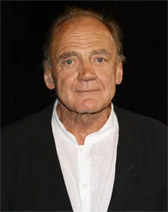
Bruno Ganz
Born on March 22, 1941
Died on February 16, 2019
Age at death: 78
Profession: Actor
Place of Birth: Zurich, Switzerland
Place of Death: Au, Wädenswil, Switzerland
Bruno Ganz was an internationally respected Swiss actor whose work in theatre and cinema secured him a singular position in European cultural history. He is widely regarded as one of the most important figures in German-language theatre and European art cinema. He achieved worldwide recognition for his portrayal of Adolf Hitler in Downfall (2004), a performance acclaimed for its psychological depth and its refusal of caricature.
Early Life and Background
Bruno Ganz was born on March 22, 1941, in Zurich, Switzerland. He was the son of a Swiss factory worker of Italian origin and an Italian mother. Growing up in a culturally diverse household, he developed an early sensitivity to language, literature, and artistic expression.
Before completing high school, he decided to pursue acting as a profession. At the age of nineteen, he appeared in his first film role. In 1961, he entered the theatre world, quickly earning recognition as a disciplined and intellectually rigorous young actor.
Theatre Foundations and the Schaubühne
In the early 1970s, Bruno Ganz became one of the founding members of Berlin’s renowned Schaubühne theatre. The institution emerged as a central force in postwar German theatre, distinguished by its politically engaged productions and innovative interpretations of both classical and contemporary works.
Ganz’s stage performances were characterized by restraint, precision, and deep internalization of character. He performed works by Goethe, Brecht, Ibsen, and Peter Handke, and came to be regarded as an actor’s actor, admired for his seriousness and artistic integrity.
Film Career and International Recognition
Alongside his theatre career, Bruno Ganz developed an extraordinary filmography spanning European art cinema and international productions. He collaborated with major directors including Theo Angelopoulos, Werner Herzog, Volker Schlöndorff, Wim Wenders, Francis Ford Coppola, and Hans W. Geissendörfer.
His acting style relied heavily on silence, stillness, and controlled physical expression. Rather than overt emotional display, he conveyed psychological complexity through subtle gestures and vocal restraint, making him particularly suited to philosophical and introspective cinema.
One of his most iconic performances came in Wings of Desire (1987), directed by Wim Wenders, in which he portrayed the angel Damiel. The film became a landmark of European cinema, and Ganz’s performance remains one of the most celebrated of his career.
Downfall and the Portrayal of Adolf Hitler
Bruno Ganz achieved global fame with his portrayal of Adolf Hitler in Downfall (2004), a film depicting the final twelve days of the Nazi leader’s life in his Berlin bunker. Rejecting caricature, Ganz portrayed Hitler as a psychologically disintegrating figure, exposing fear, denial, and emotional volatility.
The performance generated intense international debate and was widely praised for its historical seriousness and moral complexity. It is now considered one of the most significant and controversial portrayals of Hitler in cinematic history.
Eternity and a Day
In 1998, Bruno Ganz starred in Eternity and a Day, directed by Theo Angelopoulos. He portrayed a terminally ill writer reflecting on memory, language, and mortality during the final day of his life.
The film won the Palme d’Or at the Cannes Film Festival and is widely regarded as one of the defining achievements of Ganz’s career, further solidifying his reputation as a performer capable of embodying profound existential themes.
Music, Literature, and the Iffland Ring
Beyond acting, Bruno Ganz maintained a deep engagement with literature and classical music. He frequently appeared as a narrator in musical performances, including collaborations with the Berlin Philharmonic Orchestra, notably in Luigi Nono’s Il Canto Sospeso.
In 1996, he was awarded the Iffland Ring, the most prestigious honor in German-language theatre. The ring is passed from actor to actor by testament and is traditionally bestowed upon the most distinguished stage performer of the era.
Awards and Distinctions
Throughout his career, Bruno Ganz received numerous prestigious honors. On March 2, 2006, he was awarded the Medal for Science and Art in Vienna by Austrian President Heinz Fischer.
He also received the European Film Awards, the German Federal Order of Merit, and the Goldene Kamera. In 2010, he was elected President of the German Film Academy alongside Iris Berben.
Personal Life
Bruno Ganz married Sabine Ganz in 1965; the couple later divorced. He had one son, Daniel Ganz, born in 1972. For many years, he lived between Berlin and Venice, maintaining a private and reserved personal life.
Illness and Death
In February 2018, Bruno Ganz was diagnosed with intestinal cancer and began chemotherapy treatment. Due to his deteriorating health, he was forced to cancel appearances at the Salzburg Festival.
He died on February 16, 2019, at his home in the village of Au, near Wädenswil, Switzerland, just weeks before his 78th birthday.
Reflecting on his frequent portrayals of dying characters, he once stated in an interview with Die Zeit:
Filmography
1960 – The Man in the Black Derby – Unknown Role – Feature Film
1961 – Chikita – Unknown Role – Feature Film
1976 – Summer Guests – Unknown Role – Feature Film
1976 – Lumière – Unknown Role – Feature Film
1976 – The Marquise of O... – Unknown Role – Feature Film
1977 – The American Friend – Jonathan Zimmermann – Feature Film
1977 – The Left-Handed Woman – Unknown Role – Feature Film
1978 – The Boys from Brazil – Unknown Role – Feature Film
1979 – Nosferatu the Vampyre – Jonathan Harker – Feature Film
1979 – Return to the Beloved – Unknown Role – Feature Film
1980 – 5% Risk – Unknown Role – Feature Film
1980 – The Inventor – Unknown Role – Feature Film
1980 – Lady of the Camellias – Unknown Role – Feature Film
1981 – Circle of Deceit – Unknown Role – Feature Film
1983 – War and Peace – Unknown Role – TV Series
1987 – Wings of Desire – Damiel – Feature Film
1989 – Strapless – Unknown Role – Feature Film
1991 – Success – Unknown Role – TV Series
1991 – Especially on Sunday – Unknown Role – Feature Film
1992 – The Last Days of Chez Nous – Unknown Role – Feature Film
1992 – Night on Fire – Unknown Role – Feature Film
1993 – Faraway, So Close! – Damiel – Feature Film
1994 – The Absence – Unknown Role – Feature Film
1997 – Saint-Ex – Antoine de Saint-Exupéry – Feature Film
1998 – Eternity and a Day – Alexander – Feature Film
2000 – Bread and Tulips – Fernando Girasole – Feature Film
2001 – Faust – Faust – TV Movie
2002 – Epstein’s Night – Unknown Role – Feature Film
2003 – Luther – Johann Tetzel – Feature Film
2004 – The Manchurian Candidate – Unknown Role – Feature Film
2004 – Downfall – Adolf Hitler – Feature Film
2005 – Have No Fear: The Life of Pope John Paul II – Unknown Role – TV Movie
2006 – Baruto no Gakuen – Unknown Role – Feature Film
2007 – Vitus – Unknown Role – Feature Film
2007 – Youth Without Youth – Unknown Role – Feature Film
2008 – The Reader – Unknown Role – Feature Film
2008 – The Baader Meinhof Complex – Unknown Role – Feature Film
2009 – The Dust of Time – Unknown Role – Feature Film
2010 – Colours in the Dark – Unknown Role – Feature Film
2010 – The End Is My Beginning – Unknown Role – Feature Film
2011 – Unknown – Unknown Role – Feature Film
2013 – Night Train to Lisbon – Unknown Role – Feature Film
2013 – Michael Kohlhaas – Unknown Role – Feature Film
2013 – The Counselor – Unknown Role – Feature Film
2014 – In Order of Disappearance – Unknown Role – Feature Film
2015 – Amnesia – Unknown Role – Feature Film
2015 – Remember – Unknown Role – Feature Film
2015 – Heidi – Unknown Role – Feature Film
2016 – Un Juif pour l'exemple – Unknown Role – Feature Film
2018 – The House That Jack Built – Verge – Feature Film
Source: Biyografiler.com
Frequently asked questions about Bruno Ganz
Who is Bruno Ganz?, Bruno Ganz biography, Bruno Ganz life story, Bruno Ganz age, Bruno Ganz facts, Bruno Ganz birthplace, Bruno Ganz photos, Bruno Ganz videos, Bruno Ganz career
Related Biographies

Lamine Yamal
Professional footballer

Erling Haaland
Professional footballer

Austin Abrams
Actor

Keanu Reeves
Actor

Kylian Mbappe
Professional footballer

Bad Bunny
Rapper, Songwriter


Hongjoong
Singer, Rapper, Songwriter, Composer

Ludacris
Rapper, Actor

Kwon Eunbi
Singer

Sarah Wayne Callies
Actress, Screenwriter, Producer, Director

LaTavia Roberson
Singer, Actress, Entrepreneur
Keanu Reeves
Actor

Demi Moore
Actress

Leonardo DiCaprio
Actor

Kim Jong-un
Politician
Bad Bunny
Rapper, Songwriter

Haruki Murakami
Novelist, Writer