
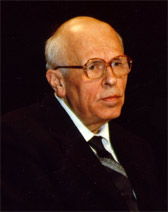
Andrey Saharov
Father of the Soviet hydrogen bomb and global symbol of scientific conscience.
Born on May 21, 1921
Died on December 19, 1989
Age at death: 68
Profession: Theoretical Physicist, Scientist
Place of Birth: Moscow, Russian SFSR, Soviet Union
Place of Death: Moscow, Soviet Union
Andrey Dmitriyevich Sakharov was a Soviet theoretical physicist who rose to prominence as one of the principal architects of the Soviet Union’s nuclear weapons program before undergoing a profound moral transformation that led him to become one of the twentieth century’s most influential human rights activists. Widely referred to as the “father of the Soviet hydrogen bomb,” Sakharov later emerged as a universal symbol of intellectual freedom, civil liberties, and resistance to state oppression, culminating in his receipt of the 1975 Nobel Peace Prize.
Early Life and Education
Andrey Sakharov was born on May 21, 1921, in Moscow into an intellectually cultivated family. His father, Dmitry Sakharov, was a physics teacher and author of scientific textbooks whose integrity and principled worldview deeply shaped his son’s moral outlook. Sakharov received part of his early education at home before entering formal schooling in 1933, where his exceptional abilities quickly became evident.
In 1938, Sakharov was admitted to the physics department of Moscow State University. Following the outbreak of World War II, the university was evacuated to Ashgabat, where he continued his studies and graduated with distinction in 1942. Due to health reasons, he was exempted from military service and instead worked as an engineer at a munitions factory during the war years.
Scientific Career and the Soviet Nuclear Program
After returning to Moscow in 1945, Andrey Sakharov began postgraduate studies at the Lebedev Physical Institute under the supervision of Igor Tamm. He completed his doctoral degree in 1947 and was soon recruited into the Soviet Union’s most secret and strategically vital project: the development of nuclear weapons.
From 1948 onward, Sakharov played a decisive role in the creation of Soviet thermonuclear weapons. Working alongside leading physicists such as Vitaly Ginzburg and Yakov Zeldovich, he helped develop the “Sloika” (“Layer Cake”) design, which relied on alternating layers of deuterium and uranium. This concept became the foundation for the Soviet Union’s first hydrogen bomb test in 1953. Sakharov was present at the first Soviet atomic bomb detonation on August 29, 1949.
At the age of just 32, he was elected a full member of the USSR Academy of Sciences. He received numerous state honors, including multiple awards of Hero of Socialist Labor, and gained access to privileges unavailable to ordinary Soviet citizens.
Moral Awakening and Opposition to Nuclear Testing
Despite his extraordinary success, Andrey Sakharov began to confront the devastating implications of his work. By the late 1950s, he had become increasingly alarmed by the global consequences of nuclear weapons and atmospheric testing. In 1961, he openly opposed Nikita Khrushchev’s decision to test a 100-megaton hydrogen bomb, warning that radioactive fallout posed catastrophic risks to humanity.
This period marked the beginning of Sakharov’s conviction that scientists bear a profound moral responsibility to society. His concerns extended beyond nuclear weapons to broader questions of human survival, ethical governance, and the limits of state power.
“Progress, Peaceful Coexistence, and Intellectual Freedom”
The turning point in Andrey Sakharov’s public life came in 1968 with the writing of his seminal essay, Progress, Peaceful Coexistence, and Intellectual Freedom. Circulated clandestinely through samizdat and smuggled to the West, the text called for nuclear disarmament, democratic socialism, freedom of thought, and the dismantling of repressive political systems.
The essay was published in full by The New York Times on July 22, 1968, occupying three pages of the newspaper. Its appearance caused shock in the West and fury within the Soviet leadership. Western audiences were astonished to hear a rational, humane voice emerging from behind the Iron Curtain, while Soviet authorities struggled to comprehend how one of their most privileged scientists could jeopardize everything for the sake of “intellectual freedom.”
Sakharov initially attempted to raise his concerns through official channels, seeking dialogue with members of the CPSU Central Committee and Soviet leader Leonid Brezhnev. When these efforts were met with silence, he concluded that public disclosure was the only remaining option. That year, his Thoughts became one of the most widely published books in the world.
Human Rights Activism and Exile
Following these actions, Andrey Sakharov was removed from classified work and subjected to increasing state repression. In 1970, he became a founding member of the Moscow Human Rights Committee. His outspoken condemnation of the Soviet invasion of Afghanistan in 1979 proved decisive.
In January 1980, Sakharov was stripped of all state honors and exiled without trial to the closed city of Gorky (now Nizhny Novgorod). His wife, Yelena Bonner, was later sent into internal exile as well. During this period, Sakharov endured constant surveillance, isolation, and deteriorating health, yet he continued to speak out through hunger strikes and appeals smuggled to the outside world.
Nobel Peace Prize and International Recognition
In 1975, Andrey Sakharov was awarded the Nobel Peace Prize for his fearless defense of human dignity, civil liberties, and the rule of law. The Soviet government barred him from attending the ceremony in Oslo; the prize was accepted on his behalf by Yelena Bonner. The Nobel Committee described Sakharov as an unwavering moral force standing against the abuse of power.
Return, Political Engagement, and Final Years
After years of international pressure, Sakharov was released from exile in December 1986 under the leadership of Mikhail Gorbachev. He returned to Moscow and became actively involved in the era of Glasnost and Perestroika. In 1989, he was elected to the Congress of People’s Deputies, where he advocated constitutional reform, political pluralism, and genuine democracy.
Visionary in both science and ethics, Andrey Sakharov anticipated many future global challenges, including the societal implications of the internet and artificial intelligence, decades before they became mainstream concerns.
Personal Life
Andrey Sakharov was married twice. His first wife, Klavdia Vikhireva, whom he married in 1943, died of cancer in 1969. They had a daughter, Tatyana Sakharova, born in 1945. In 1972, he married Yelena Bonner, who became his closest ally during years of persecution and exile.
Death and Legacy
Andrey Sakharov died on December 14, 1989, in Moscow at the age of 68. He left behind a legacy unmatched in its moral gravity: a scientist who confronted the destructive power he helped create and transformed that reckoning into a lifelong struggle for humanity’s conscience.
The Sakharov Prize for Freedom of Thought, named in his honor, continues to stand as one of the world’s most prestigious symbols of resistance against oppression and the enduring power of moral courage.
Source: Biyografiler.com
Frequently asked questions about Andrey Saharov
Who is Andrey Saharov?, Andrey Saharov biography, Andrey Saharov life story, Andrey Saharov age, Andrey Saharov facts, Andrey Saharov birthplace, Andrey Saharov photos, Andrey Saharov videos, Andrey Saharov career

Lamine Yamal
Professional footballer

Erling Haaland
Professional footballer

Austin Abrams
Actor

Keanu Reeves
Actor

Kylian Mbappe
Professional footballer

Bad Bunny
Rapper, Songwriter


Hongjoong
Singer, Rapper, Songwriter, Composer

Ludacris
Rapper, Actor

Kwon Eunbi
Singer

Sarah Wayne Callies
Actress, Screenwriter, Producer, Director

LaTavia Roberson
Singer, Actress, Entrepreneur
Keanu Reeves
Actor

Demi Moore
Actress

Leonardo DiCaprio
Actor

Kim Jong-un
Politician

Haruki Murakami
Novelist, Writer
Austin Abrams
Actor