
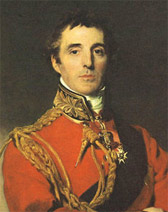
Arthur Wellesley
Known as the “Iron Duke,” the British commander who defeated [[Napoleon Bonaparte]] at the Battle of Waterloo and later served twice as Prime Minister of the United Kingdom
Born on May 1, 1769
Died on September 14, 1852
Age at death: 83
Profession: Politician, Prime Minister, Soldier,
Place of Birth: Dublin, Ireland
Place of Death: Walmer Castle, Kent, England
Arthur Wellesley, 1st Duke of Wellington, was born on May 1, 1769, in Dublin, Ireland, into an Anglo-Irish aristocratic family. A soldier, statesman and twice Prime Minister of the United Kingdom, he became one of the most celebrated military commanders in British history. His campaigns in India, the Peninsular War and, above all, his victory over Napoleon Bonaparte at the Battle of Waterloo in 1815 established his international reputation. Later known as the “Iron Duke,” Arthur Wellesley also became an influential and often controversial political figure during a period of profound constitutional and social change in Britain.
Early Life and Education
Arthur Wellesley was the son of Garret Wesley, 1st Earl of Mornington, and Anne Hill-Trevor. His family belonged to the Protestant Anglo-Irish aristocracy. His elder brother Richard Wellesley would later become Governor-General of India and an important figure in the expansion of British power on the subcontinent.
His father died in 1781, when Arthur Wellesley was still young, leaving the family under financial pressure. He attended Eton College, but his mother eventually withdrew him. His education subsequently continued on the European continent, including periods in Belgium and France. At Angers in France, he attended the Royal Academy of Equitation, where he received training that helped prepare him for a military career.
Contemporary accounts suggest that his family did not initially regard him as particularly promising. The disciplined, methodical officer who later became famous across Europe emerged only gradually through military experience, administrative responsibility and a strong capacity to learn from previous campaigns.
Beginning of His Military Career
Arthur Wellesley entered the British Army in 1787 as an ensign. Like many aristocratic officers of the period, he advanced through a system in which commissions could be purchased, but his later reputation rested increasingly on practical command ability rather than social position alone.
His first substantial experience of active warfare came during the French Revolutionary Wars. In 1794 and 1795 he served in the Flanders Campaign in the Netherlands. The operation proved difficult for British and allied forces, but it became an important education for Wellesley. Poor supply arrangements, inadequate coordination and confused command structures impressed upon him the importance of logistics, discipline and secure lines of communication.
These lessons became central to his later methods. Arthur Wellesley developed a reputation for carefully organizing supplies, choosing strong defensive positions and maintaining strict discipline among his troops. His armies were rarely allowed to depend entirely upon improvisation for food, ammunition or transport.
Military Career in India
In 1796, Arthur Wellesley sailed for India, where his military career began to develop on a much larger scale. His elder brother Richard Wellesley later became Governor-General, placing the Wellesley family at the center of British imperial policy in the region.
As commander of the 33rd Regiment of Foot, Arthur Wellesley participated in the campaign against the Kingdom of Mysore. In 1799 he took part in operations culminating in the capture of Seringapatam, where the forces of Tipu Sultan were defeated and Tipu was killed. After the victory, Wellesley was given significant administrative and military responsibilities in the conquered territories.
His years in India were important not merely because of battlefield experience. Arthur Wellesley learned to command forces over vast distances, organize transport and supply networks, negotiate with allies and local rulers, gather intelligence and administer territories affected by war.
Assaye and the Second Anglo-Maratha War
The Second Anglo-Maratha War gave Arthur Wellesley the opportunity to establish himself as an independent battlefield commander. On September 23, 1803, he fought the Battle of Assaye against a numerically superior Maratha force.
Wellesley chose an aggressive course, crossing a river and attacking a position defended by strong infantry and artillery. The fighting was exceptionally severe and British casualties were heavy, but his army ultimately won the battle. He later regarded Assaye as one of the most impressive victories of his military career.
Further successes followed at Battle of Argaum and the capture of Gawilghur. By the time Arthur Wellesley left India, he had acquired extensive experience in independent command and had developed many of the organizational principles that would later characterize his campaigns against Napoleonic France.
Entry into Politics
Arthur Wellesley's political career developed alongside his military service. He had already represented Trim in the Irish House of Commons from 1790 to 1797. After returning to Britain, he entered the Parliament at Westminster in 1806, initially representing Rye.
He subsequently served as Chief Secretary for Ireland, working under Charles Lennox, Duke of Richmond. His ability to move between military command and political administration became a defining characteristic of his public career.
In 1809, following his military successes in the Iberian Peninsula, Arthur Wellesley was elevated to the peerage as Viscount Wellington and Baron Douro. From that point he sat in the House of Lords, rather than first entering it in 1827 as is sometimes incorrectly stated.
The Peninsular War
The most sustained military campaign of Arthur Wellesley's career began in 1808, when he was sent to Portugal to oppose French forces during the Peninsular War. The conflict became one of the longest and most damaging fronts of the Napoleonic Wars, tying down large numbers of French troops in Portugal and Spain.
Wellesley defeated French forces at the Battle of Vimeiro in August 1808. Political controversy surrounding the subsequent Convention of Cintra temporarily interrupted his command, but he returned to the peninsula and gradually became the dominant British commander in the theatre.
In 1809, he defeated a French army at the Battle of Talavera. Although the strategic situation forced him to withdraw afterward, the victory strengthened his reputation and contributed to his elevation to the peerage.
One of Arthur Wellesley's greatest strengths was defensive warfare. He carefully selected terrain, concealed troops when possible from enemy artillery and encouraged French forces to attack prepared positions. The Battle of Bussaco in 1810 demonstrated this method effectively.
The Lines of Torres Vedras
Among Arthur Wellesley's most impressive strategic achievements was the construction of the Lines of Torres Vedras, an extensive system of fortifications protecting Lisbon. The works were prepared largely in secrecy before the French invasion of Portugal led by Marshal André Masséna.
Rather than attempting to defeat the invading army immediately in open battle, Wellesley withdrew behind the fortified lines while Portuguese authorities removed supplies from areas through which the French had to advance. Masséna's army found itself facing powerful defenses while suffering increasingly severe supply problems.
The French eventually withdrew. The campaign demonstrated that Wellesley's military thinking extended well beyond battlefield tactics. Logistics, engineering, intelligence and denial of resources could be as decisive as direct combat.
From Portugal into Spain
As the military situation improved, Arthur Wellesley moved from defensive strategy to offensive operations. He fought at Fuentes de Oñoro in 1811 and captured the fortified towns of Ciudad Rodrigo and Badajoz in 1812.
The storming of Badajoz was particularly brutal. British troops suffered severe casualties during the assault, and after entering the city elements of the victorious army engaged in looting and violence. The episode illustrated the limits of even Wellesley's celebrated ability to maintain discipline under the extreme conditions of siege warfare.
Later in 1812 he defeated Marshal Auguste de Marmont at the Battle of Salamanca. The victory demonstrated Wellesley's capacity for rapid offensive action when an opponent made a tactical error. Seeing that the French line had become dangerously extended, he attacked before the enemy could correct its formation.
Vitoria and the Defeat of French Power in Spain
In June 1813, Arthur Wellesley won a decisive victory at the Battle of Vitoria. The French army commanded by Joseph Bonaparte, Napoleon's brother and King of Spain, was forced into retreat, effectively breaking French control over much of the Iberian Peninsula.
Wellesley's army then advanced toward the French frontier. His successes elevated him to the rank of Field Marshal in 1813 and increased his prestige throughout the allied coalition opposing Napoleon Bonaparte.
By 1814, British and allied forces under his command had crossed into southern France. Napoleon's first abdication brought the major campaigns to an end, and Arthur Wellesley was created 1st Duke of Wellington in recognition of his achievements.
The Hundred Days
The peace proved temporary. In 1815, Napoleon Bonaparte escaped from exile on Elba and returned to France, beginning the period known as the Hundred Days. European powers quickly formed another coalition against him.
Arthur Wellesley, now Duke of Wellington, assumed command of a multinational allied army in the Netherlands. His force included British, Dutch, Belgian and German troops. A separate Prussian army was commanded by Field Marshal Gebhard Leberecht von Blücher.
Napoleon attempted to defeat the allied armies individually before they could combine. On June 16, 1815, the French fought the Prussians at Battle of Ligny, while Wellington's forces were engaged at Battle of Quatre Bras. After learning of the Prussian withdrawal, Wellington moved his army toward a defensive position south of Waterloo.
Battle of Waterloo
On June 18, 1815, Arthur Wellesley faced Napoleon Bonaparte at the Battle of Waterloo, in what became one of the most famous battles in European history. Wellington deployed much of his army behind a ridge, reducing its exposure to French artillery fire.
Important defensive positions at Hougoumont, La Haye Sainte and nearby farms became focal points of the fighting. French infantry and cavalry repeatedly attacked the allied line. Marshal Michel Ney directed major cavalry assaults, but Wellington's infantry formed defensive squares that resisted repeated charges.
Wellington's central strategic objective was to hold his position until Gebhard Leberecht von Blücher and the Prussian army could reach the battlefield. During the afternoon, Prussian forces began attacking Napoleon's eastern flank, placing increasing pressure on the French army.
Late in the battle, Napoleon committed elements of his Imperial Guard in a final attempt to break the allied center. The attack failed. Wellington then ordered a general advance while Prussian pressure intensified. The French army collapsed and retreated.
The allied victory at Waterloo ended Napoleon's attempt to restore his empire. Napoleon Bonaparte abdicated for the second time and was eventually exiled to Saint Helena. For Arthur Wellesley, Waterloo secured a position among the most famous military commanders of the nineteenth century.
Diplomacy and Postwar Europe
After the Napoleonic Wars, Arthur Wellesley participated in the diplomatic settlement of Europe. He represented Britain during important negotiations and played a role in the arrangements surrounding the occupation of France after Napoleon's final defeat.
His prestige made him an important figure not only in military affairs but also in European diplomacy. Nevertheless, as the immediate danger posed by Napoleonic France disappeared, domestic politics increasingly became the main arena of his public life.
Commander-in-Chief and Government Service
Arthur Wellesley held a succession of senior government and military positions after the war. He became Commander-in-Chief of the British Army in 1827, a role that reflected his status as the country's most prominent living soldier.
His political outlook was conservative and closely connected to the Tory establishment. However, circumstances sometimes forced him to accept reforms he had previously resisted, a pragmatic characteristic that became especially visible during his premiership.
First Term as Prime Minister
In January 1828, Arthur Wellesley became Prime Minister of the United Kingdom. His administration confronted growing pressure over religious rights, parliamentary representation and the political demands of Britain's changing society.
The defining domestic measure of his first government was the Roman Catholic Relief Act 1829. Catholic emancipation had long divided British politics. Campaigning by figures such as Daniel O'Connell had made the existing restrictions increasingly difficult to maintain, particularly in Ireland.
Although Wellington had conservative instincts and initially opposed broad concessions, he concluded that continued resistance risked serious civil conflict. Working with Robert Peel, he supported legislation allowing Roman Catholics to sit in Parliament and removing several other political disabilities.
The decision angered many traditional Tories and weakened his political position, but it demonstrated that Arthur Wellesley was capable of accepting major institutional change when he considered it necessary for political stability.
Opposition to Parliamentary Reform
Wellington was far less willing to accept demands for parliamentary reform. Britain's electoral system included small constituencies with very few voters while rapidly growing industrial cities remained inadequately represented.
In 1830, Arthur Wellesley publicly defended the existing constitutional arrangements and strongly resisted significant reform. His position became increasingly unpopular as demands for change intensified. His government fell in November 1830 and was replaced by the Whig administration of Charles Grey, 2nd Earl Grey.
The subsequent Reform Act 1832 altered the distribution of parliamentary seats and broadened political participation, despite Wellington's resistance. His opposition contributed substantially to a period of public hostility toward him.
The “Iron Duke”
The nickname “Iron Duke” became strongly associated with Arthur Wellesley during the politically turbulent years surrounding parliamentary reform. Although later generations often interpreted the phrase as a tribute to his military toughness, its widespread use was connected at least partly to his reputation for political rigidity.
During periods of intense public hostility, his London residence, Apsley House, was targeted by demonstrators and its windows were protected with iron shutters. The nickname ultimately became a permanent part of Wellington's public identity, combining ideas of military endurance, personal discipline and political inflexibility.
Second Term as Prime Minister
In November 1834, after William IV dismissed the government of William Lamb, Viscount Melbourne, Arthur Wellesley briefly assumed responsibility for government while Robert Peel was returning from continental Europe.
Wellington simultaneously handled several major offices during this caretaker period. Once Peel returned and formed a government in December 1834, Arthur Wellesley stepped aside. His second premiership therefore lasted only a matter of weeks.
Later Political Career
Arthur Wellesley remained an influential senior statesman after leaving the premiership. He served in Robert Peel's governments and increasingly acted as an adviser, mediator and stabilizing figure within conservative politics.
By the 1840s, his immense military prestige allowed him to exercise influence even when he was no longer leading a government. In 1842 he again became Commander-in-Chief of the British Army and retained the post until his death in 1852.
He also held a number of prestigious ceremonial and institutional positions, including Constable of the Tower of London, Lord Warden of the Cinque Ports and Chancellor of University of Oxford. After 1846 he largely withdrew from active party politics but continued to perform military and public duties.
Personal Life
Arthur Wellesley married Catherine Pakenham, commonly known as Kitty Pakenham, in 1806. They had two sons: Arthur Wellesley, 2nd Duke of Wellington and Lord Charles Wellesley.
The marriage was complicated by Wellesley's long absences on military campaigns and by differences that had developed between the couple during their years apart. Although they remained married until Catherine's death in 1831, their relationship was often emotionally distant.
Death
Arthur Wellesley died on September 14, 1852, at Walmer Castle in Kent, England, aged 83. By that time he had outlived most of the major political and military figures of the Napoleonic era and had regained much of the public popularity lost during the political controversies of the 1830s.
Because of his extraordinary national stature, he was given a state funeral in London. The funeral procession attracted enormous crowds, and Arthur Wellesley was buried in St Paul's Cathedral, close to the tomb of Admiral Horatio Nelson, another of Britain's most celebrated military heroes.
Military Importance and Cultural Impact
Arthur Wellesley's military reputation was built not on spectacular improvisation alone but on preparation, logistics, disciplined infantry, intelligence gathering and the careful use of terrain. His campaigns in India, Portugal, Spain and Belgium demonstrated an ability to command multinational forces and maintain operational effectiveness over extended campaigns.
His relationship with Napoleon Bonaparte became central to popular interpretations of the Napoleonic era, although the two men directly commanded opposing armies against one another only at Waterloo. Wellington's broader achievement had already been established through years of fighting Napoleon's marshals in the Iberian Peninsula.
His methods continue to be studied in military history, particularly his defensive tactics during the Peninsular War, the strategic use of the Lines of Torres Vedras and the coordination of allied forces during the Waterloo campaign.
The name Wellington also entered everyday language. A style of leather boot associated with Arthur Wellesley was adapted over time into the waterproof footwear commonly known as “Wellington boots” or “wellies.” Numerous cities, streets, institutions and monuments throughout the former British Empire and elsewhere were named after him.
Major Battles and Campaigns
1794–1795 – Flanders Campaign1799 – Siege of Seringapatam
1803 – Battle of Assaye
1803 – Battle of Argaum
1803 – Siege of Gawilghur
1808 – Battle of Vimeiro
1809 – Battle of Talavera
1810 – Battle of Bussaco
1811 – Battle of Fuentes de Oñoro
1812 – Siege of Ciudad Rodrigo
1812 – Siege of Badajoz
1812 – Battle of Salamanca
1813 – Battle of Vitoria
1813–1814 – Campaign in the Pyrenees and southern France
1815 – Battle of Quatre Bras
1815 – Battle of Waterloo
Political Career
1790–1797 – Member of the Irish House of Commons1806–1809 – Member of the Parliament of the United Kingdom
1807–1809 – Chief Secretary for Ireland
1809 – Entered the House of Lords after being created Viscount Wellington
1818–1827 – Held senior positions in Tory governments
1827 – Commander-in-Chief of the British Army
1828–1830 – Prime Minister of the United Kingdom
1834 – Briefly served again as Prime Minister during the government transition
1842–1852 – Commander-in-Chief of the British Army
Principal Titles and Honours
Baron Douro of WellesleyViscount Wellington of Talavera
Earl of Wellington
Marquess of Wellington
1st Duke of Wellington
Field Marshal
Knight of the Order of the Garter
Prince of Waterloo
Duke of Ciudad Rodrigo
Marquess of Douro
Marquess of Torres Vedras
Count of Vimeiro
Source: Biyografiler.com
Frequently asked questions about Arthur Wellesley
Who is Arthur Wellesley?, Arthur Wellesley biography, Arthur Wellesley life story, Arthur Wellesley age, Arthur Wellesley facts, Arthur Wellesley birthplace, Arthur Wellesley photos, Arthur Wellesley videos, Arthur Wellesley career
Related Biographies

Lamine Yamal
Professional footballer

Erling Haaland
Professional footballer

Austin Abrams
Actor

Keanu Reeves
Actor

Kylian Mbappe
Professional footballer

Bad Bunny
Rapper, Songwriter


Hongjoong
Singer, Rapper, Songwriter, Composer

Ludacris
Rapper, Actor

Kwon Eunbi
Singer

Sarah Wayne Callies
Actress, Screenwriter, Producer, Director

LaTavia Roberson
Singer, Actress, Entrepreneur
Erling Haaland
Professional footballer
Lamine Yamal
Professional footballer

Sadio Mane
Professional footballer
Keanu Reeves
Actor

Ma Huateng
Entrepreneur, Inventor

Giorgia Meloni
Politician, Journalist