
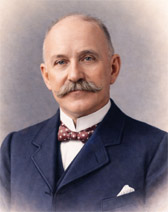
Andrew Preston
Architect of the Modern Global Banana Trade
Born on June 29, 1846
Died on September 26, 1924
Age at death: 78
Profession: Businessperson
Place of Birth: Beverly Farms, Massachusetts, United States
Place of Death: Swampscott, Massachusetts, United States
Andrew Woodbury Preston was an American entrepreneur whose vision and organizational strategy helped shape the modern international banana trade. As a founder of Boston Fruit Company and co-founder and long-serving president of United Fruit Company, he played a decisive role in transforming bananas from a regional Caribbean crop into a mass consumer product in the United States. His business methods, infrastructure investments, and strategic mergers laid the groundwork for what would later become Chiquita Brands International, one of the most recognizable fruit brands in the world.
Early Life and Background
Andrew Woodbury Preston was born on June 29, 1846, in Beverly Farms, Massachusetts, to Benjamin Preston and Sarah Poland. Raised in coastal New England during a period of expanding American commerce, he grew up in an environment shaped by maritime trade and mercantile ambition. At just eighteen years old, in 1864, he entered into a shoe manufacturing partnership with Augustus Williams in his hometown. The venture, however, was cut short due to illness, forcing him to abandon the industry before establishing long-term success.
This early setback proved formative. Rather than retreating from commerce, Andrew Woodbury Preston redirected his ambitions toward the fruit and produce trade. He joined the Boston-based firm Charles Kimball and Company, a wholesale fruit and vegetable enterprise. This position introduced him to the expanding market for imported tropical fruits—particularly bananas—then considered an exotic and relatively rare commodity in northern U.S. cities.
Entry into the Tropical Fruit Trade
Between 1885 and 1886, Andrew Woodbury Preston worked in New Orleans for various fruit merchants. At the time, New Orleans served as a crucial Gulf port for Caribbean imports. In 1886, he was hired by Jesse Freeman as a fruit agent and relocated to the city permanently. There, he focused increasingly on banana imports from Jamaica, recognizing the fruit’s commercial potential in northern markets.
After returning to Boston, he began organizing direct distribution channels for Jamaican bananas to local customers. He relied heavily on informal maritime networks, including captains such as Lorenzo Dow Baker, who transported bananas from the Caribbean. Baker’s shipments provided Preston with reliable supply access, and together these commercial relationships formed the backbone of an emerging transnational trade system.
Following the death of Jesse Freeman, Andrew Woodbury Preston assumed the role of general manager in Boston. Dissatisfied with the company’s restructuring and long-term vision, he gradually maneuvered to gain greater control. By 1899, after years of strategic positioning, he played a leading role in reshaping the industry through consolidation and merger.
Boston Fruit Company and the Creation of United Fruit
In 1884, Andrew Woodbury Preston and nine investors founded Boston Fruit Company, an enterprise widely regarded as the institutional starting point of the modern banana trade. The company established regularized import routes from Jamaica and the Caribbean to the United States, transforming what had been an irregular commodity flow into a structured, predictable commercial system.
In 1899, Preston orchestrated a landmark merger between Boston Fruit Company and the Central American operations of Minor Cooper Keith, a railroad developer with vast holdings in Costa Rica. The result was the formation of United Fruit Company, a vertically integrated multinational corporation combining agricultural production, railroad infrastructure, port facilities, and maritime shipping. Preston became president, while Keith assumed the role of vice president.
This consolidation marked a turning point in global agribusiness. Under Preston’s leadership, United Fruit expanded aggressively, controlling plantations, railways, and distribution channels across Central America and the Caribbean. Decades later, in 1984, the company would rebrand as Chiquita Brands International, inheriting both the commercial power and controversial legacy of its predecessor.
The “Great White Fleet” and Logistics Innovation
During Andrew Woodbury Preston’s presidency, United Fruit invested heavily in maritime infrastructure. The company established what became known as the “Great White Fleet,” a privately owned shipping arm that began with four small vessels and rapidly expanded. In 1903, the company introduced its first refrigerated ship, dramatically improving the reliability and shelf life of banana shipments.
By 1910, the fleet had grown to 115 ships, making it one of the largest private fleets in the United States. Beyond fruit transport, the ships carried passengers, mail, and general cargo between the Caribbean and American ports. The fleet also provided strategic leverage: during labor disputes or political instability, Preston could redirect or suspend trade flows, effectively influencing economic conditions in the regions where United Fruit operated.
Marketing Strategy and Brand Identity
Andrew Woodbury Preston understood that marketing would be essential to sustaining large-scale banana consumption. United Fruit promoted its products through branding initiatives, including the creation of the “Miss Chiquita” character—a cartoon-style female figure depicted wearing a tropical fruit hat. This early example of brand personification helped normalize bananas as an everyday American food product.
Although the Miss Chiquita character would gain wider prominence decades later, the foundation of that marketing approach originated during Preston’s era, when the company recognized the importance of consumer familiarity and consistent branding in mass retail markets.
Antitrust Strategy and Competitive Tactics
At a time when American industrial giants such as John D. Rockefeller and J.P. Morgan were facing federal antitrust scrutiny, Andrew Woodbury Preston adopted a calculated approach to avoid similar prosecution. He ensured that United Fruit did not exceed a 49 percent market share in any single region, maintaining plausible deniability against monopoly accusations.
In 1913, he sold the remaining 10 percent stake in Cuyamel Fruit Company to Sam Zemurray, strengthening a potential competitor and diffusing federal concerns about excessive concentration. This pragmatic maneuver allowed United Fruit to preserve profitability and operational dominance without triggering aggressive government intervention. The strategy proved effective; the company remained commercially stable until Preston’s death in 1924.
Influence in Latin America
Under Andrew Woodbury Preston’s leadership, United Fruit constructed railroads, ports, and plantations across Central America. By 1900, the company controlled more than 212,000 acres of land. These investments stimulated infrastructure development and provided employment in regions that had previously lacked large-scale industrial activity.
However, United Fruit’s expanding land ownership and labor policies drew criticism. Workers often labored 10–12 hours per day for low wages, frequently relying on company-owned stores and housing. The company’s economic dominance in several countries would later contribute to the term “banana republic,” reflecting the profound political and economic influence exerted by corporations over national governance.
Personal Life
Andrew Woodbury Preston married Frances Elizabeth Gutterson on August 5, 1869. The couple had one daughter, Bessie Woodbury Preston. Throughout his life, he resided primarily in Massachusetts, living in Brookline, Swampscott, and Boston.
Death
Andrew Woodbury Preston died on September 26, 1924, at the age of 78, at his summer residence in Swampscott, Massachusetts. His death marked the end of a formative chapter in American agribusiness and international trade.
Philanthropy and Estate
In accordance with his will, a $100,000 Andrew W. Preston Charity Fund was established to provide financial assistance and healthcare support to those in need. In addition, he left a substantial $6 million bequest dedicated to the advancement of chemistry. This donation aimed to promote scientific research and institutional development, reflecting his belief in industrial progress supported by scientific innovation.
Andrew Woodbury Preston remains a pivotal yet complex figure in business history—simultaneously recognized as a pioneer of global food distribution and scrutinized for the socioeconomic consequences of corporate expansion in Latin America. His legacy endures through the multinational structures and branding strategies that continue to define the global fruit industry.
Source: Biyografiler.com
Frequently asked questions about Andrew Preston
Who is Andrew Preston?, Andrew Preston biography, Andrew Preston life story, Andrew Preston age, Andrew Preston facts, Andrew Preston birthplace, Andrew Preston photos, Andrew Preston videos, Andrew Preston career
Related Biographies

Lamine Yamal
Professional footballer

Sam Altman
Entrepreneur, Investor, CEO

Kylian Mbappe
Professional footballer

Erling Haaland
Professional footballer

Alice Weidel
Politician, Economist

Giorgia Meloni
Politician, Journalist


Hongjoong
Singer, Rapper, Songwriter, Composer

Ludacris
Rapper, Actor

Kwon Eunbi
Singer

Sarah Wayne Callies
Actress, Screenwriter, Producer, Director

LaTavia Roberson
Singer, Actress, Entrepreneur

Austin Abrams
Actor

David Fincher
Film Director

Rob Jetten
Politician

Kevin Warsh
Economist

Sydney Sweeney
Actress
Lamine Yamal
Professional footballer