
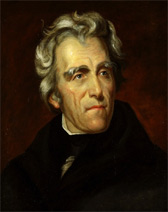
Andrew Jackson
Old Hickory | 7th President of the United States (1829–1837)
Born on March 15, 1767
Died on June 8, 1845
Age at death: 78
Profession: Politician, Military Officer, Lawyer, Former President
Place of Birth: Waxhaw, South Carolina, United States
Place of Death: Nashville, Tennessee, United States
Andrew Jackson was born on March 15, 1767, in the Waxhaw region of South Carolina. One of the most consequential and controversial figures in American presidential history, Jackson spent much of his life in Nashville, Tennessee. He is widely known as the architect of the Indian Removal Act, a policy that resulted in the forced displacement and deaths of tens of thousands of Native Americans, and as a Southern slaveholder.
During the American Revolutionary War (1775–1783), Jackson’s family perished amid the conflict, and he himself was captured and held in a British prison camp. While in captivity, a British officer ordered him to polish his boots; when Jackson refused, the officer slashed his face with a sword, leaving a permanent scar. These experiences instilled in him a lifelong hatred of the British.
After the war, Jackson moved to Tennessee and studied law under a practicing attorney. In 1788, he became a prosecutor in the western district of North Carolina, a region that would later become part of Tennessee. Following Tennessee’s admission to the Union, Jackson served in the state constitutional convention, then went on to serve in the United States House of Representatives and the United States Senate. After 1798, he became a judge on the Tennessee Supreme Court. Political disputes with President Thomas Jefferson later led him to temporarily withdraw from public life.
Between 1805 and 1812, Jackson managed his plantation, The Hermitage. In 1806, he was gravely wounded in a pistol duel when a bullet pierced two ribs and lodged near his heart. He continued to participate in duels; another gunshot wound caused him chronic stomach pain. Known to the American public as “Old Hickory,” Jackson cultivated an image of toughness and resilience.
Jackson fought in numerous campaigns against Native American tribes and rose to national fame during the War of 1812, particularly for his leadership against the British. His military success brought widespread popularity and propelled him toward national politics. Although he lost his first presidential contest against John Quincy Adams, he returned to win decisively in the next election.
On December 22, 1828, Jackson defeated incumbent President John Quincy Adams and assumed office on March 4, 1829. His administration introduced an unprecedented system of political patronage, replacing many federal officials with loyal supporters and creating new offices. Jackson viewed this “spoils system” as a democratic reform that opened political institutions to broader segments of the population.
Re-elected in 1832, Jackson served two terms from 1829 to 1837. He was the first U.S. president who neither came from the Eastern elite nor held a college degree, and he was not born into wealth. His inauguration celebration, marked by an unruly public party at the White House, symbolized a dramatic shift in American political culture.
As president, Jackson focused on the interests of farmers in the Southern and Western states. He aggressively pursued the removal of Native American tribes from the Southeast to lands west of the Mississippi River, a policy that culminated in mass forced relocations. His presidency coincided with escalating national debates over slavery and sectional division. Although himself a Southern slaveholder, Jackson opposed the doctrine of states’ rights when it challenged federal authority. He even sent federal forces to South Carolina to enforce a controversial tariff law.
Jackson is also known for dismantling the Second Bank of the United States, effectively eliminating the nation’s central banking system of the era. After completing two terms, he retired to The Hermitage but remained influential in national politics, advising subsequent presidents and playing a key role in the formation of the Democratic Party.
Unlike earlier presidents such as George Washington, John Adams, Thomas Jefferson, and James Madison, Jackson was the first president who did not emerge from the educated elite. His populist appeal reshaped American democracy.
Andrew Jackson married Rachel Donelson in 1791. She died of a heart attack on December 22, 1828, shortly before Jackson assumed the presidency.
Andrew Jackson died on June 8, 1845, at the age of 78, in Nashville, Tennessee, United States.
Legacy Note:
Andrew Jackson has historically appeared on the U.S. $20 bill. On April 20, 2016, U.S. Treasury Secretary Jack Lew announced plans to replace Jackson’s portrait with that of Harriet Tubman. Although the redesign was scheduled for release in 2020, it was not implemented after President Donald Trump declined to approve the change.
Source: Biyografiler.com
Frequently asked questions about Andrew Jackson
Who is Andrew Jackson?, Andrew Jackson biography, Andrew Jackson life story, Andrew Jackson age, Andrew Jackson facts, Andrew Jackson birthplace, Andrew Jackson photos, Andrew Jackson videos, Andrew Jackson career
Related Biographies


Lamine Yamal
Professional footballer

Sam Altman
Entrepreneur, Investor, CEO

Kylian Mbappe
Professional footballer

Erling Haaland
Professional footballer

Alice Weidel
Politician, Economist

Giorgia Meloni
Politician, Journalist


Hongjoong
Singer, Rapper, Songwriter, Composer

Ludacris
Rapper, Actor

Kwon Eunbi
Singer

Sarah Wayne Callies
Actress, Screenwriter, Producer, Director

LaTavia Roberson
Singer, Actress, Entrepreneur
Lamine Yamal
Professional footballer
Giorgia Meloni
Politician, Journalist

Austin Abrams
Actor

Eliezer Yudkowsky
Researcher, Writer

Kaia Gerber
Model, Actress
Kylian Mbappe
Professional footballer