
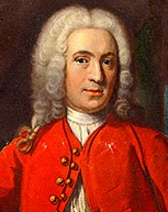
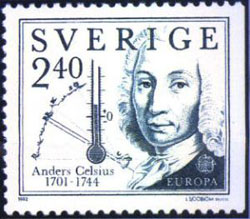
Anders Celsius
Swedish astronomer, physicist, and mathematician who developed the Celsius temperature scale in 1742. He also studied the aurora borealis, participated in an expedition to measure the shape of the Earth, and established the Uppsala Astronomical Observatory.
Born on November 27, 1701
Died on April 25, 1744
Age at death: 43
Profession: Astronomer, Physicist, Mathematician
Place of Birth: Uppsala, Sweden
Place of Death: Uppsala, Sweden
Anders Celsius was born on November 27, 1701, in Uppsala, Sweden. He was a Swedish astronomer, physicist, and mathematician best known for developing the Celsius temperature scale in 1742. He proposed dividing the temperature interval between the freezing and boiling points of water into 100 equal degrees. His original scale assigned 0 degrees to boiling water and 100 degrees to freezing water, the reverse of the system used today. Celsius became professor of astronomy at Uppsala University in 1730 and participated in a French scientific expedition to northern Sweden in 1736–1737 to investigate the shape of the Earth. He also studied the aurora borealis, terrestrial magnetism, and astronomical observations. In 1741, he established the Uppsala Astronomical Observatory, where he continued his research until his death from tuberculosis on April 25, 1744, aged 42.
Early Life and Education
Anders Celsius was born on November 27, 1701, in Uppsala, Sweden, into a family with a long association with astronomy and mathematics.
His father, Nils Celsius, was a professor of astronomy at Uppsala University. His mother, Gunilla Spole, was the daughter of astronomer Anders Spole. His paternal grandfather, Magnus Celsius, was also a mathematician and astronomer.
Celsius studied astronomy, mathematics, and experimental physics at Uppsala University. He became involved in astronomical observations and meteorological measurements while still a student.
In 1725, he became secretary of the Royal Society of Sciences in Uppsala, a position he held until his death in 1744.
In 1730, Celsius was appointed professor of astronomy at Uppsala University.
Astronomical Research and the Northern Lights
Anders Celsius began systematic meteorological observations in 1722, working with professor Erik Burman. These measurements included temperature, atmospheric pressure, and wind direction.
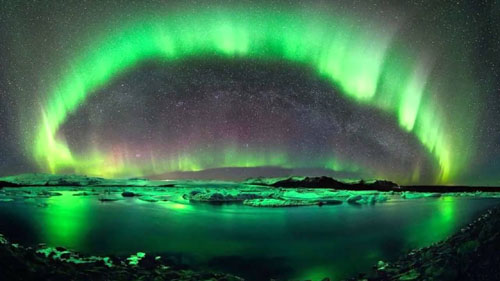
In 1733, he published a collection of 316 observations of the aurora borealis, or northern lights, recorded between 1716 and 1732 by himself and other observers.
The publication brought together descriptions of the northern lights and their appearance in northern European skies.
Later, Celsius worked with Swedish astronomer Olof Hiorter to investigate the relationship between the aurora borealis and changes in the Earth's magnetic field. In 1741, they observed variations in compass needles occurring at the same time as auroral activity.
Their observations provided early evidence connecting the northern lights with terrestrial magnetism.
European Scientific Travels
Between 1732 and 1735, Anders Celsius traveled across Europe to visit observatories and meet other scientists.
He visited scientific institutions in Germany, France, Italy, and England, studying astronomical instruments and observational techniques.
During these travels, he became acquainted with astronomers and mathematicians involved in determining the shape and dimensions of the Earth.
His contact with French scientists led to his participation in an expedition organized by the French Academy of Sciences.
Lapland Expedition and the Shape of the Earth
In 1736, Anders Celsius joined a French scientific expedition led by mathematician and astronomer Pierre Louis Maupertuis.
The expedition traveled to the Torne Valley in northern Sweden, near the Arctic Circle, to measure the length of a degree of latitude.
The project was designed to test the theory proposed by Isaac Newton that the Earth is slightly flattened at the poles because of its rotation.
Celsius and the other expedition members carried out astronomical observations and geographical measurements between 1736 and 1737.
The results, considered alongside measurements from other regions, supported Newton's explanation of the Earth's shape.
Celsius later published research discussing the observations used to determine the Earth's dimensions.
Establishment of the Uppsala Astronomical Observatory
After returning to Sweden, Anders Celsius proposed the establishment of a permanent astronomical observatory at Uppsala University.
He secured support for the project, and the Uppsala Astronomical Observatory was completed in 1741.
Celsius used the observatory to study the movements of celestial bodies, the eclipses of Jupiter's satellites, and the brightness of stars.
He also investigated methods for determining geographical longitude and latitude through astronomical observations.
His work included measurements of gravitational acceleration and magnetic declination. He collaborated with astronomers Olof Hiorter and Pehr Wilhelm Wargentin on several observational projects.
The observatory remained his principal place of scientific work during the final years of his life.
Development of the Celsius Temperature Scale
In 1742, Anders Celsius developed a temperature scale based on the freezing and boiling points of water at a specified atmospheric pressure.
He divided the interval between these two reference temperatures into 100 equal degrees.
Unlike the modern system, however, his original scale placed the boiling point of water at 0 degrees and the freezing point at 100 degrees.
Following his death, the scale was adopted in its reversed form, with 0 degrees representing the freezing point and 100 degrees representing the boiling point of water under standard atmospheric pressure.
Swedish botanist Carl Linnaeus used this reversed arrangement in his thermometers in the 1740s. French physicist Jean-Pierre Christin had independently introduced a similar arrangement in 1743.
The revised system became widely used in scientific measurements and everyday temperature readings.
Celsius and Fahrenheit Temperature Scales
Before Celsius introduced his scale, several temperature measurement systems were already in use.
German-born physicist Daniel Gabriel Fahrenheit, who worked primarily in the Netherlands, developed a mercury thermometer and introduced the Fahrenheit temperature scale during the early eighteenth century.
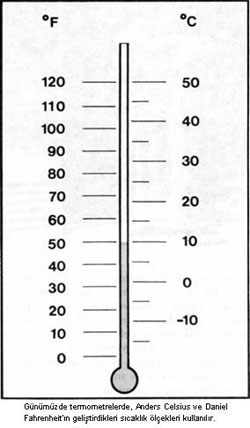
On the Fahrenheit scale, water freezes at 32°F and boils at 212°F under standard atmospheric pressure, creating an interval of 180 degrees.
The modern Celsius scale uses 0°C for the freezing point and 100°C for the boiling point of water under the same conditions.
The relationship between the two scales is expressed as follows:
°F = (°C × 9/5) + 32
In scientific work, the Kelvin temperature scale, named after physicist William Thomson, 1st Baron Kelvin, is also widely used.
The Kelvin and Celsius scales have equal-sized temperature intervals, but Kelvin uses absolute zero as its starting point.
Scientific Publications and Other Research
In addition to his temperature scale, Anders Celsius published studies on astronomy, geography, and physical measurements.
His 1730 publication, Nova Methodus distantiam solis a terra determinandi, proposed a method for determining the distance between the Earth and the Sun.
In 1738, he published De observationibus pro figura telluris determinanda, concerning observations used to establish the Earth's shape.
He also conducted research on the brightness of stars, Jupiter's satellites, and terrestrial magnetism.
Another subject of his research was the apparent decline of sea levels along Swedish coasts. In 1743, he measured the rate of change, now understood as land uplift following the retreat of ancient ice sheets.
Death
Anders Celsius died of tuberculosis on April 25, 1744, in Uppsala, Sweden, at the age of 42.
He never married and was buried at the Old Uppsala Church cemetery.
The temperature scale he developed continued to be refined after his death. In 1948, the General Conference on Weights and Measures officially adopted the name *degree Celsius* in place of *degree centigrade*.
A lunar crater named Celsius was also designated in his honor.
Books and Scientific Publications
1730 – Nova Methodus distantiam solis a terra determinandi (A New Method for Determining the Distance from the Earth to the Sun)
1733 – Observations of the Aurora Borealis – Collection of 316 observations recorded between 1716 and 1732
1738 – De observationibus pro figura telluris determinanda (On Observations for Determining the Shape of the Earth)
1742 – Observations on Two Persistent Degrees on a Thermometer – Scientific paper introducing his temperature scale
Source: Biyografiler.com
Frequently asked questions about Anders Celsius
Who is Anders Celsius?, Anders Celsius biography, Anders Celsius life story, Anders Celsius age, Anders Celsius facts, Anders Celsius birthplace, Anders Celsius photos, Anders Celsius videos, Anders Celsius career
Related Biographies

Lamine Yamal
Professional footballer

Erling Haaland
Professional footballer

Keanu Reeves
Actor

Kylian Mbappe
Professional footballer

Bad Bunny
Rapper, Songwriter

Leonardo DiCaprio
Actor

Andy Wachowski
Film Director, Screenwriter

Andy Rubin
Computer Scientist, Entrepreneur, Investor

Andy Serkis
Actor, Film Director

Andy Burnham
Former Prime Minister, Politician

Andy Garcia
Actor, Film Director

Andre Brugiroux
Explorer, Writer

Amy Ryan
Actress

Ali Larter
Actress, Former Model

Ursula von der Leyen
Politician, Physician
Andy Garcia
Actor, Film Director
Andy Serkis
Actor, Film Director

Alfred de Musset
Poet, Novelist