
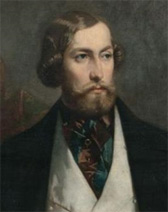
Alfred de Musset
French Romantic poet and playwright known for his writings on love, youth, emotional conflict, and human relationships. His principal works include Lorenzaccio, No Trifling with Love, The Moods of Marianne, and The Confession of a Child of the Century.
Born on December 11, 1810
Died on May 2, 1857
Age at death: 47
Profession: Poet, Novelist
Place of Birth: Paris, France
Place of Death: Paris, France
Alfred de Musset, whose full name was Alfred Louis Charles de Musset, was born on December 11, 1810, in Paris, France. He was a French poet, playwright, and novelist associated with the Romanticism movement. His poetry frequently explored love, youth, disappointment, and personal suffering, while his plays combined romantic drama with irony and psychological conflict. His best-known works include Tales of Spain and Italy (1830), The Moods of Marianne (1833), Lorenzaccio (1834), No Trifling with Love (1834), and The Confession of a Child of the Century (1836). His relationship with novelist George Sand between 1833 and 1835 provided material for several of his poems and fictional works. He was elected to the Académie française in 1852 and died in Paris on May 2, 1857, at the age of 46.
Early Life and Education
Alfred de Musset was born into an educated family in Paris. His father, Victor Donatien de Musset, was a writer and literary scholar who published under the name Musset-Pathay. His older brother, Paul de Musset (1804–1880), also became a writer and later published a biography of Alfred.
Musset received his education at the Lycée Henri-IV in Paris. He showed an early interest in poetry and literature, although he briefly considered studying law and medicine.
During his youth, he became acquainted with writers associated with French Romanticism, including Charles Nodier, Alfred de Vigny, and Victor Hugo. He attended literary gatherings connected with Hugo's circle, where he met other writers and poets.
Early Literary Career
In 1830, Alfred de Musset published his first poetry collection, Tales of Spain and Italy (*Contes d'Espagne et d'Italie*). The collection, influenced by the Romantic literary movement, included poems characterized by imaginative subjects, irony, and emotional expression.
Following its publication, Musset became involved in Parisian literary and social circles. He adopted the fashionable appearance associated with the English dandy Beau Brummell and participated in the social life of the French capital.
His poems and prose appeared in publications including Le Temps, La Revue de Paris, and Revue des Deux Mondes.
In 1830, his comedy A Venetian Night (*La Nuit vénitienne*) was performed in Paris but received an unfavorable response. Disappointed by the production, Musset began writing plays intended primarily for reading rather than immediate theatrical performance.
Romantic Theater and Major Plays
During the 1830s, Alfred de Musset wrote comedies, historical dramas, and tragicomedies that explored love, jealousy, ambition, and the contradictions of human behavior.
His The Moods of Marianne (*Les Caprices de Marianne*, 1833) examines romantic relationships through misunderstandings and conflicting emotions.
In Lorenzaccio (1834), a historical drama set in Renaissance Florence, he portrays Lorenzo de' Medici and the political corruption surrounding the rule of Alessandro de' Medici. The play combines political conflict with questions of morality and personal responsibility.
Other works from this period included Fantasio (1834), No Trifling with Love (*On ne badine pas avec l'amour*, 1834), The Chandelier (*Le Chandelier*, 1835), and Never Swear to Anything (*Il ne faut jurer de rien*, 1836).
His plays moved between tragic situations and lighter comedy. He continued using Romantic subjects while also criticizing the exaggerated conventions of contemporary Romantic literature.
His approach to theater became known through the collection A Spectacle in an Armchair (*Un spectacle dans un fauteuil*), which presented dramatic works intended to be read rather than staged.
Relationship with George Sand
In July 1833, Alfred de Musset began a romantic relationship with French novelist George Sand, whose real name was Amantine Lucile Aurore Dupin.
They traveled together to Italy in December 1833, spending time in Venice. Their relationship became increasingly difficult, and they separated in 1834.
Although they later resumed contact, their relationship ended definitively in 1835.
The experience influenced Musset's poetry and fiction, particularly his cycle of poems known as The Nights (*Les Nuits*) and his novel The Confession of a Child of the Century.
His correspondence with Sand also became part of the historical record of their relationship.
The Confession of a Child of the Century
In 1836, Alfred de Musset published The Confession of a Child of the Century (*La Confession d'un enfant du siècle*), a novel partly inspired by his relationship with George Sand.
The novel follows Octave, a young man struggling with love, disillusionment, jealousy, and the moral uncertainty of his generation.
Although it contains autobiographical elements, it is a fictional work rather than a fully reliable account of Musset's life.
The book also examines the psychological and social atmosphere of France following the Napoleonic era, particularly the sense of disappointment experienced by younger generations.
Poetry and Literary Style
Alfred de Musset wrote poems ranging from light satire to lyrical expressions of personal suffering.
Among his best-known poems are The Night of May (*La Nuit de mai*, 1835), The Night of December (*La Nuit de décembre*, 1835), The Night of August (*La Nuit d'août*, 1836), and The Night of October (*La Nuit d'octobre*, 1837).
These poems address love, separation, memory, and the relationship between emotional suffering and artistic creation.
In Letter to Lamartine (*Lettre à Lamartine*, 1836), he addressed fellow Romantic poet Alphonse de Lamartine.
Musset also published Letters of Dupuis and Cotonet (*Lettres de Dupuis et Cotonet*, 1836–1837), a satirical examination of literary fashions and the language used by contemporary writers.
Although he remained associated with Romanticism, he frequently used irony to question its conventions.
Later Career and Recognition
During the 1840s, Alfred de Musset continued writing poetry, prose, and plays, although his literary output gradually decreased.
His comedy A Whim (*Un Caprice*, 1837) achieved theatrical success when it entered the repertoire of the Comédie-Française in 1847. This renewed interest in his dramatic writing, and several earlier works were subsequently staged.
His later plays included A Door Must Be Open or Closed (*Il faut qu'une porte soit ouverte ou fermée*, 1845), Louison (1849), and Bettine (1851).
In 1845, Musset was appointed a Knight of the Legion of Honour. On February 12, 1852, he was elected to the Académie française, succeeding Emmanuel Dupaty.
Death
Alfred de Musset experienced declining health during his final years, with cardiovascular problems and other complications affecting his daily life.
He died of heart failure on May 2, 1857, in Paris, aged 46.
He was buried at Père Lachaise Cemetery in Paris.
Novels and Prose
1836 – The Confession of a Child of the Century (*La Confession d'un enfant du siècle*) – Turkish translation by Yaşar Nabi Nayır
1837 – Frédéric and Bernerette (*Frédéric et Bernerette*) – Turkish translation by Hüseyin Rahmi Gürpınar
1841 – Emmeline
1842 – The Journey Where You Please (*Le Voyage où il vous plaira*)
1843 – The Story of a White Blackbird (*Histoire d'un merle blanc*)
Poetry
1830 – Tales of Spain and Italy (*Contes d'Espagne et d'Italie*)
1833 – Rolla
1835 – The Night of May (*La Nuit de mai*)
1835 – The Night of December (*La Nuit de décembre*)
1836 – The Night of August (*La Nuit d'août*)
1836 – Letter to Lamartine (*Lettre à Lamartine*)
1837 – The Night of October (*La Nuit d'octobre*)
Plays
1830 – The Devil's Receipt (*La Quittance du diable*)
1830 – A Venetian Night (*La Nuit vénitienne*)
1832 – The Cup and the Lips (*La Coupe et les lèvres*)
1833 – What Young Girls Dream Of (*À quoi rêvent les jeunes filles*)
1833 – André del Sarto – Turkish translation by Nurullah Ataç
1833 – The Moods of Marianne (*Les Caprices de Marianne*) – Turkish translations by Sabahattin Eyüboğlu and Bedrettin Tuncel
1834 – Lorenzaccio – Turkish translation by Berna Günen
1834 – Fantasio – Turkish translation by İzzet Melih Devrim
1834 – No Trifling with Love (*On ne badine pas avec l'amour*)
1835 – Barberine's Distaff (*La Quenouille de Barberine*) – Turkish translation by Orhan Veli Kanık
1835 – The Chandelier (*Le Chandelier*) – Turkish translation by Sabahattin Eyüboğlu
1836 – Never Swear to Anything (*Il ne faut jurer de rien*) – Turkish translation by İsmail Hami Danişmend
1837 – Do Without Saying (*Faire sans dire*) – Turkish translation by Sabahattin Eyüboğlu
1837 – A Whim (*Un Caprice*) – Turkish translation by İlhan Ertuğ
1845 – A Door Must Be Open or Closed (*Il faut qu'une porte soit ouverte ou fermée*) – Turkish translations by Oktay Rıfat and Orhan Veli Kanık
1849 – The Green Coat (*L'Habit vert*) – One-act comedy written with Émile Augier; Turkish translation by Cemil Miroğlu
1849 – Louison – Turkish translation by Yaşar Nabi Nayır
1849 – One Cannot Think of Everything (*On ne saurait penser à tout*) – Turkish translation by Yaşar Nabi Nayır
1850 – Carmosine – Turkish translation by Yaşar Nabi Nayır
1851 – Bettine – Turkish translation by Yaşar Nabi Nayır
1855 – The Donkey and the Stream (*L'Âne et le ruisseau*)
Source: Biyografiler.com
Frequently asked questions about Alfred de Musset
Who is Alfred de Musset?, Alfred de Musset biography, Alfred de Musset life story, Alfred de Musset age, Alfred de Musset facts, Alfred de Musset birthplace, Alfred de Musset photos, Alfred de Musset videos, Alfred de Musset career

Lamine Yamal
Professional footballer

Erling Haaland
Professional footballer

Keanu Reeves
Actor

Kylian Mbappe
Professional footballer

Bad Bunny
Rapper, Songwriter

Leonardo DiCaprio
Actor

Andy Wachowski
Film Director, Screenwriter

Andy Rubin
Computer Scientist, Entrepreneur, Investor

Andy Serkis
Actor, Film Director

Andy Burnham
Former Prime Minister, Politician

Andy Garcia
Actor, Film Director

Andre Brugiroux
Explorer, Writer

Amy Ryan
Actress

Ali Larter
Actress, Former Model

Ursula von der Leyen
Politician, Physician

Alfred de Musset
Poet, Novelist

Alfred Jarry
Writer, Novelist, Poet
Andy Garcia
Actor, Film Director