
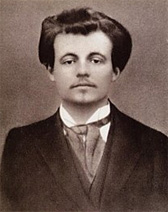
Alfred Jarry
French writer and playwright associated with avant-garde theater, best known for Ubu Roi (1896). He developed the concept of 'pataphysics, which he described as the science of imaginary solutions, and his work influenced later surrealist and absurdist literature.
Born on September 8, 1873
Died on October 1, 1907
Age at death: 34
Profession: Writer, Novelist, Poet
Place of Birth: Laval, Mayenne, France
Place of Death: Paris, France
Alfred Jarry (September 8, 1873 – November 1, 1907) was a French playwright, novelist, poet, and essayist associated with the development of avant-garde theater. He is best known for Ubu Roi (1896), a grotesque satire of political power, social conventions, and bourgeois values. His writing rejected many conventions of naturalist and realist theater, combining irrational situations, exaggerated characters, black humor, and absurd dialogue. Jarry also developed the philosophical and literary concept of Pataphysics, which he described as the science of imaginary solutions. His experiments in language and theatrical form preceded the emergence of Dadaism, Surrealism, and the Theatre of the Absurd, later associated with writers such as Samuel Beckett and Eugène Ionesco. His other works include Days and Nights (1897), Messalina (1901), The Supermale (1902), and Exploits and Opinions of Dr. Faustroll, Pataphysician, published posthumously in 1911.
Early Life and Education
Alfred Jarry was born on September 8, 1873, in Laval, in the Mayenne department of France. His father, Anselme Jarry, worked as a commercial representative in the textile industry, while his mother, Caroline Quernest, came from a family associated with the legal profession. He had an older sister, Charlotte Jarry.
Following financial difficulties in his father's business, his mother moved with the children to Saint-Brieuc in 1879. Jarry attended school there and began writing poetry, short prose, and theatrical pieces during childhood.
His early compositions included Brigands de la Calabre (1885), Le Parapluie-Seringue du Docteur Thanaton, and Le Procès.
In 1888, the family moved to Rennes, where Jarry enrolled at the Lycée de Rennes. During his school years, he became interested in satire, caricature, and unconventional theatrical performances.
The Origins of Ubu
While studying in Rennes, Alfred Jarry became involved in theatrical sketches created by students who mocked their physics teacher, Félix Hébert. The teacher inspired a grotesque character known among the students as Père Hébert, later transformed into Père Ubu.
Jarry developed this material into an early play titled Les Polonais, which was performed as a puppet and shadow-theater production around 1888–1890.
The character was portrayed as greedy, cowardly, vulgar, and obsessed with authority. Jarry continued rewriting the story during the following years, eventually developing the play that became Ubu Roi.
The original character and material emerged from a collective schoolboy satire, but Jarry transformed them into a published dramatic work with a broader political and social meaning.
Move to Paris and First Publications
In 1891, Alfred Jarry moved to Paris and enrolled at the Lycée Henri-IV, where he prepared for entrance examinations to the École Normale Supérieure. Although he did not gain admission, he became involved in the city's literary circles.
He developed friendships with writers and editors associated with Mercure de France, including Alfred Vallette, Rachilde, and Remy de Gourmont.
His poems and prose appeared in literary magazines, and in 1894 he published his first book, Minutes of Memorial Sand (*Les Minutes de sable mémorial*).
The following year, he published César Antichrist, an experimental dramatic work containing material associated with the developing Ubu character.
Between 1894 and 1898, Jarry also contributed to several short-lived literary publications and collaborated with writers associated with French Symbolism.
Ubu Roi and the 1896 Premiere
On December 10, 1896, Alfred Jarry's Ubu Roi premiered at the Théâtre de l'Œuvre in Paris under the direction of Aurélien Lugné-Poe.
The play follows Père Ubu and his wife, Mère Ubu, as they plot to seize the throne of Poland. After gaining power, Ubu rules through violence, greed, and arbitrary decisions.
The dialogue includes invented expressions, deliberate vulgarity, and exaggerated language. Its opening word, *Merdre*, a distorted version of a French obscenity, provoked a reaction from the audience.
The premiere generated disputes among spectators and critics. Some objected to the language and theatrical presentation, while others supported the play's departure from established dramatic conventions.
The production received only one public performance in its original staging. Nevertheless, the published text continued circulating, and the Ubu character became central to Jarry's subsequent writing.
Ubu Roi used grotesque comedy to portray political ambition, abuse of authority, and the behavior of individuals who obtain power without restraint.
Novels and Literary Works
Following the premiere of Ubu Roi, Alfred Jarry published several novels combining experimental narrative techniques with satire and unconventional subjects.
His novel Days and Nights (*Les Jours et les Nuits*, 1897) follows a military deserter and incorporates psychological and dreamlike episodes.
Love on Visits (*L'Amour en visites*, 1898) combines short literary pieces with experimental narrative forms, while Absolute Love (*L'Amour absolu*, 1899) explores religious imagery and unconventional relationships.
In Messalina (*Messaline*, 1901), Jarry turned to ancient Rome and the figure of Messalina, wife of Emperor Claudius.
His 1902 novel The Supermale (*Le Surmâle*) combines science fiction, sexuality, physical endurance, and satire. Its story concerns a man who attempts to exceed ordinary human limitations through extraordinary feats.
These works extended Jarry's interest in irrational situations and exaggerated human behavior beyond the theater.
Pataphysics and Doctor Faustroll
In 1898, Alfred Jarry completed Exploits and Opinions of Dr. Faustroll, Pataphysician (*Gestes et opinions du docteur Faustroll, pataphysicien*), although the work was not published until 1911, four years after his death.
The novel introduces Doctor Faustroll, a fictional scientist whose investigations challenge conventional explanations of reality.
Jarry used the work to define Pataphysics as the science of imaginary solutions. Rather than examining universal scientific laws, Pataphysics concerns exceptional cases, imagined relationships, and alternative interpretations of phenomena.
The concept combines philosophical parody, literary experimentation, and satire of scientific authority.
In 1948, writers and artists in France established the Collège de 'Pataphysique, an organization devoted to the study and continuation of Jarry's ideas.
His writings on Pataphysics subsequently attracted the interest of experimental writers and artists, including Raymond Queneau and Boris Vian.
The Ubu Cycle
Alfred Jarry continued developing Père Ubu in additional plays, shorter theatrical texts, and illustrated publications.
Ubu Enchained (*Ubu enchaîné*) was completed in 1899 and published in 1900. It returns to the Ubu character and examines questions of authority, freedom, and submission through absurd situations.
Ubu Cuckolded (*Ubu cocu*) was written during the 1890s but first published in full in 1944, long after Jarry's death.
He also published The Illustrated Almanac of Père Ubu in editions associated with 1899 and 1901, including illustrations by Pierre Bonnard.
In 1906, Ubu on the Hill (*Ubu sur la butte*) appeared as a shorter adaptation of Ubu Roi.
The Ubu works remained associated with Jarry's theatrical experiments, including puppet theater, exaggerated characterizations, and the use of deliberately artificial dialogue.
Personal Life and Financial Difficulties
Alfred Jarry developed an unconventional public persona that increasingly resembled the fictional character Père Ubu.
He was known for his interest in bicycles, firearms, and absinthe, an alcoholic spirit widely consumed in France during the late nineteenth century.
Despite financial difficulties, he purchased a bicycle and a small boat. He frequently wore cycling clothes and adopted exaggerated speech and behavior.
He maintained friendships with artists and writers, including painter Henri Rousseau, and spent periods living in modest accommodation near Paris.
His literary interests included the writings of François Rabelais, whose grotesque humor and inventive language provided an earlier example of literary experimentation.
By the early twentieth century, Jarry had spent most of his inheritance and was experiencing financial insecurity. His consumption of alcohol and ether also contributed to deteriorating health.
Death
Alfred Jarry experienced serious health problems during his final years, including the effects of tuberculosis and prolonged alcohol use.
He died on November 1, 1907, at the Hôpital de la Charité in Paris, aged 34.
Several of his manuscripts remained unpublished at the time of his death, including Doctor Faustroll, which appeared in 1911.
Literary Works
1894 – Minutes of Memorial Sand (*Les Minutes de sable mémorial*) – Poetry and prose
1897 – Days and Nights (*Les Jours et les Nuits*) – Novel
1898 – Love on Visits (*L'Amour en visites*) – Prose
1899 – Absolute Love (*L'Amour absolu*) – Novel
1901 – Messalina (*Messaline*) – Historical novel
1902 – The Supermale (*Le Surmâle*) – Novel
1911 – Exploits and Opinions of Dr. Faustroll, Pataphysician – Novel, published posthumously
Plays and the Ubu Cycle
1888–1890 – Les Polonais – Early school play and puppet-theater work
1895 – César Antichrist – Experimental dramatic work
1896 – Ubu Roi – First performed December 10, 1896
1897 – Ubu Cuckolded (*Ubu cocu*) – Written during the 1890s, published in 1944
1900 – Ubu Enchained (*Ubu enchaîné*) – Published in 1900
1899 – The Illustrated Almanac of Père Ubu – Illustrated publication
1901 – The Illustrated Almanac of Père Ubu – Later edition
1906 – Ubu on the Hill (*Ubu sur la butte*) – Shortened stage adaptation
Source: Biyografiler.com
Frequently asked questions about Alfred Jarry
Who is Alfred Jarry?, Alfred Jarry biography, Alfred Jarry life story, Alfred Jarry age, Alfred Jarry facts, Alfred Jarry birthplace, Alfred Jarry photos, Alfred Jarry videos, Alfred Jarry career

Lamine Yamal
Professional footballer

Erling Haaland
Professional footballer

Keanu Reeves
Actor

Kylian Mbappe
Professional footballer

Bad Bunny
Rapper, Songwriter

Leonardo DiCaprio
Actor

Andy Wachowski
Film Director, Screenwriter

Andy Rubin
Computer Scientist, Entrepreneur, Investor

Andy Serkis
Actor, Film Director

Andy Burnham
Former Prime Minister, Politician

Andy Garcia
Actor, Film Director

Andre Brugiroux
Explorer, Writer

Amy Ryan
Actress

Ali Larter
Actress, Former Model

Ursula von der Leyen
Politician, Physician

Alfred Jarry
Writer, Novelist, Poet
Andy Garcia
Actor, Film Director
Andy Serkis
Actor, Film Director