
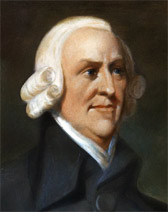
Adam Smith
Scottish economist and philosopher, author of The Wealth of Nations and The Theory of Moral Sentiments, and one of the founders of classical economics.
Born on June 5, 1723
Died on July 17, 1790
Age at death: 67
Profession: Economist, Author
Place of Birth: Kirkcaldy, Fife, Scotland
Place of Death: Edinburgh, Scotland
Adam Smith (1723 – July 17, 1790) was a Scottish economist, moral philosopher, and author whose writings examined economic production, trade, political institutions, and human behavior. He is regarded as one of the founders of classical economics and is frequently described as the "Father of Modern Economics." His major works, The Theory of Moral Sentiments (1759) and An Inquiry into the Nature and Causes of the Wealth of Nations (1776), addressed the foundations of moral judgment and the organization of economic life. His analysis of the division of labor, productivity, free trade, market competition, capital accumulation, and the relationship between individual interests and collective outcomes became central to subsequent economic debates.
Early Life and Family Background
Adam Smith was born in 1723 in Kirkcaldy, a town in Fife, Scotland. His exact date of birth is unknown, but parish records establish that he was baptized on June 5, 1723.
His father, Adam Smith Sr., was a lawyer and public official who died before his son was born. His mother, Margaret Douglas, raised him and remained an important presence throughout his life. Smith maintained a close relationship with her, and they later lived together during his years in Edinburgh.
An anecdote recorded in early biographical accounts states that Smith was abducted by a group of traveling people when he was approximately four years old and was subsequently recovered by relatives. The circumstances of the alleged incident are not firmly established by surviving contemporary documentation.
Education at Glasgow and Oxford
Adam Smith entered the University of Glasgow in 1737, when he was approximately fourteen years old. There, he studied philosophy and other subjects under Francis Hutcheson, a professor of moral philosophy associated with the Scottish Enlightenment.
Hutcheson's lectures addressed ethics, natural liberty, human motivation, and political society. His ideas concerning moral judgment and the relationship between individual conduct and social welfare formed part of the intellectual background of Smith's later writings.
In 1740, Smith received a Snell Exhibition scholarship that enabled him to continue his education at Balliol College, University of Oxford. He remained at Oxford until 1746.
Smith later criticized aspects of the university's teaching practices, particularly the limited incentives for professors to provide instruction. During his time there, he pursued extensive independent reading in philosophy, literature, and other subjects.
He returned to Scotland in 1746 without completing a degree at Oxford. His subsequent professional development took place primarily within the intellectual and academic circles of Edinburgh and Glasgow.
Academic Career at Edinburgh and Glasgow
Beginning in 1748, Adam Smith delivered public lectures in Edinburgh on rhetoric, literature, jurisprudence, and related subjects. The lectures attracted attention within the city's intellectual community and helped establish his reputation as a teacher.
In 1751, he was appointed Professor of Logic at the University of Glasgow. The following year, he became Professor of Moral Philosophy, a position he held until 1764.
His moral philosophy lectures covered natural theology, ethics, jurisprudence, and political economy. This broad curriculum allowed Smith to examine economic institutions as part of a wider study of human behavior, law, and society.
During his years at Glasgow, Smith developed relationships with philosophers, scientists, and other scholars associated with the Scottish Enlightenment. Among his closest intellectual companions was David Hume, whose writings on human nature, knowledge, commerce, and political society were widely discussed.
Smith and Hume maintained a friendship that continued until Hume's death in 1776. Their correspondence and published works provide evidence of their shared interests and occasional differences concerning philosophy, religion, and social institutions.
The Theory of Moral Sentiments (1759)
In 1759, Adam Smith published his first major book, The Theory of Moral Sentiments. The work examined how people form moral judgments, evaluate their own conduct, and respond to the behavior of others.
A central concept in the book is sympathy, understood as the human capacity to imagine and respond to the feelings and circumstances of another person. Smith argued that moral evaluation involves considering how an informed and impartial observer might assess a particular action.
He developed the concept of the impartial spectator to explain how people assess their own behavior by imagining the judgment of someone who is not directly involved in their personal interests or emotions.
The book also addressed conscience, justice, virtue, self-command, social approval, and the motivations behind human actions. Smith examined the ways in which individuals seek recognition from others while also developing standards for judging themselves.
His account of human motivation was not limited to self-interest. Although he recognized the importance of personal advantage, he also emphasized sympathy, moral responsibility, and the social conditions under which people develop judgments about right and wrong.
These themes remained relevant to his later economic writings. His moral philosophy and political economy both examined how individuals interact within systems of rules, expectations, institutions, and social relationships.
European Travels and the French Physiocrats
In 1764, Adam Smith resigned from his professorship at the University of Glasgow to become tutor to the young Henry Scott, who later became the third Duke of Buccleuch.
The appointment involved accompanying Scott on an extended journey through continental Europe. Smith traveled in France and Switzerland, visiting intellectual centers and meeting philosophers, economists, and political figures.
During his travels, he encountered Voltaire and the French economic thinkers François Quesnay and Anne Robert Jacques Turgot. His discussions with members of the Physiocratic school introduced him to their systematic approach to production, national income, taxation, and economic policy.
The Physiocrats emphasized the economic importance of agriculture and advocated reducing certain government restrictions on economic activity. Smith shared some of their criticisms of trade controls but developed a broader theory in which productive labor was not confined to agriculture.
He returned to Scotland in 1766 and settled for an extended period in Kirkcaldy. Supported by the financial arrangements associated with his tutoring appointment, he devoted several years to preparing the work that became The Wealth of Nations.
The Wealth of Nations (1776)
On March 9, 1776, Adam Smith published An Inquiry into the Nature and Causes of the Wealth of Nations, commonly known as The Wealth of Nations. The book presented a systematic examination of economic production, labor, prices, capital, trade, taxation, and the responsibilities of government.
The work was organized into five books addressing the productive powers of labor, the nature and accumulation of capital, historical patterns of economic development, systems of political economy, and public revenue and expenditure.
Smith challenged the mercantilist assumption that national wealth should primarily be measured by accumulated gold and silver. He argued that a country's annual production of goods and services, supported by labor, specialization, capital investment, and exchange, provided a more useful basis for understanding economic prosperity.
His analysis considered the relationship between the division of labor and market size, the role of prices in coordinating exchange, and the allocation of capital among different productive activities.
He also examined the effects of monopolies, trade restrictions, taxation, and government privileges. The book criticized economic policies that granted special advantages to particular commercial interests at the expense of consumers and other producers.
Division of Labor and the Pin Factory
Adam Smith opened The Wealth of Nations with a discussion of the division of labor and its effect on productivity. His illustration involved a pin factory in which the manufacturing process was divided into a series of specialized tasks.
Rather than having each worker complete every stage of production independently, individual workers performed particular operations, such as drawing out wire, straightening it, cutting it, or preparing the pin heads.
Smith explained that specialization could substantially increase output through improved worker dexterity, reduced time spent switching between tasks, and the development of machinery that simplified repetitive operations.
He also argued that the extent of specialization was limited by the size of the market. A larger market could support more specialized occupations because producers would have sufficient demand for their goods and services.
Although Smith recognized the productivity benefits of specialized work, he also discussed its possible disadvantages. Repetitive labor, he argued, could restrict intellectual development when workers spent much of their lives performing only a narrow range of tasks.
He therefore considered public education an appropriate means of addressing some of the social consequences of an increasingly specialized economy.
Free Trade, Competition and Criticism of Mercantilism
Adam Smith criticized many mercantilist policies that restricted international trade or gave commercial privileges to particular merchants and manufacturers.
He argued that voluntary exchange and competition could encourage producers to allocate resources toward activities for which there was demand. International trade also allowed countries to obtain goods more efficiently than when domestic production was protected through unnecessary restrictions.
His arguments supported the removal of many tariffs, monopolies, and commercial preferences. However, he did not claim that every trade restriction was inappropriate under all circumstances. He recognized exceptions involving national defense and certain forms of taxation.
Smith also warned that merchants and manufacturers could use their political influence to promote regulations designed to protect their own profits. He examined how economic privileges granted to organized commercial interests could harm consumers and reduce competition.
His approach to economic policy therefore involved both the advantages of commercial freedom and the need to examine the incentives of those seeking government intervention.
The Invisible Hand
One of the expressions most closely associated with Adam Smith is the "invisible hand." In The Wealth of Nations, he used the metaphor while discussing how a merchant's preference for domestic investment could produce broader economic consequences that the merchant had not deliberately intended.
The phrase also appeared in his earlier The Theory of Moral Sentiments in a different context involving the distribution of resources.
Smith's argument was that the pursuit of individual interests could, under certain conditions, contribute to outcomes beyond the intentions of the individuals involved. The metaphor did not constitute a universal claim that all private economic actions automatically benefit society.
His writings also identified circumstances in which personal interests conflicted with public welfare, particularly when businesses sought monopoly power, restricted competition, or influenced government policies to secure special advantages.
The invisible hand became a widely discussed concept in later economic thought, although interpretations of its meaning have often extended beyond Smith's specific uses of the expression.
The Role of Government in Economic Life
Adam Smith did not advocate the complete absence of government from economic affairs. In The Wealth of Nations, he identified several responsibilities that he considered necessary for a functioning society.
These included national defense, the administration of justice, and the provision of public works and institutions that could benefit society but might not generate sufficient private profit to attract individual investors.
He discussed infrastructure such as roads, bridges, canals, and harbors, along with institutions supporting education and other public purposes.
Smith also examined taxation, proposing principles concerning fairness, certainty, convenience, and the cost of collection. His analysis of public finance addressed the relationship between government revenue, public expenditure, and the economic burdens placed on citizens.
In discussing education, he recognized that an extensive division of labor could limit workers' opportunities for intellectual development. He supported measures that would make elementary instruction more widely accessible.
His economic arguments therefore included an examination of the institutional conditions required for commercial activity, legal protection, and public welfare.
Friendship with David Hume
The friendship between Adam Smith and David Hume was an established intellectual relationship within the Scottish Enlightenment. Both examined human behavior, social institutions, and the development of commercial society.
Although they differed on particular philosophical and religious questions, the two maintained correspondence and mutual respect throughout their professional lives.
Following Hume's death in 1776, Smith wrote an account of his friend's final illness and personal conduct. The text appeared in connection with the publication of Hume's autobiographical writing My Own Life.
Smith described Hume's composure during his final illness and expressed admiration for his personal character. The publication provoked criticism from some religious readers because Hume's skeptical philosophical positions had already generated controversy.
Commissioner of Customs and Final Years
In 1778, Adam Smith was appointed Commissioner of Customs in Scotland and moved to Edinburgh. He lived there with his mother, Margaret Douglas, and continued to work on revisions of his published books.
His customs appointment involved responsibilities connected with the administration and collection of government revenue. Although his economic writings criticized many restrictions on trade, he served within the existing public revenue system.
Smith never married. His household included his mother until her death in 1784, and he maintained close relationships with friends and members of Edinburgh's intellectual community.
During the later years of his life, he prepared revised editions of The Theory of Moral Sentiments and The Wealth of Nations. The sixth edition of his moral philosophy work appeared in 1790, the year of his death.
He also instructed that certain unpublished manuscripts be destroyed rather than issued after his death. His surviving writings nevertheless included essays and lecture materials that later contributed to scholarly understanding of his philosophical and economic ideas.
Death
Adam Smith died on July 17, 1790, in Edinburgh, Scotland, at approximately 67 years of age. He was buried in the Canongate Kirkyard, part of the historic Canongate district of Edinburgh.
His two principal books remained in publication, while manuscripts and writings preserved by colleagues were subsequently edited and published. In 1795, a collection of his essays appeared posthumously under the title Essays on Philosophical Subjects.
Source: Biyografiler.com
Frequently asked questions about Adam Smith
Who is Adam Smith?, Adam Smith biography, Adam Smith life story, Adam Smith age, Adam Smith facts, Adam Smith birthplace, Adam Smith photos, Adam Smith videos, Adam Smith career

Lamine Yamal
Professional footballer

Erling Haaland
Professional footballer

Keanu Reeves
Actor

Kylian Mbappe
Professional footballer

Austin Abrams
Actor

Bad Bunny
Rapper, Songwriter

Adewale Akinnuoye-Agbaje
Actor, Former Model

Adam Smith
Economist, Author

Adam Driver
Actor

Adam Baldwin
Actor

Acun Ilıcalı
Producer, TV Personality, Media executive, Businessperson

Achmed Sukarno
Former President, Politician

John Healey
Politician

Ursula von der Leyen
Politician, Physician

Leonardo DiCaprio
Actor

Oprah Winfrey
Television Host, Media executive, Actress
Lamine Yamal
Professional footballer

Abby Brammell
Actress