
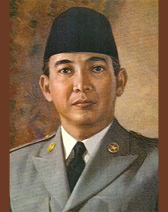
Achmed Sukarno
First President of Indonesia (1945–1967), co-proclaimer of Indonesian independence, and a founding figure of the Non-Aligned Movement.
Born on June 6, 1901
Died on June 21, 1971
Age at death: 70
Profession: Former President, Politician
Place of Birth: Surabaya, East Java, Dutch East Indies (now Indonesia)
Place of Death: Jakarta, Indonesia
Sukarno (June 6, 1901 – June 21, 1970) was an Indonesian politician and independence movement leader who served as the first President of Indonesia from 1945 to 1967. Together with Mohammad Hatta, he proclaimed Indonesia's independence from Dutch colonial rule on August 17, 1945. Known popularly as Bung Karno, he led the country through its struggle for international recognition, the transition to parliamentary government, and the establishment of his Guided Democracy system. He also participated in the 1955 Bandung Conference, which contributed to the development of the Non-Aligned Movement. His presidency ended in 1967 following a prolonged political crisis and the transfer of power to General Suharto.
Early Life and Family Background
Sukarno was born on June 6, 1901, in Surabaya, East Java, then part of the Dutch East Indies. His birth name was Kusno Sosrodihardjo, but his parents later changed it to Sukarno following an illness during his childhood.
His father, Raden Soekemi Sosrodihardjo, was a Javanese Muslim schoolteacher, while his mother, Ida Ayu Nyoman Rai, was a Balinese Hindu. His family background brought together Javanese and Balinese cultural traditions.
He became widely known by the affectionate name Bung Karno. The Indonesian word "Bung" is a familiar form of address meaning brother or comrade, and it was frequently used by nationalist activists during the independence movement.
Education and Early Political Influences
Sukarno received his elementary education in East Java and subsequently attended a European elementary school in Mojokerto. He continued his studies at the Hogere Burgerschool (HBS), a Dutch-language secondary school in Surabaya.
While studying in Surabaya, he lived in the home of Oemar Said Tjokroaminoto, a political leader associated with Sarekat Islam, one of the major Indonesian organizations opposing colonial political and economic inequality. Tjokroaminoto was also a friend of Sukarno's father.
Through this household, Sukarno encountered political activists and discussions concerning nationalism, Islam, colonialism, and social reform. The political environment introduced him to competing ideas about the future of the Dutch East Indies.
In 1921, Sukarno enrolled at the Technische Hoogeschool te Bandoeng, the institution later known as the Bandung Institute of Technology. He studied civil engineering while continuing to read political and philosophical works dealing with nationalism, socialism, Marxism, and anti-colonial movements.
During his university years, he helped establish the Algemeene Studieclub, a political discussion organization in Bandung. Its members examined political developments in the colony and debated strategies for achieving independence.
He graduated as a civil engineer in 1926. After completing his education, he established an engineering and architectural practice with a colleague in Bandung. His growing involvement in nationalist politics, however, increasingly occupied his time.
In his early political writings, Sukarno examined the relationship between nationalism, Islam, and Marxism. He argued that supporters of these different traditions could cooperate in the struggle for Indonesian independence despite their ideological disagreements.
Founding the Indonesian National Party
In July 1927, Sukarno founded the Indonesian National Party (Partai Nasional Indonesia, PNI). The party called for independence from Dutch colonial rule and sought to organize political support among Indonesians.
His speeches and political activities attracted increasing attention from the colonial authorities. The Dutch administration regarded the growth of nationalist organizations as a threat to its control over the territory.
In December 1929, Sukarno was arrested by the colonial government. During his trial in 1930, he delivered a defense criticizing Dutch colonial policies and explaining the arguments for Indonesian self-determination. The speech later became known as Indonesia Menggugat (Indonesia Accuses).
He was convicted and imprisoned but was subsequently released. After returning to political activity, he was arrested again in 1933.
The colonial authorities exiled him first to Flores and later to Bengkulu in Sumatra. He remained under restrictions for much of the following decade, limiting his ability to participate directly in nationalist political organizations.
Japanese Occupation of the Dutch East Indies
In 1942, Japan invaded and occupied the Dutch East Indies during World War II. The collapse of Dutch colonial administration changed the political situation throughout the Indonesian archipelago.
The Japanese occupation authorities released Sukarno from exile and sought the cooperation of Indonesian nationalist leaders. Because of his public recognition and political experience, he became involved in organizations established under Japanese supervision.
Sukarno regarded cooperation with the occupation administration as a possible means of advancing Indonesian independence. Alongside other nationalist leaders, he participated in political mobilization and organizations intended to prepare Indonesians for greater administrative responsibility.
The occupation also involved severe exploitation of the local population. Japanese authorities recruited or compelled large numbers of Indonesians into the romusha forced-labor system. Many laborers experienced dangerous conditions, inadequate food, disease, and death.
Sukarno's role in mobilizing labor and supporting Japanese-sponsored organizations became one of the controversial aspects of his political career. His cooperation with the Japanese authorities has been examined in relation to both the independence movement's strategic objectives and the human consequences of occupation policies.
Pancasila and the Proclamation of Indonesian Independence
On June 1, 1945, Sukarno addressed the Investigating Committee for Preparatory Work for Independence, an organization established during the final months of Japanese occupation.
In his speech, he proposed the philosophical foundations of a future independent Indonesian state. The principles became associated with Pancasila, a national ideology based on belief in one God, humanitarianism, national unity, democracy through deliberation, and social justice. The original formulation underwent further discussion before its inclusion in the constitutional framework.
Following Japan's surrender on August 15, 1945, Indonesian nationalists moved to declare independence before the reestablishment of Dutch colonial authority.
On August 17, 1945, Sukarno and Mohammad Hatta proclaimed the independence of Indonesia in Jakarta. Sukarno read the proclamation, which announced the establishment of an independent Indonesian state.
The following day, the new republic adopted its constitution and appointed Sukarno as its first president, with Hatta serving as vice president.
The Indonesian flag raised during the independence proclamation had been sewn by Sukarno's wife, Fatmawati. The red-and-white flag became one of the symbols of the newly independent republic.
Indonesia's First President and the War of Independence
Although independence was proclaimed in August 1945, the Netherlands attempted to restore colonial authority after the end of World War II. Armed conflict developed between Indonesian republican forces and Dutch military units, supported initially by the presence of Allied forces responsible for postwar arrangements.
Sukarno served as the political head of the republic during the Indonesian National Revolution, which continued from 1945 to 1949. The revolutionary government faced military campaigns, diplomatic negotiations, and disputes concerning the future political organization of Indonesia.
As pressure on the republican administration increased in Jakarta, the government relocated its principal operations to Yogyakarta in 1946. Sukarno continued exercising presidential authority from the city.
On December 19, 1948, Dutch forces launched a major offensive and occupied Yogyakarta. Sukarno, Mohammad Hatta, and other senior republican officials were arrested. Sukarno was subsequently held on Bangka Island.
Indonesian armed resistance continued after the arrests. International criticism of Dutch military operations also increased, leading to further diplomatic efforts to resolve the conflict.
The negotiations culminated in the Dutch–Indonesian Round Table Conference held in The Hague in 1949. On December 27, 1949, the Netherlands formally transferred sovereignty to the United States of Indonesia, a federal state that was replaced by the unitary Republic of Indonesia in 1950.
Sukarno remained president during these constitutional changes and continued to serve as head of state as Indonesia established its post-independence political institutions.
Parliamentary Democracy and Political Instability
During the 1950s, Indonesia operated under a parliamentary political system with several parties representing different ideological, religious, and regional interests.
The period was characterized by changing coalition governments, disputes among political parties, and difficulties establishing a stable parliamentary majority.
Regional rebellions and disputes over the distribution of government authority also challenged national unity. Political divisions involved nationalist organizations, Islamic political movements, communists, military officers, and regional leaders.
Sukarno became increasingly critical of parliamentary democracy, arguing that the system encouraged party competition and failed to reflect Indonesia's political and social conditions.
He proposed an alternative form of government based on consultation and consensus, in which political parties, the military, and other organized groups would participate under stronger presidential leadership.
Guided Democracy
On July 5, 1959, Sukarno issued a presidential decree restoring the 1945 Constitution and dissolving the Constitutional Assembly, which had been unable to agree on a permanent constitutional framework.
The decree marked the beginning of the political system known as Guided Democracy. Presidential authority expanded, while the role of parliamentary opposition and party competition became increasingly restricted.
Sukarno sought to maintain a political balance among the military, nationalist organizations, religious groups, and the Communist Party of Indonesia (PKI).
His political approach was associated with the concept of Nasakom, combining nationalism, religion, and communism. The formula reflected his effort to accommodate competing ideological movements within a unified political framework.
During the Guided Democracy period, the military increased its role in public administration and national politics. The Communist Party also expanded its political influence, creating tensions between the party and military leadership.
The growing concentration of authority under the presidency reduced the independence of representative institutions. Political restrictions and ideological disputes intensified as Sukarno sought to sustain the balance among rival groups.
The Bandung Conference and the Non-Aligned Movement
In April 1955, Sukarno hosted the Asian-African Conference in Bandung, Indonesia. The meeting brought together representatives of 29 Asian and African countries, many of which had recently achieved independence or were engaged in struggles against colonial rule.
Participants included leaders such as Indian Prime Minister Jawaharlal Nehru, Egyptian President Gamal Abdel Nasser, Chinese Premier Zhou Enlai, and Burmese Prime Minister U Nu.
The conference discussed colonialism, racial discrimination, economic cooperation, international security, and peaceful coexistence during the Cold War.
In his opening address, Sukarno called for solidarity among Asian and African nations and criticized colonial domination. The conference adopted principles concerning sovereignty, territorial integrity, non-interference, and peaceful relations between states.
The Bandung Conference helped establish a political framework for cooperation among countries seeking independence from the rival power blocs led by the United States and the Soviet Union.
These ideas contributed to the later establishment of the Non-Aligned Movement, formally founded at the 1961 Belgrade Conference. Sukarno was among the political leaders associated with its development, alongside Josip Broz Tito, Jawaharlal Nehru, Gamal Abdel Nasser, and Kwame Nkrumah.
Foreign Policy and the West New Guinea Dispute
Sukarno pursued a foreign policy strongly opposed to colonialism and foreign political domination. His government maintained diplomatic relationships with countries representing different ideological systems while emphasizing Indonesia's sovereignty.
One of the central foreign policy disputes of his presidency concerned West New Guinea, also known as West Irian, which remained under Dutch administration after the transfer of sovereignty in 1949.
Indonesia demanded control of the territory, while the Netherlands initially resisted incorporating it into the Indonesian republic.
The dispute involved diplomatic negotiations, international pressure, and Indonesian military preparations. The United Nations and the United States became involved in efforts to resolve the disagreement.
Under the 1962 New York Agreement, the Netherlands transferred administration of the territory to a temporary United Nations authority. In May 1963, administration passed to Indonesia.
During the 1960s, Sukarno developed closer political and economic relations with China and the Soviet Union. His government also confronted the formation of Malaysia, which Sukarno opposed through a policy known as Konfrontasi, or Confrontation.
In January 1965, Indonesia announced its withdrawal from the United Nations after Malaysia was elected to a non-permanent seat on the United Nations Security Council. Indonesia subsequently resumed participation in the organization in 1966.
The September 30 Movement and the Political Crisis of 1965
On the night of September 30 and the morning of October 1, 1965, a group of Indonesian military officers associated with the September 30 Movement abducted and killed several senior army generals.
The movement was suppressed by military forces led by Major General Suharto, who subsequently consolidated control over the army.
The Communist Party of Indonesia was accused of involvement in the attempted seizure of power. The precise origins of the movement and the extent of responsibility among political and military figures have remained subjects of historical investigation and debate.
Following the suppression of the movement, widespread anti-communist violence spread across Indonesia. Military units and civilian groups participated in killings, arrests, and persecution directed against Communist Party members, suspected communists, and other targeted communities.
Historical estimates commonly place the number of people killed in the ensuing violence in the hundreds of thousands. Large numbers of others were imprisoned or detained without trial.
Sukarno's political authority weakened rapidly during the crisis. His attempts to maintain a balance between the military and political organizations were undermined as Suharto gained control of the security apparatus and increasingly influenced government decisions.
Transfer of Power to Suharto
On March 11, 1966, Sukarno signed an order commonly known as Supersemar, an abbreviation of Surat Perintah Sebelas Maret, or the March 11 Order.
The document granted General Suharto broad authority to take measures necessary to restore security and political stability. The circumstances under which Sukarno signed the order, including whether he was subjected to military pressure, remain disputed.
Suharto used the authority provided by the order to prohibit the Communist Party and expand his control over government institutions. Political power increasingly shifted from the president to the military leadership.
In March 1967, the Provisional People's Consultative Assembly removed Sukarno's presidential powers and appointed Suharto acting president.
This decision ended Sukarno's presidency, which had begun with the proclamation of independence in 1945. Suharto was formally appointed president in March 1968, beginning the period of Indonesian government commonly known as the New Order.
Marriages and Family
Sukarno married several times during his lifetime. His first wife was Siti Oetari, the daughter of his political mentor Oemar Said Tjokroaminoto. They married in 1921 and separated in 1923.
In 1923, Sukarno married Inggit Garnasih, who was older than him. Their marriage lasted approximately twenty years. They had no biological children together but adopted two children, Ratna Djuami and Kartika. The marriage ended in divorce in 1943.
That same year, he married Fatmawati, who became Indonesia's first First Lady. She was known for sewing the Indonesian flag used during the proclamation of independence on August 17, 1945.
They had five children: Guntur Sukarnoputra, Megawati Sukarnoputri, Rachmawati Sukarnoputri, Sukmawati Sukarnoputri, and Guruh Sukarnoputra.
His daughter Megawati Sukarnoputri entered politics and served as Indonesia's fifth president from 2001 to 2004, becoming the country's first female president.
Sukarno later married Hartini, with whom he had two sons, Taufan Sukarnoputra and Bayu Sukarnoputra.
His other wives included Kartini Manoppo, Ratna Sari Dewi Sukarno, Haryati, Yurike Sanger, and Heldy Djafar. Ratna Sari Dewi Sukarno was born in Japan under the name Naoko Nemoto and later became known publicly through her marriage to Sukarno.
Published accounts differ regarding the exact dates of certain marriages and the total number of children attributed to Sukarno. His extended family included children from several marriages as well as adopted children.
Final Years and Death
After his removal from power, Sukarno lived under increasingly restrictive conditions. His freedom of movement was limited, and he remained under government supervision during the final years of his life.
His health deteriorated, and he experienced serious medical problems, including kidney disease. He was eventually admitted to the Gatot Soebroto Army Hospital in Jakarta.
Sukarno died on June 21, 1970, at the age of 69. He was buried in Blitar, East Java, near his mother's grave.
During the presidency of Suharto, public treatment of Sukarno's political career was influenced by the government's efforts to establish the legitimacy of the New Order. In later decades, his role in Indonesia's independence and his writings on nationalism received renewed public attention. His burial site in Blitar became a destination for visitors and commemorative ceremonies.
Spouses
Siti Oetari
Inggit Garnasih
Fatmawati
Hartini
Kartini Manoppo
Ratna Sari Dewi Sukarno (born Naoko Nemoto)
Haryati
Yurike Sanger
Heldy Djafar
Children
Guntur Sukarnoputra
Megawati Sukarnoputri
Rachmawati Sukarnoputri
Sukmawati Sukarnoputri
Guruh Sukarnoputra
Taufan Sukarnoputra
Bayu Sukarnoputra
Kartika Sari Dewi Sukarno
Totok Suryawan Sukarnoputra
Ratna Djuami (adopted)
Kartika (adopted)
Source: Biyografiler.com
Frequently asked questions about Achmed Sukarno
Who is Achmed Sukarno?, Achmed Sukarno biography, Achmed Sukarno life story, Achmed Sukarno age, Achmed Sukarno facts, Achmed Sukarno birthplace, Achmed Sukarno photos, Achmed Sukarno videos, Achmed Sukarno career

Lamine Yamal
Professional footballer

Erling Haaland
Professional footballer

Keanu Reeves
Actor

Kylian Mbappe
Professional footballer

Austin Abrams
Actor

Bad Bunny
Rapper, Songwriter

Adewale Akinnuoye-Agbaje
Actor, Former Model

Adam Smith
Economist, Author

Adam Driver
Actor

Adam Baldwin
Actor

Acun Ilıcalı
Producer, TV Personality, Media executive, Businessperson

Achmed Sukarno
Former President, Politician

John Healey
Politician

Ursula von der Leyen
Politician, Physician

Leonardo DiCaprio
Actor

Oprah Winfrey
Television Host, Media executive, Actress
Lamine Yamal
Professional footballer

Abby Brammell
Actress