
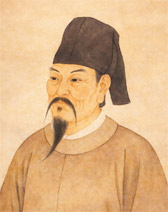
Wang Wei
A master of nature poetry who fused art, spirituality, and landscape into a single vision
Born on ?? ??, 0699
Died on 0759
Age at death: 60
Profession: Poet, Painter, Musician
Place of Birth: Qi County, Shanxi, China
Place of Death: Chang’an (Xi’an), China
Wang Wei was a Chinese poet, painter, musician, and statesman of the Tang Dynasty, widely regarded as one of the greatest cultural figures of classical Chinese civilization. His poetry, deeply influenced by nature and Buddhist philosophy, has endured for centuries and continues to be celebrated as a pinnacle of literary refinement. Alongside contemporaries such as Li Po and Du Fu, Wang Wei helped define the golden age of Tang poetry, while his contributions to landscape painting shaped the future of East Asian art. :contentReference[oaicite:0]{index=0}
Early Life and Background
Wang Wei, 699 yılında China’nın Shanxi eyaletindeki Qi County kentinde doğmuştur. Born into a wealthy and educated family, he received a classical education that prepared him for both literary achievement and public service. His intellectual formation reflected the values of Confucian scholarship, yet from an early age, he also demonstrated a deep sensitivity to art and spirituality.
In 721, Wang Wei successfully passed the prestigious imperial examination, entering the ranks of the mandarin bureaucracy. This achievement marked the beginning of a distinguished career in government, although his artistic pursuits would ultimately define his enduring legacy. :contentReference[oaicite:1]{index=1}
Career in Government and the Arts
While serving in official positions within the Tang administration, Wang Wei maintained a parallel life devoted to artistic expression. His ability to balance bureaucratic responsibility with creative output distinguished him from many of his contemporaries. His poetry and paintings were not separate disciplines but complementary forms of expression.
The Song Dynasty thinker Su Shi later described his work with the famous phrase: “there is painting in his poetry and poetry in his painting.” This observation encapsulates the unique synthesis that defined Wang Wei’s artistic philosophy. :contentReference[oaicite:2]{index=2}
Buddhist Influence and Philosophical Depth
Buddhism, particularly Chan (Zen) Buddhism, played a central role in shaping Wang Wei’s worldview. His poetry frequently explores themes of solitude, inner peace, and spiritual contemplation. He spent significant periods of his life in rural settings and near monasteries, seeking harmony between human existence and the natural world.
His devotion to Buddhist thought extended beyond poetry. Wang Wei studied Chan teachings extensively and even adopted the name “Wang Weimojie” in some of his writings, referencing the enlightened layman Vimalakirti. His works reflect a quiet detachment and meditative clarity that distinguish him within the Tang literary tradition. :contentReference[oaicite:3]{index=3}
Master of Landscape Painting
In addition to his literary achievements, Wang Wei was a pioneering figure in Chinese landscape painting. His artistic style emphasized simplicity, atmosphere, and spiritual resonance rather than strict realism. This approach influenced generations of artists, particularly during later dynasties.
Prominent painters such as Wang Shimin and Wang Yuanqi of the Qing Dynasty studied and emulated his techniques, while Ming Dynasty art theorist Dong Qichang incorporated elements of his style into his own reinterpretations of classical traditions. Through these influences, Wang Wei’s visual language became foundational to the development of literati painting. :contentReference[oaicite:4]{index=4}
Literary Themes and Poetic Style
Wang Wei’s poetry is distinguished by its clarity, emotional restraint, and symbolic richness. Common themes include nature, longing, solitude, and the passage of time. His use of imagery—such as red beans symbolizing love or plum blossoms evoking homesickness—allowed him to express complex emotions through deceptively simple language.
In one of his well-known poems, he portrays a traveler’s longing for home through the image of a blooming plum tree, while in another, he evokes the tranquility of a solitary walk in the Zhongnan Mountains, where the observer finds peace by watching clouds rise where water ends. These moments illustrate his ability to merge external landscapes with internal reflection.
His poem often translated as “Autumn Night in the Mountains” captures a serene post-rain scene: moonlight filtering through pine trees, a clear stream flowing over stones, and distant human sounds returning to the village. Such compositions demonstrate how Wang Wei transformed natural observation into philosophical meditation.
Global Influence and Cultural Legacy
The influence of Wang Wei extended far beyond China. Japanese haiku master Yosa Buson referenced him in his death poem, while Austrian composer Gustav Mahler drew inspiration from his poetry in the final movement of Das Lied von der Erde.
In the modern West, scholars such as Ernest Fenollosa introduced his work to new audiences, and poet Ezra Pound incorporated elements of his imagery into the development of the Ideogrammic Method. These cross-cultural connections highlight the timeless and universal qualities of Wang Wei’s art. :contentReference[oaicite:5]{index=5}
Death
Wang Wei died in 759 in Chang’an (modern Xi’an), the capital of the Tang Dynasty. By the time of his death, he had already secured a reputation as one of the greatest poets of his era.
Today, Wang Wei is remembered not only as a poet but as a visionary artist who unified poetry, painting, and spirituality. His works continue to represent one of the most refined expressions of harmony between nature and the human soul in world literature.
Selected Poems
When those red berries of spring appear,
On your southern branches shining clear,
Gather them home for my sake, I pray,
A symbol of love that will never decay.
You who come from my old homeland,
Tell me what has happened there.
Before my silken window passed,
Did the plum blossom bloom in the cold air?
Source: Biyografiler.com
Frequently asked questions about Wang Wei
Who is Wang Wei?, Wang Wei biography, Wang Wei life story, Wang Wei age, Wang Wei facts, Wang Wei birthplace, Wang Wei photos, Wang Wei videos, Wang Wei career

Lamine Yamal
Professional footballer

Erling Haaland
Professional footballer

Kylian Mbappe
Professional footballer

Austin Abrams
Actor

Bad Bunny
Rapper, Songwriter

Sam Altman
Entrepreneur, Investor, CEO


Hongjoong
Singer, Rapper, Songwriter, Composer

Ludacris
Rapper, Actor

Kwon Eunbi
Singer

Sarah Wayne Callies
Actress, Screenwriter, Producer, Director

LaTavia Roberson
Singer, Actress, Entrepreneur

Amber Heard
Actress, Model
Lamine Yamal
Professional footballer
Bad Bunny
Rapper, Songwriter
Erling Haaland
Professional footballer
Kylian Mbappe
Professional footballer
Austin Abrams
Actor