
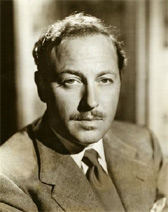
Tennessee Williams
One of the Greatest Playwrights of the 20th Century
Born on March 26, 1911
Died on February 25, 1983
Age at death: 72
Profession: Screenwriter
Place of Birth: Columbus, Mississippi, United States
Place of Death: New York City, United States
Tennessee Williams was one of the most distinguished playwrights of the twentieth century. Renowned for his psychologically intense characters and poetic realism, he became a defining voice of modern American theater. He is the author of the celebrated play Cat on a Hot Tin Roof, which stands among the classics of world drama.
Tennessee Williams was born on March 26, 1911, in Columbus, Mississippi, as the son of Edwina Williams and Cornelius Coffin Williams. His birth name was Thomas Lanier Williams. He had a sister named Rose and a brother named Dakin Williams. His father, a traveling salesman of textile goods, was frequently away on business, leaving Williams to be raised largely by his emotionally unstable mother. As a result of a severe bout of diphtheria during childhood, Williams suffered recurring paralysis in his leg.
When Williams was three years old, the family moved to Clarksdale, Mississippi. In 1918, they relocated again, this time to St. Louis, Missouri. During these years, Williams was diagnosed with diphtheria and spent nearly two years bedridden. At the age of thirteen, his mother gave him a typewriter, an event that would shape the course of his life.
In 1927, at the age of sixteen, he won third prize and five dollars from the literary magazine Smart Set for his essay titled “Can a Good Wife Be a Good Sport?” This early success encouraged him to pursue writing more seriously.
In 1931, Williams enrolled at the University of Missouri in Columbia, where he studied journalism, theology, and literature. During this period, he became a member of the Alpha Tau Omega fraternity. Because of his Southern accent, his friends began calling him “Tennessee,” a nickname that would later become his pen name. Financial hardship forced him to interrupt his studies for two years, during which he worked in a shoe factory. Writing became, in his mind, a possible escape from economic struggle. His obsessive writing habits and lack of rest eventually led to a nervous breakdown at the age of twenty-four.
In 1936, Williams transferred to Washington University for one year while working various jobs. He ultimately completed his education in 1938, graduating from the University of Iowa.
In 1939, Tennessee Williams moved to the French Quarter of New Orleans, Louisiana, a city that would deeply influence his artistic identity. He initially published his first work under his real name but failed to achieve success. His second book was released under the name Tennessee Williams, marking the beginning of his literary identity.
In 1942, Williams began working in Hollywood as a screenwriter while continuing to write plays for the theater. Although Hollywood rejected his screenplay adaptation, The Glass Menagerie, the play achieved enormous success on stage. Like many of his later works, the play was set in the American South. It tells the story of a sailor and failed poet who abandons his neurotic mother and fragile sister in an attempt to escape the despair of his childhood. Through this memory-based drama, Williams realized his concept of “plastic theater,” creating a poetic and symbolic stage world using music, lighting effects, and expressionistic techniques.
Tennessee Williams maintained a long-term relationship with his secretary and partner Frank Merlo from 1947 until Merlo’s death from lung cancer in 1963.
In 1947, Williams’s play A Streetcar Named Desire premiered on stage and was awarded the Pulitzer Prize the same year. The psychological drama centers on a young woman from a once-respected Southern family whose fragile dreams are destroyed by her brother-in-law, ultimately leading to her confinement in a mental institution.
After the commercial failure of Camino Real, Williams wrote what is widely regarded as his most successful play, Cat on a Hot Tin Roof, in 1955. Three years later, the play was adapted for the screen by Richard Brooks, starring Elizabeth Taylor and Paul Newman.
Tennessee Williams died on February 25, 1983, at the age of seventy-two, in New York City. While staying at the Hotel Elysee, he accidentally choked to death when the cap of a nasal spray lodged in his throat as he tilted his head back to use it.
Williams left his copyrights and estate to Sewanee: The University of the South. His sister Rose, who spent much of her life in mental institutions, later donated her inheritance—exceeding fifty million dollars—to the same university upon her death.
In 1994, Tennessee Williams was honored with his image printed on a United States postage stamp.
Awards
1961 – New York Drama Critics’ Circle Award – The Night of the Iguana
1955 – Pulitzer Prize – Cat on a Hot Tin Roof
1952 – Tony Award for Best Play – The Rose Tattoo
1947 – Pulitzer Prize – A Streetcar Named Desire
1945 – New York Drama Critics’ Circle Award – The Glass Menagerie
Theatrical Works
1942 – The Glass Menagerie
1947 – A Streetcar Named Desire
1950 – The Rose Tattoo
1953 – Camino Real
1955 – Cat on a Hot Tin Roof
1957 – Orpheus Descending
1958 – Suddenly Last Summer
1961 – The Night of the Iguana
1977 – Vieux Carré
Other Plays
The Milk Train Doesn't Stop Here Anymore
Portrait of a Madonna
Mr. Paradise
Escape
The Palooka
The Municipal Abattoir
Adam and Eve on a Ferry
Stairs to the Roof
Baby Doll
This Property Is Condemned
The Case of the Crushed Petunias
Sweet Bird of Youth
Summer and Smoke
Kingdom of Earth
Source: Biyografiler.com
Frequently asked questions about Tennessee Williams
Who is Tennessee Williams?, Tennessee Williams biography, Tennessee Williams life story, Tennessee Williams age, Tennessee Williams facts, Tennessee Williams birthplace, Tennessee Williams photos, Tennessee Williams videos, Tennessee Williams career

Lamine Yamal
Professional footballer

Sam Altman
Entrepreneur, Investor, CEO

Kylian Mbappe
Professional footballer

Alice Weidel
Politician, Economist

Erling Haaland
Professional footballer

Giorgia Meloni
Politician, Journalist


Hongjoong
Singer, Rapper, Songwriter, Composer

Ludacris
Rapper, Actor

Kwon Eunbi
Singer

Sarah Wayne Callies
Actress, Screenwriter, Producer, Director

LaTavia Roberson
Singer, Actress, Entrepreneur

Monica Bellucci
Actress, Model
Kylian Mbappe
Professional footballer
Lamine Yamal
Professional footballer

Jennifer Aniston
Actress, Producer

Kaia Gerber
Model, Actress

Sigourney Weaver
Actress, Producer