
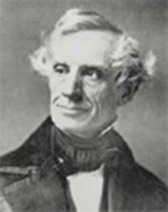
Samuel Morse
Inventor of the Telegraph and the Morse Code
Born on April 27, 1791
Died on April 2, 1872
Age at death: 81
Profession: Inventor, Painter, Professor
Place of Birth: Charlestown, Massachusetts, United States
Place of Death:
Samuel Finley Breese Morse was the inventor of the electric telegraph and the creator of the communication system known worldwide as Morse Code. He was also a distinguished portrait and historical scene painter and an influential figure in the early development of American fine arts.
Samuel Morse was born in Charlestown, Massachusetts, as the first child of Jedidiah Morse, a geographer and Congregational minister, and Elizabeth Ann Breese Morse. He attended Phillips Academy at a young age and began higher education at the age of fourteen. He later studied at Yale University, where he received a classical education and attended lectures on electricity given by Benjamin Silliman and Jeremiah Day. These early scientific influences would later play a crucial role in his inventive work.
After graduating from Yale University in 1810 at the age of nineteen, Morse traveled to England with the painter Washington Allston to pursue formal training in art. He spent two years studying painting before returning to the United States in 1812. During this period, portrait painting was in high demand, and Morse focused primarily on this genre. Among his most notable works are The Old House of Representatives, The Gallery of the Louvre, and The Dying Hercules.
In addition to painting, Morse demonstrated a strong interest in mechanical invention. He designed a marble-cutting machine capable of carving stone in three dimensions, although he was unable to secure a patent due to a similar invention by Thomas Blanchard in 1820. In 1813, he obtained a patent for a fire-fighting device, reflecting his continued engagement with practical scientific experimentation.
Morse played a significant role in American cultural life. In 1826, he contributed to the founding of the National Academy of Design and became its first president. The following year, he traveled to Europe again, returning to the United States in 1829. After his return, his focus increasingly shifted toward scientific research, particularly in the field of electrical communication.
In 1832, during a sea voyage, Morse met Charles Thomas Jackson, who spoke to him about electromagnetism. Already interested in telegraphy, Morse began developing an electromagnetic telegraph system. His design relied on an electric circuit activating an electromagnet that moved a stylus across a rolling paper strip, producing marks corresponding to electrical impulses.
These impulses consisted of short and long signals, which Morse systematized into a coded alphabet. This system of dots and dashes became known as the Morse Code. Work on this invention intensified in 1835, though Morse initially struggled to gain international support. He attempted to attract backing from European governments, including an effort involving the Ottoman Empire, which ultimately failed due to an unfortunate maritime accident.
In the same year, Morse was appointed professor of art history at New York University. Also in 1835, he constructed his first electromagnetic telegraph, though its early zigzag-based recording system proved inefficient. By 1837, he successfully demonstrated a more refined telegraph using dots and dashes and presented public demonstrations of the system. He secured the patent for the electric telegraph in 1840.
With government support, Morse oversaw the construction of a 65-kilometer telegraph line between Washington, D.C., and Baltimore. On May 24, 1844, the first operational electric telegraph line officially began service, marking a turning point in the history of long-distance communication.
The Morse telegraph system was later adopted internationally. The Ottoman Empire first used the Morse telegraph during the Crimean War in 1855, demonstrating the global impact of Morse’s invention.
Samuel Finley Breese Morse died in 1872 at the age of eighty in his home at 5 West 22nd Street in New York City. He was buried at Green-Wood Cemetery in Brooklyn. His legacy endures as one of the foundational figures in modern communication, bridging art, science, and technology through his life’s work.
Source: Biyografiler.com
Frequently asked questions about Samuel Morse
Who is Samuel Morse?, Samuel Morse biography, Samuel Morse life story, Samuel Morse age, Samuel Morse facts, Samuel Morse birthplace, Samuel Morse photos, Samuel Morse videos, Samuel Morse career

Lamine Yamal
Professional footballer

Sam Altman
Entrepreneur, Investor, CEO

Kylian Mbappe
Professional footballer

Alice Weidel
Politician, Economist

Erling Haaland
Professional footballer

Giorgia Meloni
Politician, Journalist


Hongjoong
Singer, Rapper, Songwriter, Composer

Ludacris
Rapper, Actor

Kwon Eunbi
Singer

Sarah Wayne Callies
Actress, Screenwriter, Producer, Director

LaTavia Roberson
Singer, Actress, Entrepreneur
Lamine Yamal
Professional footballer
Kylian Mbappe
Professional footballer

Kaia Gerber
Model, Actress

Austin Abrams
Actor
Giorgia Meloni
Politician, Journalist
Sam Altman
Entrepreneur, Investor, CEO