
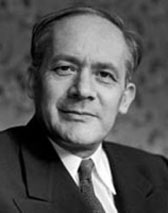
Raphael Lemkin
The Father of the Genocide Convention
Born on June 24, 1900
Died on August 28, 1959
Age at death: 59
Profession: Lawyer
Place of Birth: Vawkavysk, Byelorussian SSR (now Belarus)
Place of Death: New York City, United States
Raphael Lemkin was a Polish-born Jewish American legal scholar who authored the 1948 United Nations Convention on the Prevention and Punishment of the Crime of Genocide and created the legal concept of “genocide,” shaping the foundations of modern international criminal law.
Raphael Lemkin was born on June 24, 1900, in Vawkavysk, then part of Byelorussia. He was one of three children of Joseph and Bella (Pomerantz) Lemkin. After completing a local commercial school, he studied law at Jan Kazimierz University in Lviv, Ukraine. He later continued his academic education in philosophy at Heidelberg University in Germany. Upon graduating in 1926, he began his legal career as an assistant prosecutor at the Warsaw District Court. Between 1929 and 1934, he served as a public prosecutor at the Warsaw Regional Court.
In 1933, at an international criminal law conference held in Madrid, Lemkin addressed crimes committed against humanity in violation of international law. These ideas later evolved into his theory of genocide. Following political pressure after the conference, he resigned from his official post and began working as a private lawyer in Warsaw.
Lemkin’s interest in law and mass violence was deeply influenced by literature and historical events. His legal awakening began after reading Quo Vadis?, the novel by Henryk Sienkiewicz, which portrays the persecution of Christians under Roman Emperor Nero. Another defining moment occurred on March 15, 1921, when Soghomon Tehlirian assassinated Talat Pasha in Berlin. While still a student at Lviv University, Lemkin closely followed Tehlirian’s trial and resolved to pursue a career in law. The acquittal of perpetrators of the Armenian Genocide during the Malta Trials further strengthened his conviction that impunity enabled mass crimes. Lemkin argued that constitutional protections for minorities were insufficient to prevent such atrocities, especially during wartime. He believed an internationally binding legal mechanism was necessary to punish crimes committed against minority populations, particularly women and children. In this context, he proposed the term “acts of barbarity” at the Fifth International Conference for the Unification of Criminal Law in Madrid in 1933, although the proposal was rejected.
At the outbreak of World War II on September 1, 1939, Lemkin joined the Polish Army to resist the German invasion. During the Siege of Warsaw, he was captured by German forces on September 28, 1939, and was wounded in the hip while escaping. In 1940, he fled through Lithuania to Sweden, where he worked as a lecturer at Stockholm University. In 1941, he immigrated to the United States. Although he survived, 49 members of his family, including his parents, were murdered during the German occupation as Polish and Lithuanian Jews.
After arriving in the United States in 1941, Lemkin accepted an invitation from Professor McDermott to teach law at Duke University in North Carolina. In 1942, he also taught summer courses at the University of Virginia. In 1943, he moved to Washington, D.C., where he served as a special adviser on international law within the War Department of U.S. President Franklin D. Roosevelt, working under the Board of Economic Warfare and the Foreign Economic Administration.
Between 1945 and 1946, Lemkin served as an adviser to the Supreme Court of the United States. After World War II, he remained in the United States and, after 1948, taught criminal law at Yale University. In 1955, he was appointed Professor of Law.
The Convention on the Prevention and Punishment of the Crime of Genocide, drafted by Raphael Lemkin and submitted to the United Nations with the support of the United States, was adopted on December 9, 1948, by a unanimous vote of 55 countries. The convention entered into force in January 1951 after ratification by 20 national parliaments. Turkey became a party to the convention as a non-signatory state following a parliamentary decision on July 31, 1950.
Following the Holocaust, in which approximately six million people were murdered, the Genocide Convention was conceived as a legal instrument to prevent future genocides effectively and sustainably. Despite the devastation of World War II, the drafting and adoption of the convention was a prolonged and difficult process, made possible largely through Lemkin’s relentless personal advocacy.
Raphael Lemkin was not only the author of the United Nations Genocide Convention but also the legal scholar who created the concept of genocide itself. While serving as an adviser during the Nuremberg Trials, he learned that his entire family had perished in Nazi concentration camps.
Lemkin first used the term “genocide” in 1944 in his book Axis Rule in Occupied Europe: Laws of Occupation – Analysis of Government-Proposals for Redress. In this work, he cited the Armenian Genocide and the Holocaust as primary examples, while also addressing colonial practices of Western powers. According to Lemkin, the deliberate targeting of a group and the intent to destroy it were sufficient to constitute the crime of genocide.
Raphael Lemkin died of a heart attack on August 28, 1959, at the age of 59, in a public relations office in New York City.
The Genocide Convention defines punishable acts as follows:
a) Killing members of a group,
b) Causing serious bodily or mental harm to members of a group,
c) Deliberately inflicting on the group conditions of life calculated to bring about its physical destruction in whole or in part,
d) Imposing measures intended to prevent births within the group,
e) Forcibly transferring children of the group to another group.
Source: Biyografiler.com
Frequently asked questions about Raphael Lemkin
Who is Raphael Lemkin?, Raphael Lemkin biography, Raphael Lemkin life story, Raphael Lemkin age, Raphael Lemkin facts, Raphael Lemkin birthplace, Raphael Lemkin photos, Raphael Lemkin videos, Raphael Lemkin career
Related Biographies

Lamine Yamal
Professional footballer

Kylian Mbappe
Professional footballer

Sam Altman
Entrepreneur, Investor, CEO

Erling Haaland
Professional footballer

Alice Weidel
Politician, Economist

Giorgia Meloni
Politician, Journalist


Hongjoong
Singer, Rapper, Songwriter, Composer

Ludacris
Rapper, Actor

Kwon Eunbi
Singer

Sarah Wayne Callies
Actress, Screenwriter, Producer, Director

LaTavia Roberson
Singer, Actress, Entrepreneur
Giorgia Meloni
Politician, Journalist

Nicki Minaj
Rapper, Singer, Songwriter, Actress

Bad Bunny
Rapper, Songwriter

Mustafa Suleyman
Business Leader, Entrepreneur

Nicole Kidman
Actress

Woody Harrelson
Actor