
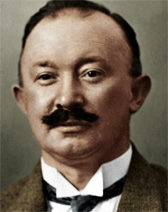
Hugo Boss
Founder of the global fashion house Hugo Boss
Born on July 18, 1885
Died on August 9, 1948
Age at death: 63
Profession: Fashion Designer, Entrepreneur
Place of Birth: Metzingen, Stuttgart, Germany
Place of Death: Metzingen, Germany
Hugo Ferdinand Boss, known as Hugo Boss, was a German fashion designer and entrepreneur who founded the company that later evolved into one of the world’s leading luxury fashion brands. While the Hugo Boss name is today associated with tailored suits and global retail success, the company’s early development was closely intertwined with the political structure of Nazi Germany under Adolf Hitler.
Early Life and Business Foundations
Hugo Boss was born on July 8, 1885, in Metzingen near Stuttgart, as the youngest of five children of Heinrich Boss and Luise Münzenmayer Boss. After completing military service in 1903, he worked in a textile factory in Konstanz, where he gained technical knowledge of fabric production and garment construction.
In 1908, he took over his family’s lingerie and linen shop in Metzingen. That same year, he married Anna Katharina Freysinger, with whom he later had a son, Siegfried Boss. The small family business became the foundation for his later industrial expansion.
Establishment of the Company
In 1923, Hugo Boss established his own clothing factory in Metzingen. By 1924, he was employing approximately 30 workers, producing shirts, jackets, workwear, sports clothing, and raincoats. The company initially struggled during Germany’s economic instability in the interwar years but gradually stabilized as political conditions shifted.
Affiliation with the Nazi Regime
In 1931, Hugo Boss joined the National Socialist German Workers’ Party. Following Adolf Hitler’s rise to power in 1933, government contracts significantly expanded his business. The company became a licensed manufacturer of uniforms for the Wehrmacht (German armed forces), as well as for the SS (Schutzstaffel) and SA (Sturmabteilung).
The black SS uniforms, often visually associated with Nazi symbolism and overseen within the regime by figures such as Heinrich Himmler, were produced under state contract. During World War II, forced laborers—including French and Polish prisoners of war—were compelled to work in the company’s factories.
Post-War Accountability
After the fall of Nazi Germany in 1945, Hugo Boss underwent denazification proceedings. He was classified as a supporter and beneficiary of the regime and fined 80,000 German Marks. He temporarily lost the right to run his company, although he later regained limited involvement.
Death
Hugo Boss died on August 9, 1948, in Metzingen at the age of 63 due to complications from a dental abscess. He did not witness the global transformation of his brand in the decades that followed.
Transformation into a Global Fashion Brand
After his death, leadership passed to the next generation, including his son Siegfried Boss. In the 1960s, the company shifted its focus toward high-quality men’s suits and formal tailoring. The BOSS trademark was officially registered in 1977, marking the beginning of its international brand identity.
In 1991, the Italian textile group Marzotto acquired a controlling stake in Hugo Boss AG, accelerating its expansion into global luxury markets. The brand diversified into womenswear, accessories, fragrances, and lifestyle collections, establishing retail operations in more than 110 countries.
Production facilities expanded internationally. In 1999, a suit manufacturing factory was opened in Izmir, Turkey, followed by additional shirt and womenswear factories in 2005. A significant portion of Hugo Boss suits sold globally are produced in Turkey.
Source: Biyografiler.com
Frequently asked questions about Hugo Boss
Who is Hugo Boss?, Hugo Boss biography, Hugo Boss life story, Hugo Boss age, Hugo Boss facts, Hugo Boss birthplace, Hugo Boss photos, Hugo Boss videos, Hugo Boss career
Related Biographies

Lamine Yamal
Professional footballer

Kylian Mbappe
Professional footballer

Sam Altman
Entrepreneur, Investor, CEO

Erling Haaland
Professional footballer

Alice Weidel
Politician, Economist

Giorgia Meloni
Politician, Journalist


Hongjoong
Singer, Rapper, Songwriter, Composer

Ludacris
Rapper, Actor

Kwon Eunbi
Singer

Sarah Wayne Callies
Actress, Screenwriter, Producer, Director

LaTavia Roberson
Singer, Actress, Entrepreneur

Alfred Molina
Actor
Lamine Yamal
Professional footballer
Kylian Mbappe
Professional footballer

John Healey
Politician

Olivia Rodrigo
Singer

Ronaldinho
Professional footballer