
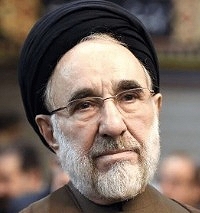
Mohammad Khatami
Iranian politician and religious scholar who served as the fifth President of Iran from 1997 to 2005. Known for his reformist policies, advocacy of civil society, political participation, cultural openness and the Dialogue Among Civilizations initiative.
Born on September 29, 1943
Age: 83
Profession: Former President, Politician
Place of Birth: Ardakan, Yazd Province, Iran
Mohammad Khatami is an Iranian politician, Shia cleric and writer who served as the fifth President of Iran from August 3, 1997, to August 3, 2005. Before becoming president, he served as a member of parliament, Minister of Culture and Islamic Guidance, and head of the National Library of Iran. His presidency was associated with political reform, cultural liberalization, civil society and the promotion of dialogue between different civilizations.
Early Life and Education
Mohammad Khatami, also known as Seyyed Mohammad Khatami, was born in 1943 in Ardakan, Yazd Province, Iran. His date of birth is reported as September 29 in some biographical sources and October 14 in others. He was one of six children of Ayatollah Ruhollah Khatami, a religious scholar who served as Friday prayer leader in Yazd, and Sakineh Ziai, whose family owned agricultural land.
After completing his secondary education in 1961, he began religious studies at the Qom Seminary. In 1965, he continued his theological education in Isfahan while also enrolling in philosophy courses at the University of Isfahan. He completed his undergraduate studies in philosophy in 1969.
He subsequently pursued graduate studies in educational sciences at the University of Tehran and continued advanced Islamic studies in Qom, including jurisprudence and the principles of Islamic legal interpretation.
Early Political Activities
Mohammad Khatami became involved in political activities during the early 1960s. He participated in opposition to the government of Shah Mohammad Reza Pahlavi and helped reproduce and distribute political statements, particularly those issued by Ayatollah Ruhollah Khomeini.
While studying at the University of Isfahan, he participated in the activities of the Islamic Students Association. He also maintained contact with Ahmad Khomeini, the son of Ruhollah Khomeini.
Unlike some religious activists of his generation, Khatami completed military service in the Iranian armed forces, serving as a junior officer.
In 1978, shortly before the Iranian Revolution of 1979, he traveled to Hamburg, West Germany, to direct the Islamic Centre Hamburg, following a recommendation associated with Ayatollah Mohammad Beheshti. He remained involved in religious and political activities during the revolutionary period.
Parliament and Ministry of Culture
After the Iranian Revolution, Mohammad Khatami returned to Iran. In the first parliamentary elections of 1980, he was elected to the Islamic Consultative Assembly (Majlis), representing Ardakan and Meybod.
In 1980, Ayatollah Ruhollah Khomeini appointed him to oversee the Kayhan Institute, which published the influential Kayhan newspaper and other periodicals.
In November 1982, Prime Minister Mir-Hossein Mousavi appointed Khatami Minister of Culture and Islamic Guidance. He remained in the position during the government of Mousavi and continued serving under President Akbar Hashemi Rafsanjani after the constitutional changes of 1989.
During the Iran–Iraq War (1980–1988), Khatami also performed cultural and propaganda-related duties within the organization responsible for coordinating Iran's wartime communications.
As Minister of Culture, he supported somewhat greater freedom for publishing, artistic production and cultural activities within the Islamic Republic's political framework. These policies brought him into conflict with conservative political and religious figures.
Resignation and Cultural Institutions
In May 1992, Mohammad Khatami resigned as Minister of Culture and Islamic Guidance following increasing pressure from conservative members of parliament and political institutions. The disputes concerned cultural policy, censorship and the acceptable limits of artistic and intellectual expression.
Following his resignation, President Akbar Hashemi Rafsanjani appointed him as a cultural adviser and head of the National Library of Iran.
In 1996, Supreme Leader Ali Khamenei appointed him to the Supreme Council of the Cultural Revolution, a body responsible for cultural and educational policy.
1997 Presidential Election
Mohammad Khatami entered the 1997 Iranian presidential election as a candidate associated with reformist political groups. His campaign emphasized the rule of law, civil society, political participation, cultural freedom and greater opportunities for women and young people.
On May 23, 1997, he won the presidential election with approximately 69 percent of the vote, defeating the conservative candidate Ali Akbar Nateq-Nouri. He took office on August 3, 1997, succeeding Akbar Hashemi Rafsanjani.
His election brought together supporters from different social and political backgrounds, including university students, women, intellectuals and sections of the urban middle class. The political movement associated with his victory became known as the Second of Khordad Movement, named after the date of his electoral success in the Iranian calendar.
Presidency and Reform Policies
During his presidency, Mohammad Khatami advocated reforms within the constitutional framework of the Islamic Republic. His government supported wider public discussion, cultural activities, legal reform and the development of civil society organizations.
The reformist period saw an expansion of newspapers, political publications and public debate. However, many reformist newspapers were subsequently closed by the judiciary, and journalists and political activists faced prosecution.
Khatami's administration encountered repeated opposition from conservative institutions, including the Guardian Council, the judiciary and organizations operating under the authority of the Supreme Leader.
In July 1999, student demonstrations following the closure of a reformist newspaper led to unrest and a violent crackdown in Tehran. The events exposed disagreements between the government's reformist supporters and institutions responsible for internal security.
Khatami won re-election in June 2001 with approximately 77 percent of the vote. During his second term, attempts to expand presidential authority and strengthen electoral accountability faced continued institutional resistance.
Dialogue Among Civilizations and Foreign Policy
Mohammad Khatami promoted the idea of Dialogue Among Civilizations as an alternative to international confrontation. His proposal emphasized communication between cultures, religions and political societies.
At his suggestion, the United Nations designated 2001 as the United Nations Year of Dialogue Among Civilizations.
In foreign policy, Khatami sought to improve Iran's relations with European countries and reduce diplomatic tensions with Western governments. He also supported dialogue with neighboring states and international institutions.
Relations with the United States remained difficult, although Khatami made public statements encouraging cultural exchanges and mutual understanding. His reform-oriented diplomacy did not produce a full restoration of diplomatic relations between the two countries.
End of Presidency and Later Political Activities
Mohammad Khatami completed his second presidential term in August 2005. He was succeeded by Mahmoud Ahmadinejad, who took office on August 3, 2005.
After leaving office, Khatami remained involved in Iranian political and intellectual life. He supported reformist political initiatives and continued speaking about constitutional government, political participation and the role of civil society.
During the disputed 2009 presidential election and its aftermath, he supported reformist political figures, including Mir-Hossein Mousavi, and criticized the treatment of demonstrators and political opponents.
In subsequent years, Khatami continued to advocate political reform through peaceful and constitutional means, although restrictions on reformist organizations and political activities limited his public role.
Books and Intellectual Work
Mohammad Khatami has written books and essays on Islamic political thought, philosophy, modernity, democracy, religion and social development. His works reflect his academic background in philosophy and Islamic theology.
Among his publications are Whose Authority? (1979), Tradition, Modernity and Development (1996), Fear of the Wave and From the World of the City to the City of the World.
His other works include Thought and Faith in the Grip of Tyranny (2000), Political Development, Economic Development and Security (2000), Islam, Spirituality and the Islamic Revolution (2000) and Women and Youth (2000).
He has also delivered lectures at universities and academic institutions. In addition to Persian, he has studied Arabic and has working knowledge of English and German.
Source: Biyografiler.com
Frequently asked questions about Mohammad Khatami
Who is Mohammad Khatami?, Mohammad Khatami biography, Mohammad Khatami life story, Mohammad Khatami age, Mohammad Khatami facts, Mohammad Khatami birthplace, Mohammad Khatami photos, Mohammad Khatami videos, Mohammad Khatami career
Related Biographies


Lamine Yamal
Professional footballer

Brad Pitt
Actor

Erling Haaland
Professional footballer

Leonardo DiCaprio
Actor

Kylian Mbappe
Professional footballer

Sam Altman
Entrepreneur, Investor, CEO

Marc Andreessen
Engineer, Entrepreneur

Manuel Pellegrini
Football Manager, Former Professional Footballer

Manuel Neuer
Professional footballer

Malin Maria Akerman
Model, Actress

Malcolm McDowell
Actor, Voice Actor

Margaret Mitchell
Novelist, Journalist

Aidan Gillen
Actor

Mario Puzo
Novelist, Screenwriter
Brad Pitt
Actor

Adam Sandler
Actor
Manuel Neuer
Professional footballer
Margaret Mitchell
Novelist, Journalist