
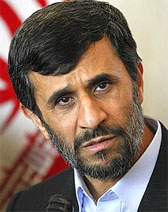
Mahmoud Ahmadinejad
Iranian politician and sixth president of the Islamic Republic of Iran, who served two terms from 2005 to 2013. His presidency included disputes over Iran's nuclear program, international sanctions, Holocaust denial, and widespread protests following the disputed 2009 election.
Born on October 28, 1956
Age: 70
Profession: Politician, Former President
Place of Birth: Aradan, near Garmsar, Semnan Province, Iran
Mahmoud Ahmadinejad, born on October 28, 1956, in the village of Aradan near Garmsar, Iran, is an Iranian politician, civil engineer, and former president of the Islamic Republic of Iran. He served two consecutive presidential terms from 2005 to 2013, having previously been governor of Ardabil Province and mayor of Tehran. His presidency was marked by disputes with the United States and Israel, controversy surrounding Iran's nuclear program, and international criticism of his statements about the Holocaust. His disputed re-election in 2009 triggered nationwide demonstrations and a government crackdown on opposition activists.
Early Life and Family Background
Mahmoud Ahmadinejad was born in Aradan, near the city of Garmsar in Semnan Province. His father, Ahmad Ahmadinejad, worked as a blacksmith and in other manual trades. His family moved to Tehran in 1957, when he was still an infant.
The family had previously used the surname Sabourjian, which was changed to Ahmadinejad after their move to the capital. He grew up in Tehran in a family of seven children.
Education and Academic Career
In 1976, Mahmoud Ahmadinejad took Iran's national university entrance examination. According to his own account, he ranked 132nd among hundreds of thousands of applicants. He subsequently enrolled at the Iran University of Science and Technology, where he studied civil engineering.
He continued his postgraduate education in engineering and transportation planning. In 1997, he completed a doctorate in transportation engineering and planning at the same university.
Ahmadinejad also worked as a university lecturer, teaching engineering-related subjects. He returned to academic work after leaving his provincial governorship in 1997.
The Iranian Revolution and Iran–Iraq War
During the Iranian Revolution of 1979, Mahmoud Ahmadinejad participated in Islamic student organizations at his university. He was among student representatives who took part in meetings with Ruhollah Khomeini.
Following the seizure of the United States Embassy in Tehran in November 1979, allegations later emerged that Ahmadinejad had participated in the hostage-taking operation. Several former American hostages identified him as a possible participant. However, the allegations remained disputed, and investigations did not establish conclusive evidence of his direct involvement.
During the Iran–Iraq War of 1980–1988, Ahmadinejad was associated with activities involving the Islamic Revolutionary Guard Corps and the volunteer Basij forces. Accounts differ over whether he was formally enrolled in the Revolutionary Guards or primarily served as a Basij volunteer.
His wartime activities reportedly included engineering, logistical support, and assignments in western Iran. Some accounts also describe involvement in Revolutionary Guard operations during the later stages of the war, although details of his military service remain disputed.
Administrative Career and Governorship
During the 1980s, Mahmoud Ahmadinejad held administrative positions in Maku and Khoy in West Azerbaijan Province. He also worked as an adviser within the administration of Kurdistan Province.
In 1993, he became governor of Ardabil Province, a position he held until 1997. His responsibilities included regional administration and development policies.
Following the election of reformist President Mohammad Khatami in 1997, Ahmadinejad left the governorship and returned to the Iran University of Science and Technology.
Mayor of Tehran
On May 3, 2003, Mahmoud Ahmadinejad was selected as mayor of Tehran by the Tehran City Council. He remained in office until his presidential election victory in 2005.
As mayor, he promoted conservative social policies and increased the religious orientation of some municipal cultural activities. His administration supported projects commemorating those killed during the Iran–Iraq War and provided food assistance to lower-income residents.
His municipal administration also worked on road maintenance, public services, and urban infrastructure. The management of municipally affiliated cultural institutions and the newspaper Hamshahri underwent changes during his tenure.
Controversies involving Hamshahri included disputes over editorial decisions and the dismissal of journalists. Journalist Nafiseh Kohnavard was reported to have lost her position after questioning President Mohammad Khatami about allegations concerning parallel intelligence organizations. Claims against her subsequently appeared in conservative Iranian publications, but those accusations should not be treated as established facts.
The 2005 Presidential Election
Mahmoud Ahmadinejad entered the 2005 Iranian presidential election with the support of conservative political networks. His campaign emphasized opposition to corruption, economic assistance to poorer households, and adherence to the principles of the Islamic Revolution.
In the first round, he received approximately 19 percent of the vote and advanced to a runoff against former President Akbar Hashemi Rafsanjani.
On June 24, 2005, Ahmadinejad won the second round with approximately 61.7 percent of the vote. His election was formally endorsed by Supreme Leader Ali Khamenei on August 3, 2005, marking the beginning of his presidency.
Presidency: Domestic and Economic Policies
Mahmoud Ahmadinejad served as Iran's president from August 2005 until August 2013. His administration introduced and expanded programs intended to provide financial assistance to low-income households and improve housing access.
Among his early proposals was the Imam Reza Love Fund, designed to provide financial support for marriage, housing, and employment. He argued that national oil revenues should be used more directly to improve ordinary citizens' living conditions.
His government also implemented a major reform of energy and food subsidies beginning in 2010. The program replaced some subsidized prices with direct cash payments to households.
Ahmadinejad's economic record was disputed. His supporters cited social spending and financial transfers, while critics pointed to inflation, government intervention in the economy, and the consequences of international sanctions.
Iran's Nuclear Program and Foreign Policy
During Mahmoud Ahmadinejad's presidency, Iran's nuclear program became a central source of international confrontation. His government maintained that Iran had the right to develop nuclear technology for peaceful purposes, including energy production.
The United States and several European governments expressed concerns about the possible military dimensions of Iran's nuclear activities. The United Nations Security Council adopted resolutions imposing sanctions on Iran over its nuclear program.
Ahmadinejad rejected demands that Iran abandon its uranium-enrichment activities and criticized the authority granted to the Security Council's permanent members.
He regularly challenged American foreign policy and criticized Israel in speeches at international gatherings, including meetings of the United Nations General Assembly. His administration also pursued diplomatic relations with countries including Venezuela and other governments critical of United States foreign policy.
Statements About Israel and the Holocaust
In October 2005, Mahmoud Ahmadinejad delivered a speech referring to the future of the Israeli government. The statement was widely reported in English as a call for Israel to be wiped off the map.
Disputes subsequently emerged over the precise translation of the original Persian wording. Some translators argued that it more closely referred to the disappearance of the regime occupying Jerusalem. Nevertheless, Ahmadinejad continued using rhetoric hostile to the Israeli state, drawing criticism from foreign governments and international organizations.
His repeated statements questioning or denying the historical reality of the Holocaust provoked further international condemnation. The Holocaust, the systematic genocide of approximately six million Jews by Nazi Germany and its collaborators, is a thoroughly documented historical event.
In December 2006, Iran hosted a conference questioning the Holocaust under his presidency. The event was criticized for promoting Holocaust denial and providing a platform for antisemitic views.
The Disputed 2009 Presidential Election
On June 12, 2009, Mahmoud Ahmadinejad sought re-election against candidates including former Prime Minister Mir-Hossein Mousavi. Iranian authorities announced that Ahmadinejad had received approximately 63 percent of the vote, while Mousavi had obtained about 34 percent.
Mousavi and other opposition figures challenged the announced result, alleging electoral irregularities. Large demonstrations followed in Tehran and other Iranian cities.
The protests developed into the Iranian Green Movement. Security forces dispersed demonstrations, arrested activists, and restricted political activity and media coverage. The crackdown drew international criticism over the treatment of protesters and political opponents.
Despite the unrest, Ahmadinejad began a second presidential term in August 2009.
Disagreements with Iran's Supreme Leader
During his second term, Mahmoud Ahmadinejad increasingly disagreed with conservative political institutions and Supreme Leader Ali Khamenei.
One dispute concerned Esfandiar Rahim Mashaei, a close political associate whom Ahmadinejad appointed first vice president in 2009. Following opposition from Khamenei, Mashaei resigned from that position.
Further disagreements emerged in 2011 over the leadership of the Intelligence Ministry and the president's authority to appoint senior officials. These conflicts weakened Ahmadinejad's standing within parts of Iran's conservative establishment.
End of His Presidency
Under Iran's constitution, Mahmoud Ahmadinejad could not seek a third consecutive presidential term in 2013.
The presidential election held on June 14, 2013, was won by Hassan Rouhani, who campaigned on greater diplomatic engagement and a different approach to Iran's economic difficulties.
Ahmadinejad transferred the presidency to Rouhani on August 3, 2013, and resumed academic activities. He subsequently maintained a presence in Iranian political debate.
Political Activities After 2013
After leaving office, Mahmoud Ahmadinejad remained politically active and continued making public statements on domestic and international affairs.
He registered to run in the 2017 and 2021 presidential elections, but the Guardian Council rejected his candidacy on both occasions.
In 2024, following the death of President Ebrahim Raisi in a helicopter crash, Ahmadinejad again applied to contest the presidential election. The Guardian Council once more disqualified him from running.
2026 Airstrikes and Reports of His Death
On February 28, 2026, during United States and Israeli military strikes against Iran, a building associated with Mahmoud Ahmadinejad's security personnel was struck in Tehran.
Reports indicated that three members of his security detail, who belonged to the Islamic Revolutionary Guard Corps, were killed. Initial reports claimed that Ahmadinejad himself had also died.
On March 2, 2026, a close adviser told Anadolu Agency that Ahmadinejad was alive and unharmed. The adviser stated that his residence had not been directly targeted.
On July 6, 2026, Ahmadinejad appeared publicly in Tehran during funeral ceremonies for former Supreme Leader Ali Khamenei. His appearance confirmed that the earlier reports of his death had been incorrect.
2026 Israeli Intelligence and House Arrest Allegations
In July 2026, international media reported allegations that Israeli intelligence officials had attempted to establish contact with Mahmoud Ahmadinejad as part of plans involving Iran's political leadership.
A report published by The New York Times alleged that he had met officials associated with Israel's intelligence service, Mossad, and had subsequently been placed under house arrest in Iran.
Ahmadinejad's office rejected these allegations on July 13–14, 2026, describing them as false. It also denied that he was under house arrest and stated that he continued his usual activities. The underlying allegations remained disputed.
Personal Life
Mahmoud Ahmadinejad is married to Azam Farahi. They have three children, two sons and a daughter.
His political career has included service in provincial government, municipal administration, higher education, and the presidency of Iran.
Major Political Positions
- 1980s – Administrative positions in Maku and Khoy
- 1993–1997 – Governor of Ardabil Province
- 2003–2005 – Mayor of Tehran
- 2005–2013 – President of the Islamic Republic of Iran
- 2013–2022 – Member of the Expediency Discernment Council
- 2017, 2021, 2024 – Presidential candidacies rejected by the Guardian Council
Source: Biyografiler.com
Frequently asked questions about Mahmoud Ahmadinejad
Who is Mahmoud Ahmadinejad?, Mahmoud Ahmadinejad biography, Mahmoud Ahmadinejad life story, Mahmoud Ahmadinejad age, Mahmoud Ahmadinejad facts, Mahmoud Ahmadinejad birthplace, Mahmoud Ahmadinejad photos, Mahmoud Ahmadinejad videos, Mahmoud Ahmadinejad career
Related Biographies

Lamine Yamal
Professional footballer

Brad Pitt
Actor

Erling Haaland
Professional footballer

Leonardo DiCaprio
Actor

Kylian Mbappe
Professional footballer

Sam Altman
Entrepreneur, Investor, CEO

Marc Andreessen
Engineer, Entrepreneur

Manuel Pellegrini
Football Manager, Former Professional Footballer

Manuel Neuer
Professional footballer

Malin Maria Akerman
Model, Actress

Malcolm McDowell
Actor, Voice Actor

Margaret Mitchell
Novelist, Journalist

Aidan Gillen
Actor

Mario Puzo
Novelist, Screenwriter

Adam Sandler
Actor
Brad Pitt
Actor
Manuel Neuer
Professional footballer
Margaret Mitchell
Novelist, Journalist