
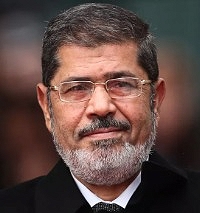
Mohamed Morsi
Egyptian politician and engineer who served as Egypt's fifth president from June 30, 2012, to July 3, 2013. The country's first democratically elected civilian president, he was associated with the Muslim Brotherhood and was removed from office by the military under General Abdel Fattah el-Sisi.
Born on August 8, 1951
Died on June 17, 2019
Age at death: 68
Profession:
Place of Birth: El-Adwah, Sharqia Governorate, Egypt
Place of Death: Cairo, Egypt
Mohamed Morsi (1951–2019) was an Egyptian politician, engineer and university professor who served as the fifth President of Egypt from June 30, 2012, to July 3, 2013. He became the country's first democratically elected civilian president following the 2011 Egyptian Revolution. A senior figure in the Muslim Brotherhood and the first chairman of the Freedom and Justice Party, Morsi was removed from office in a military coup led by General Abdel Fattah el-Sisi after mass demonstrations against his government. He remained in detention until his death during a court hearing in Cairo on June 17, 2019.
Early Life and Education
Mohamed Morsi, whose full name was Mohamed Mohamed Morsi Eissa al-Ayyat, was born on August 8, 1951, in El-Adwah, a village in the Sharqia Governorate of Egypt's Nile Delta. He grew up in a farming family with four brothers and received his early education in his hometown.
After completing his secondary education, he studied engineering at Cairo University, graduating in 1975. He subsequently earned a master's degree in engineering, specializing in metallurgy and materials science, in 1978.
Morsi continued his education in the United States and received a doctorate in engineering from the University of Southern California in 1982.
Academic Career
Between 1982 and 1985, Mohamed Morsi worked as an assistant professor of engineering at California State University, Northridge in the United States.
In 1985, he returned to Egypt and joined Zagazig University, where he became a professor and head of the Department of Materials Engineering. He continued his academic work at the university until 2010.
His scientific background was in materials engineering, and he taught engineering courses before entering national politics.
Political Career and the Muslim Brotherhood
Mohamed Morsi became involved in politics through the Muslim Brotherhood, an Islamist organization founded in Egypt in 1928 by Hassan al-Banna.
Because the organization was prohibited from participating in elections as a recognized political party, its members frequently contested parliamentary elections as independent candidates.
In 2000, Morsi was elected to the Egyptian People's Assembly as an independent candidate affiliated with the Muslim Brotherhood. He served as a member of parliament until 2005 and participated in the organization's political activities.
The 2011 Egyptian Revolution
During the 2011 Egyptian Revolution, Mohamed Morsi supported the protests against President Hosni Mubarak, whose government had ruled Egypt since 1981.
The demonstrations, which began in January 2011, led to Mubarak's resignation on February 11, 2011. The Egyptian military subsequently assumed temporary control of the country.
Following the revolution, the Muslim Brotherhood established the Freedom and Justice Party as its political organization. On April 30, 2011, Morsi was selected as the party's first chairman.
2012 Presidential Election
Mohamed Morsi became the Freedom and Justice Party's presidential candidate in 2012 after the disqualification of the Brotherhood's original candidate, Khairat el-Shater.
In the second round of the presidential election, held on June 16–17, 2012, Morsi faced Ahmed Shafik, a former prime minister who had served under Hosni Mubarak.
On June 24, 2012, Egypt's Presidential Election Commission announced that Morsi had won approximately 51.7 percent of the vote. Supporters gathered in Cairo's Tahrir Square to celebrate the result.
On June 30, 2012, Mohamed Morsi was sworn in as Egypt's fifth president and its first democratically elected civilian head of state.
Presidency and Domestic Political Crisis
During his presidency, Mohamed Morsi faced political disputes involving the judiciary, opposition parties, the military and institutions inherited from the previous government.
In November 2012, he issued a constitutional declaration that temporarily placed certain presidential decisions beyond judicial review. The measure prompted major protests from opposition groups, which accused him of concentrating excessive power in the presidency.
A new constitution was approved in a December 2012 referendum. However, disputes over the constitution, political representation and the role of the Muslim Brotherhood continued throughout his administration.
Foreign Policy and the Syrian Conflict
Mohamed Morsi supported opposition forces fighting against the government of Syrian President Bashar al-Assad during the Syrian Civil War.
On June 15, 2013, he announced that Egypt was severing diplomatic relations with Syria and closing the Syrian embassy in Cairo. He also called for Egypt's diplomatic representatives to leave Damascus.
Morsi condemned the involvement of the Lebanese organization Hezbollah in the Syrian conflict and called for its fighters to withdraw from Syria. His statements reflected his government's support for Syrian opposition groups.
2013 Military Coup and Removal from Office
On June 30, 2013, large demonstrations took place across Egypt, with protesters demanding the resignation of Mohamed Morsi. His opponents criticized his government's handling of the economy, political institutions and the constitutional process, while his supporters defended his electoral mandate.
On July 3, 2013, the Egyptian military, led by Defense Minister and General Abdel Fattah el-Sisi, removed Morsi from office, suspended the constitution and announced a political transition.
Morsi rejected the military's decision and maintained that he remained Egypt's legitimate elected president. He called on his supporters to oppose his removal.
Following the coup, he was detained by the military and subsequently transferred between detention facilities, including Burj al-Arab Prison near Alexandria and Tora Prison in Cairo.
Trials and Prison Sentences
After his removal from office, Mohamed Morsi faced several criminal trials concerning events during his presidency and the 2011 Egyptian Revolution.
In April 2015, he received a twenty-year prison sentence in a case arising from violence involving protesters outside the presidential palace in December 2012.
On May 16, 2015, an Egyptian court issued a preliminary death sentence against Morsi in connection with a mass prison escape during the 2011 uprising. The death sentence was confirmed in June 2015.
In a separate espionage case involving alleged cooperation with Hamas and Iranian organizations, he received a life sentence in June 2015.
In November 2016, Egypt's Court of Cassation overturned both the death sentence in the prison-break case and the life sentence in the Hamas espionage case, ordering retrials. In another case involving alleged espionage for Qatar, a life sentence against him was upheld in 2017.
Other senior Muslim Brotherhood figures, including Mohamed Badie, also received severe prison sentences or death sentences in proceedings following the 2013 military takeover.
Personal Life
Mohamed Morsi married Naglaa Ali Mahmoud in 1979. The couple had five children: Shaimaa, Ahmed, Osama, Omar and Abdullah.
Two of their children were born during the family's years in the United States. His wife generally avoided the traditional title of First Lady during his presidency, preferring to be identified as the president's wife.
Death
On June 17, 2019, Mohamed Morsi collapsed during a court hearing in Cairo while being tried on espionage-related charges. He was pronounced dead at the age of sixty-seven. Egyptian authorities reported that he had suffered a heart attack.
Following his death, human rights organizations, including Amnesty International and Human Rights Watch, called for an independent investigation into the circumstances of his death and his treatment in detention.
Human rights organizations reported that Morsi had been subjected to prolonged solitary confinement and inadequate access to medical treatment. Egyptian authorities maintained that he had died of natural causes.
Mohamed Morsi was buried in Cairo on June 18, 2019, during a funeral attended by members of his family.
Source: Biyografiler.com
Frequently asked questions about Mohamed Morsi
Who is Mohamed Morsi?, Mohamed Morsi biography, Mohamed Morsi life story, Mohamed Morsi age, Mohamed Morsi facts, Mohamed Morsi birthplace, Mohamed Morsi photos, Mohamed Morsi videos, Mohamed Morsi career
Related Biographies


Lamine Yamal
Professional footballer

Brad Pitt
Actor

Erling Haaland
Professional footballer

Leonardo DiCaprio
Actor

Kylian Mbappe
Professional footballer

Sam Altman
Entrepreneur, Investor, CEO

Marc Andreessen
Engineer, Entrepreneur

Manuel Pellegrini
Football Manager, Former Professional Footballer

Manuel Neuer
Professional footballer

Malin Maria Akerman
Model, Actress

Malcolm McDowell
Actor, Voice Actor

Margaret Mitchell
Novelist, Journalist

Aidan Gillen
Actor

Mario Puzo
Novelist, Screenwriter

Adam Sandler
Actor
Brad Pitt
Actor
Manuel Neuer
Professional footballer
Margaret Mitchell
Novelist, Journalist