
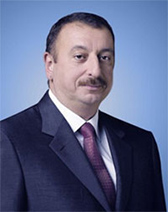
İlham Aliyev
Fourth President of Azerbaijan since 2003, chairman of the New Azerbaijan Party, and former vice president of the State Oil Company of Azerbaijan.
Born on December 24, 1961
Age: 65
Profession: President, Politician
Place of Birth: Baku, Azerbaijan SSR, Soviet Union (now Azerbaijan)
Ilham Aliyev, born Ilham Heydar oghlu Aliyev on December 24, 1961, is an Azerbaijani politician who has served as the fourth President of Azerbaijan since October 31, 2003. Before becoming president, he served as vice president and first vice president of the State Oil Company of Azerbaijan Republic (SOCAR), a member of the Azerbaijani Parliament, and Prime Minister of Azerbaijan. He has chaired the New Azerbaijan Party since 2005. His presidency has included the development of Azerbaijan's oil and natural gas industries, the 2020 Nagorno-Karabakh War, the restoration of Azerbaijani control over Nagorno-Karabakh in 2023, and negotiations with Armenia over a peace agreement.
Early Life and Family Background
Ilham Aliyev, whose full name is Ilham Heydar oghlu Aliyev, was born on December 24, 1961, in Baku, the capital of the Azerbaijan Soviet Socialist Republic, then part of the Soviet Union.
His father, Heydar Aliyev, was a senior Soviet political official who later became the third President of independent Azerbaijan. His mother, Zarifa Aliyeva, was an ophthalmologist, medical researcher, and academic.
Aliyev grew up in a family closely involved in Soviet Azerbaijan's political and academic institutions. His father held senior positions in the Azerbaijan Communist Party and subsequently served in the Soviet Union's central government.
From 1967 to 1977, Ilham Aliyev attended Secondary School No. 6 in Baku. Following his secondary education, he moved to Moscow to pursue university studies.
Education at the Moscow State Institute of International Relations
In 1977, Ilham Aliyev enrolled at the Moscow State Institute of International Relations (MGIMO), an institution specializing in international relations, diplomacy, political studies, and related disciplines.
He completed his undergraduate studies in 1982 and continued with postgraduate education at the same institution.
In 1985, he defended a dissertation in history and received the Soviet academic degree of Candidate of Historical Sciences, generally considered comparable to a doctoral qualification.
After completing his postgraduate studies, Aliyev joined the teaching staff at MGIMO. From 1985 until 1990, he worked as a lecturer, teaching subjects associated with his academic specialization.
His teaching career ended during the final years of the Soviet Union, a period of political and economic change across the Soviet republics.
Early Business Career
Between 1991 and 1994, Ilham Aliyev worked in the private sector. His commercial activities included business operations in Moscow and Istanbul.
During this period, he managed several industrial and commercial enterprises. His work in private business preceded his appointment to the management of Azerbaijan's state-owned oil company.
The years following the dissolution of the Soviet Union were marked by economic restructuring and political instability in Azerbaijan. The country declared independence in 1991, while the development and export of its energy resources became central issues for successive governments.
Career at the State Oil Company of Azerbaijan
In 1994, Ilham Aliyev was appointed vice president of the State Oil Company of Azerbaijan Republic (SOCAR), the state-owned company responsible for major activities involving Azerbaijan's oil and natural gas resources.
He later became the company's first vice president and remained in senior management until August 2003.
During his years at SOCAR, Azerbaijan pursued international agreements intended to develop offshore petroleum resources in the Caspian Sea and increase energy exports.
Aliyev participated in projects associated with the energy policies of his father, President Heydar Aliyev. These included cooperation with international oil companies, the development of Caspian oil fields, and plans to transport Azerbaijani petroleum to international markets.
One of the principal agreements of this period was the 1994 production-sharing agreement concerning the Azeri, Chirag, and deepwater Gunashli oil fields, commonly known as the Contract of the Century. The agreement involved SOCAR and a consortium of international petroleum companies.
The development of Azerbaijan's energy sector was accompanied by plans for major export infrastructure, including the Baku–Tbilisi–Ceyhan Pipeline, which would transport Caspian oil through Georgia and Turkey to the Mediterranean coast.
Aliyev's work in the oil industry continued alongside his entry into parliamentary politics during the second half of the 1990s.
Entry into Politics and Parliamentary Career
Ilham Aliyev was elected to the National Assembly of Azerbaijan, known as the Milli Majlis, in the parliamentary elections of 1995 and 2000.
He became active in the New Azerbaijan Party (Yeni Azerbaijan Party, YAP), which had been established by his father, Heydar Aliyev, in 1992.
In 1999, he was appointed deputy chairman of the party. In 2001, he became its first deputy chairman. He subsequently succeeded his father as chairman of the New Azerbaijan Party in 2005.
From 2001 to 2003, Aliyev headed Azerbaijan's parliamentary delegation to the Parliamentary Assembly of the Council of Europe (PACE).
In January 2003, he was elected a vice president of the Parliamentary Assembly and became a member of its Bureau. His responsibilities involved participation in the organization's parliamentary meetings and its activities concerning European political cooperation.
In 2004, he received an honorary membership diploma and medallion from the Parliamentary Assembly of the Council of Europe.
Appointment as Prime Minister
On August 4, 2003, President Heydar Aliyev nominated Ilham Aliyev for the position of Prime Minister of Azerbaijan.
Following approval by the Milli Majlis, he was appointed prime minister on the same day. His parliamentary membership ended as a result of the appointment.
Aliyev served as prime minister from August 4 to November 4, 2003, although he assumed the presidency before the formal end of that period.
His appointment occurred while his father was experiencing serious health problems that increasingly limited his ability to perform presidential duties.
With a presidential election scheduled for October 2003, the New Azerbaijan Party nominated Ilham Aliyev as its candidate.
Presidency of Azerbaijan
2003 Presidential Election
On October 15, 2003, Ilham Aliyev participated in Azerbaijan's presidential election as the candidate of the New Azerbaijan Party. According to the official results, he received more than 76 percent of the vote and was elected the country's fourth president.
He was inaugurated on October 31, 2003, succeeding his father, Heydar Aliyev, whose presidency had begun in 1993.
Heydar Aliyev died on December 12, 2003, approximately six weeks after his son's inauguration.
The 2003 election and its administration were criticized by international observers, who raised concerns regarding the conditions of political competition, electoral procedures, and incidents of violence following the vote.
During the first years of his presidency, Ilham Aliyev continued the government's investment strategy in the energy sector. Construction and development work proceeded on infrastructure intended to connect Caspian petroleum production with international markets.
The Baku–Tbilisi–Ceyhan Pipeline became operational in 2006, providing a route for transporting Azerbaijani crude oil through Georgia and Turkey to the Mediterranean port of Ceyhan.
2008 and 2013 Presidential Elections
On October 15, 2008, Ilham Aliyev was reelected for a second presidential term. Official election results credited him with 88.73 percent of the vote. He began the new term on October 24, 2008.
In the presidential election held on October 9, 2013, he was elected for a third term with 84.54 percent of the vote, according to the official results.
Throughout these election cycles, international monitoring organizations raised concerns about Azerbaijan's political environment, including restrictions on opposition activity, freedom of expression, and the competitiveness of elections.
Election observers from the Organization for Security and Co-operation in Europe (OSCE) reported shortcomings involving electoral procedures and fundamental freedoms in several elections held during Aliyev's presidency.
His government maintained that the electoral results reflected voter support and rejected several criticisms of the country's political system.
2016 Constitutional Referendum
On September 26, 2016, Azerbaijan held a constitutional referendum that introduced significant changes to the country's political institutions.
The amendments extended the presidential term from five to seven years and established the positions of First Vice President and other vice presidents.
The changes expanded the constitutional framework of the presidency and modified provisions concerning the succession and organization of executive authority.
On February 21, 2017, Ilham Aliyev appointed his wife, Mehriban Aliyeva, as Azerbaijan's First Vice President.
The appointment attracted international attention because it placed a member of the president's immediate family in a senior constitutional office.
2018 Presidential Election
On April 11, 2018, Azerbaijan held an early presidential election. According to the official results, Ilham Aliyev received 86.02 percent of the vote and secured a fourth presidential term.
The election took place under the seven-year presidential term introduced by the 2016 constitutional amendments.
International election observers again raised concerns about the absence of genuine political competition and restrictions affecting political participation and public debate.
Nagorno-Karabakh Conflict and Relations with Armenia
One of the principal foreign policy and security issues during Ilham Aliyev's presidency was the longstanding conflict between Azerbaijan and Armenia over Nagorno-Karabakh and surrounding territories.
The conflict emerged during the final years of the Soviet Union and developed into a war in the early 1990s. Following the fighting, Armenian forces and the Armenian-backed authorities of Nagorno-Karabakh controlled the region and several surrounding districts internationally recognized as part of Azerbaijan.
For much of the following two decades, negotiations concerning the disputed territories were conducted through international diplomatic initiatives, including the OSCE Minsk Group.
Aliyev's government consistently maintained that Nagorno-Karabakh and the surrounding territories formed part of Azerbaijan's internationally recognized sovereign territory.
Armenian authorities and representatives of the region's Armenian population advanced their own positions concerning security and self-determination. The competing claims remained unresolved despite repeated diplomatic negotiations.
2020 Nagorno-Karabakh War
On September 27, 2020, large-scale fighting broke out between Azerbaijani and Armenian forces in and around Nagorno-Karabakh.
The conflict continued for approximately six weeks. Azerbaijani forces captured several territories that had been controlled by Armenian forces since the 1990s, including the city of Shusha, also known as Shushi.
On November 9, 2020, Ilham Aliyev, Armenian Prime Minister Nikol Pashinyan, and Russian President Vladimir Putin signed a trilateral statement establishing a ceasefire.
The agreement took effect on November 10, bringing the major phase of fighting to an end.
Under its terms, Armenian forces withdrew from the districts of Aghdam, Kalbajar, and Lachin, while Russian peacekeeping forces were deployed to areas of Nagorno-Karabakh.
The agreement also established arrangements for the Lachin corridor, which connected the Armenian-populated part of Nagorno-Karabakh with Armenia.
The war resulted in substantial military and civilian casualties on both sides. It also changed the territorial and security arrangements that had existed since the end of the first Nagorno-Karabakh War.
For Azerbaijan, the outcome restored control over several territories lost during the earlier conflict. In Armenia, the ceasefire agreement generated political controversy and domestic criticism of the government.
2023 Nagorno-Karabakh Military Operation
On September 19, 2023, Azerbaijan launched a military operation against Armenian armed formations in Nagorno-Karabakh.
After approximately one day of fighting, the region's Armenian forces agreed to disarm, and Azerbaijan established control over the remaining territory of Nagorno-Karabakh.
The operation was followed by the departure of most of the region's ethnic Armenian population. According to the Office of the United Nations High Commissioner for Refugees, more than 100,000 people crossed from Nagorno-Karabakh into Armenia within approximately one week.
The displacement raised concerns among international humanitarian and human rights organizations about the security of civilians, the protection of property, and the prospects for the population's return.
On October 15, 2023, Ilham Aliyev visited Khankendi, also known as Stepanakert, and raised the Azerbaijani national flag.
Following Azerbaijan's restoration of control over the region, the government began reconstruction, infrastructure development, and resettlement initiatives in areas affected by the conflict.
These projects included housing construction, transportation links, public facilities, and programs intended to enable displaced Azerbaijani residents and their descendants to return to territories from which they had been displaced during earlier fighting.
2025 Armenia–Azerbaijan Peace Negotiations
On August 8, 2025, Ilham Aliyev met Armenian Prime Minister Nikol Pashinyan in Washington, D.C., at a meeting hosted by United States President Donald Trump.
During the meeting, the foreign ministers of Azerbaijan and Armenia initialed the agreed text of an agreement concerning the establishment of peace and interstate relations between the two countries.
Aliyev and Pashinyan also signed a joint declaration in Washington, witnessed by President Trump.
The declaration addressed mutual recognition of sovereignty and territorial integrity, the development of transportation links, and the normalization of bilateral relations.
One element concerned transportation between mainland Azerbaijan and the Nakhchivan Autonomous Republic through Armenian territory. The declaration included plans for a proposed transport initiative called the Trump Route for International Peace and Prosperity (TRIPP), involving cooperation with the United States.
The two governments also supported steps toward ending the OSCE Minsk Process, which had previously served as a diplomatic framework for negotiations concerning Nagorno-Karabakh.
The initialing of the agreement text did not constitute the final signing or ratification of a comprehensive peace treaty. Further diplomatic and legal procedures remained necessary.
Negotiations concerning formal signature, implementation, and bilateral relations continued into 2026.
2024 Presidential Election and Fifth Term
On February 7, 2024, Ilham Aliyev participated in another early presidential election. According to the official results, he received 92.12 percent of the vote and was elected for a fifth term.
The results were approved by the Constitutional Court of Azerbaijan on February 13, 2024.
The election was the first Azerbaijani presidential election conducted across all of the country's internationally recognized territory following the restoration of Azerbaijani control over Nagorno-Karabakh in September 2023.
However, the OSCE Office for Democratic Institutions and Human Rights (ODIHR) criticized the election environment, reporting an absence of genuine political alternatives and limitations on meaningful political competition.
The organization's assessment also identified broader concerns involving fundamental freedoms and the conditions under which political opposition and independent media operated.
Aliyev began the new seven-year presidential term following his reelection.
COP29 Climate Conference in Baku
In November 2024, Azerbaijan hosted the 29th Conference of the Parties to the United Nations Framework Convention on Climate Change, known as COP29, in Baku.
The conference brought together national leaders, government representatives, climate negotiators, and international organizations to discuss climate finance, emissions reduction, adaptation, and international cooperation.
On November 12, 2024, Ilham Aliyev addressed the opening of the World Leaders Climate Action Summit held as part of COP29.
Azerbaijan's position as a major producer and exporter of oil and natural gas formed part of the international discussions surrounding its hosting of the conference.
The event also provided an opportunity for the Azerbaijani government to present its energy policies and plans concerning renewable electricity generation and regional energy cooperation.
Presidency and Political Developments in 2026
As of October 2026, Ilham Aliyev continues to serve as President of Azerbaijan and chairman of the New Azerbaijan Party.
His government continues to pursue policies involving economic development, energy exports, transportation infrastructure, and reconstruction in territories affected by the Nagorno-Karabakh conflict.
Relations with Armenia remain a major subject of regional diplomacy. Following the August 2025 Washington declaration and the initialing of the proposed peace agreement, the two governments continued discussions concerning formal implementation, transportation connections, and future bilateral relations.
Azerbaijan's international economic relationships include oil and natural gas exports to European markets and transportation projects linking the Caspian region with Turkey and other countries.
Domestic political issues during Aliyev's presidency have included electoral competition, political opposition, freedom of expression, and the role of state institutions. International monitoring organizations have continued to examine the country's political and human rights environment.
President of the National Olympic Committee
Ilham Aliyev was elected president of the National Olympic Committee of Azerbaijan in 1997 and continued in this position after becoming president of the country.
During his years in sports administration, Azerbaijan invested in athletic facilities, national sports organizations, and preparations for international competitions.
Baku hosted the inaugural European Games in 2015 and the Islamic Solidarity Games in 2017.
Aliyev participated in the activities of the National Olympic Committee and in preparations connected with international sporting events hosted by Azerbaijan.
He also received the Olympic Order from the International Olympic Committee in recognition of his involvement in sports administration.
Personal Life and Family
Ilham Aliyev married Mehriban Aliyeva in 1983. The couple have three children: Leyla Aliyeva, Arzu Aliyeva, and Heydar Aliyev, their son.
Mehriban Aliyeva has served as the First Vice President of Azerbaijan since February 21, 2017. Before her appointment, she was involved in public and cultural initiatives, including the activities of the Heydar Aliyev Foundation.
Aliyev's daughters, Leyla and Arzu, have also been involved in business and cultural activities.
In addition to Azerbaijani, Ilham Aliyev speaks Russian, English, Turkish, and French.
Awards and Decorations
2007 – Grand Cross of the Legion of Honour, France
2005 – Heydar Aliyev Order, Azerbaijan
2005 – King Abdulaziz Order, Saudi Arabia
2004 – Order of the Star of Romania, Romania
2004 – Honorary Membership Diploma and Medallion, Parliamentary Assembly of the Council of Europe
Major Political and Government Positions
2003–present – President of Azerbaijan
2005–present – Chairman of the New Azerbaijan Party
2003 – Prime Minister of Azerbaijan
2001–2003 – Head of Azerbaijan's Delegation to the Parliamentary Assembly of the Council of Europe
2003 – Vice President of the Parliamentary Assembly of the Council of Europe
1995–2003 – Member of the National Assembly of Azerbaijan
1994–2003 – Vice President and First Vice President of the State Oil Company of Azerbaijan Republic (SOCAR)
1997–present – President of the National Olympic Committee of Azerbaijan
1985–1990 – Lecturer, Moscow State Institute of International Relations
Political Party
New Azerbaijan Party (YAP) – Deputy Chairman from 1999, First Deputy Chairman from 2001, and Chairman since 2005.
Source: Biyografiler.com
Frequently asked questions about İlham Aliyev
Who is İlham Aliyev?, İlham Aliyev biography, İlham Aliyev life story, İlham Aliyev age, İlham Aliyev facts, İlham Aliyev birthplace, İlham Aliyev photos, İlham Aliyev videos, İlham Aliyev career

Lamine Yamal
Professional footballer

Erling Haaland
Professional footballer

Keanu Reeves
Actor

Kylian Mbappe
Professional footballer

Austin Abrams
Actor

Bad Bunny
Rapper, Songwriter

İlham Aliyev
President, Politician

Adewale Akinnuoye-Agbaje
Actor, Former Model

Adam Smith
Economist, Author

Adam Driver
Actor

Adam Baldwin
Actor

Acun Ilıcalı
Producer, TV Personality, Media executive, Businessperson
Adewale Akinnuoye-Agbaje
Actor, Former Model

John Healey
Politician
Erling Haaland
Professional footballer

Ursula von der Leyen
Politician, Physician
Lamine Yamal
Professional footballer

Leonardo DiCaprio
Actor