
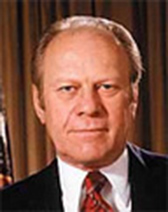
Gerald Rodolph Ford Jr.
The Accidental President | 38th President of the United States
Born on July 14, 1913
Died on December 26, 2006
Age at death: 93
Profession: Politician, Lawyer, Former President
Place of Birth: Omaha, Nebraska, United States
Place of Death: Rancho Mirage, California, United States
Gerald Rudolph Ford Jr. was the 38th President of the United States and remains the only individual in American history to have served as both Vice President and President without being elected to either office. He was born on July 14, 1913, in Omaha, Nebraska, under the name Leslie Lynch King, Jr. After his mother remarried, he took the name of his stepfather, Gerald Rudolph Ford.
Ford began his education studying economics at the University of Michigan and later graduated from Yale University Law School in 1941. That same year, he was admitted to the Michigan Bar and practiced law briefly until the Japanese attack on Pearl Harbor. Following the attack, he enlisted in the United States Navy. Serving in the Pacific Theater during World War II, Ford was awarded the nine-star Asiatic–Pacific Campaign Medal for his service. After the war, on October 15, 1948, he married Betty Ford.
In 1949, Ford entered national politics after being elected as a Republican to the U.S. House of Representatives, where he served Michigan for 13 consecutive terms. During his time in Congress, he served on numerous committees, including the Warren Commission, which investigated the assassination of President John F. Kennedy. From 1965 to 1973, Ford held the position of House Minority Leader, becoming a prominent figure in Republican leadership.
Known as a loyal Republican, Ford consistently supported his party’s positions, particularly advocating for a strong national defense budget. He led congressional opposition to President Lyndon B. Johnson’s domestic social programs and served in leadership roles within the National Republican Congressional Committee between 1968 and 1972.
The political scandals of the early 1970s altered the trajectory of Ford’s career. After Vice President Spiro T. Agnew resigned in late 1973, President Richard Nixon nominated Ford as Vice President. Ford assumed office on December 6, 1973, traveling extensively and representing the Nixon administration until August 1974, when Nixon resigned due to the Watergate scandal.
On August 9, 1974, Gerald Rudolph Ford Jr. was sworn in as the 38th President of the United States. One month into his presidency, Ford granted a full presidential pardon to Richard Nixon, a decision that provoked strong public backlash by preventing Nixon from being prosecuted for alleged corruption. This decision significantly affected public trust in Ford’s administration.
During Ford’s presidency, the United States faced mounting economic challenges. His administration oversaw the final withdrawal of American troops from Vietnam. In foreign affairs, Ford largely continued Nixon’s diplomatic policies, visiting both Asia and Europe. He pursued a moderate approach toward the Soviet Union, aiming to stabilize relations, while also attempting to reduce tensions in the Middle East.
In the 1974 midterm elections, Republicans suffered major losses, largely due to economic uncertainty and lingering fallout from the Watergate scandal. In 1975, Ford proposed a series of economic measures—including tax cuts, limited consumer spending, and heavy taxation on imported gasoline—to combat the economic downturn. These proposals were largely rejected by the Democratic-controlled Congress.
Ford ran for election in 1976 but was defeated by Democratic candidate Jimmy Carter. Following his loss, he retired from political life in 1977.
After leaving office, Ford published his memoir, A Time to Heal, in 1979. Throughout his retirement, he remained active by participating in conferences and symposiums, serving on the boards of corporations and charitable foundations, and writing articles. Continuing the tradition of former presidents, he established a presidential library in Grand Rapids, which opened in 1981.
In 2000, Ford suffered two heart attacks but recovered quickly. His health declined again in late 2005, leading to hospitalization for tests and subsequent treatment for pneumonia and respiratory issues. In 2006, he underwent angioplasty and had a pacemaker implanted. On November 12, 2006, he became the longest-living former president in U.S. history.
Gerald Rudolph Ford Jr. died on December 26, 2006, at the age of 93. In a letter released after his death, he criticized the Iraq policy of George W. Bush, stating that the Iraq War was a mistake.
Source: Biyografiler.com
Frequently asked questions about Gerald Rodolph Ford Jr.
Who is Gerald Rodolph Ford Jr.?, Gerald Rodolph Ford Jr. biography, Gerald Rodolph Ford Jr. life story, Gerald Rodolph Ford Jr. age, Gerald Rodolph Ford Jr. facts, Gerald Rodolph Ford Jr. birthplace, Gerald Rodolph Ford Jr. photos, Gerald Rodolph Ford Jr. videos, Gerald Rodolph Ford Jr. career
Related Biographies

Lamine Yamal
Professional footballer

Erling Haaland
Professional footballer

Kylian Mbappe
Professional footballer

Keanu Reeves
Actor

Austin Abrams
Actor

Bad Bunny
Rapper, Songwriter


Hongjoong
Singer, Rapper, Songwriter, Composer

Ludacris
Rapper, Actor

Kwon Eunbi
Singer

Sarah Wayne Callies
Actress, Screenwriter, Producer, Director

LaTavia Roberson
Singer, Actress, Entrepreneur
Keanu Reeves
Actor

Leonardo DiCaprio
Actor

John F. Kennedy
Politician, Statesman
Austin Abrams
Actor
Erling Haaland
Professional footballer
Lamine Yamal
Professional footballer