
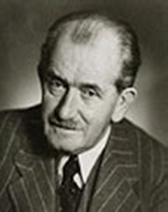
Ferdinand Porsche
Pioneer of automotive engineering; creator of the first Porsche sports car and key figure behind the Volkswagen project
Born on October 3, 1875
Died on January 30, 1951
Age at death: 76
Profession: Engineer, Designer
Place of Birth: Maffersdorf, Bohemia, Austria-Hungary
Place of Death: Stuttgart, Germany
Ferdinand Porsche was an Austrian-born automotive engineer and designer whose work laid the foundations of modern vehicle engineering. He is widely regarded as one of the most influential figures in automotive history, remembered both for his early innovations in electric and hybrid propulsion and for developing the first sports car to bear his own name after the Second World War.
Early Life and Technical Education
Ferdinand Porsche was born on October 3, 1875, in the town of Maffersdorf in Bohemia, then part of the Austro-Hungarian Empire. He was the son of a master plumber and tinsmith, and from an early age he displayed an intense curiosity for mechanics and electricity. In his spare time, he experimented with electrical devices and mechanical systems, laying the groundwork for his future career.
After completing secondary school, Porsche moved to Vienna, where he enrolled as a guest student at the Technical University of Vienna. Although he did not formally graduate, his technical talent enabled him to begin working at a company producing electric motors, marking his entry into professional engineering.
Early Innovations and the Lohner-Porsche
In 1900, Ferdinand Porsche achieved international recognition at the Paris World Exhibition, where he presented an automobile powered by electric motors mounted directly in the wheel hubs. Developed during his employment with the Viennese carriage manufacturer Lohner, the vehicle became known as the Lohner-Porsche and represented a revolutionary approach to automobile design.
Porsche soon advanced this concept by developing a hybrid propulsion system in which a gasoline engine generated electricity to power the wheel-mounted motors. This system eliminated the need for a conventional gearbox and stands as one of the earliest examples of hybrid automotive technology.
Austro-Daimler and World War I
Ferdinand Porsche later joined Austro-Daimler in Wiener Neustadt as technical director. During his tenure, he designed aircraft engines and military towing vehicles used to transport artillery during the First World War. His engineering achievements during this period established his reputation as one of the leading automotive and mechanical designers of his era.
Following the war, Porsche designed two passenger vehicles that became the final major successes of his career at Austro-Daimler, before internal disagreements led him to leave the company.
Independent Career and Industrial Leadership
In 1923, Ferdinand Porsche moved to Stuttgart as technical director and chief designer. After working for the Steyr company in Austria between 1928 and 1930, he chose independence at the age of fifty-five and established his own engineering consultancy.
His firm gained international recognition, designing vehicles for multiple manufacturers and introducing technical innovations, including a suspension system featuring a torsion-based shock-absorbing element capable of rotational movement under load.
Volkswagen Project and the Nazi Era
During the 1930s, Porsche’s financial difficulties eased when he became a key automotive consultant to the National Socialist regime. Acting under the direct authority of Adolf Hitler, Porsche was commissioned to design an affordable, durable automobile suitable for mass ownership.
By 1936, three test vehicles featuring a four-cylinder boxer engine producing 22 horsepower and displacing 984 cc had been completed. Initially marketed as the “KdF-Wagen,” inspired by the “Kraft durch Freude” organization, the air-cooled vehicle later became known as the Volkswagen. Although Ferdinand Porsche is often credited as its inventor, significant elements of the original design were developed earlier by Czechoslovak engineer Béla Barényi.
Porsche joined the National Socialist German Workers’ Party in 1937 and the SS in 1938. Despite these affiliations, he was widely regarded as a technically focused designer rather than a political ideologue. During this period, he became a founder and executive of Volkswagen in Wolfsburg.
World War II and Military Engineering
Following the commencement of mass production of the Volkswagen “Beetle,” Ferdinand Porsche redirected the company’s resources toward military vehicle production during the Second World War. He gained prominence as a designer of armored vehicles and amphibious military transports.
After receiving Germany’s highest national honor, he adopted the academic title of “Professor.” As the war neared its end, Porsche relocated his operations to Gmünd in Carinthia, Austria.
Postwar Imprisonment and Return to Engineering
After Germany’s surrender, Ferdinand Porsche was arrested and imprisoned in France. He was released on bail in 1947 and returned to Austria, where he devoted himself to sustaining his business under the leadership of his son, Ferry Porsche, focusing on repair work and spare parts manufacturing.
The First Porsche Sports Car
In 1948, Ferdinand Porsche introduced the first sports car to carry his name. Powered by a 40-horsepower Volkswagen engine, the vehicle marked the birth of the Porsche brand as an independent manufacturer of performance automobiles.
Death and Legacy
In 1950, Porsche relocated his company back to Stuttgart. He died there on January 30, 1951, at the age of seventy-five. Ferdinand Porsche left behind a complex and influential legacy, defined by groundbreaking engineering achievements, controversial political associations, and the foundation of one of the world’s most enduring automotive brands.
Source: Biyografiler.com
Frequently asked questions about Ferdinand Porsche
Who is Ferdinand Porsche?, Ferdinand Porsche biography, Ferdinand Porsche life story, Ferdinand Porsche age, Ferdinand Porsche facts, Ferdinand Porsche birthplace, Ferdinand Porsche photos, Ferdinand Porsche videos, Ferdinand Porsche career
Related Biographies

Lamine Yamal
Professional footballer

Erling Haaland
Professional footballer

Austin Abrams
Actor

Keanu Reeves
Actor

Kylian Mbappe
Professional footballer

Bad Bunny
Rapper, Songwriter


Hongjoong
Singer, Rapper, Songwriter, Composer

Ludacris
Rapper, Actor

Kwon Eunbi
Singer

Sarah Wayne Callies
Actress, Screenwriter, Producer, Director

LaTavia Roberson
Singer, Actress, Entrepreneur
Keanu Reeves
Actor

Demi Moore
Actress

Leonardo DiCaprio
Actor

Haruki Murakami
Novelist, Writer

Kim Jong-un
Politician

Gal Gadot
Actress, Model