
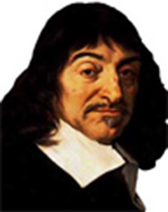
Descartes
Father of Modern Philosophy and Analytic Geometry
Born on March 31, 1596
Died on February 11, 1650
Age at death: 54
Profession: Philosopher, Writer, Scientist, Mathematician
Place of Birth: La Haye en Touraine, Indre-et-Loire, France
Place of Death: Stockholm, Sweden
René Descartes was a French thinker, writer, scientist, and mathematician, widely regarded as the founder of modern philosophy, modern psychology, and analytic geometry. Through his groundbreaking theories, he profoundly influenced subsequent scientists and philosophers and played a decisive role in elevating science to its modern level. By applying mathematical reasoning to philosophical inquiry, he argued that there exist certain forms of knowledge that arise directly, are absolutely certain, and beyond dispute. He famously expressed this foundational principle in the statement: “I think, therefore I am.” Considered one of the central figures of the Scientific Revolution, Descartes developed the Cartesian coordinate system (Cartesianism), making monumental contributions to the evolution of plane geometry and mathematics.
René Descartes was born on March 31, 1596, in La Haye en Touraine, a town in France that later took his name, into a wealthy family. One year after his birth, his mother died of tuberculosis. His father, Joachim Descartes, a judge at the High Court of Brittany, remarried, and Descartes was raised by his stepmother. At the age of ten, he was sent to the Jesuit college Royal Henry-Le-Grand in La Flèche, Anjou, which he would later describe as one of the finest schools in Europe. Due to his fragile health, he was allowed to remain in bed until he felt well, a privilege that enabled him to devote significant time to mathematics, a subject he deeply admired. The curriculum’s strong emphasis on Latin and Greek allowed him to master both languages, which later proved invaluable when studying ancient scientific and philosophical texts.
Curious about travel, discovery, and learning, Descartes moved to Paris with several friends after graduating from secondary school in 1612. Captivated by the city’s splendor, he initially lived a carefree life. However, after accidentally meeting two friends who shared his passion for mathematics, he redirected his focus toward scientific inquiry. During this period, he worked tirelessly on mathematical research, particularly alongside his close friend Marin Mersenne. His acquaintance with the renowned mathematician Claude Mydorge further broadened his intellectual horizons.
Throughout his education, Descartes cultivated his knowledge in classical literature, history, rhetoric, and philosophy. At his father’s insistence, he enrolled in the Faculty of Law at the University of Poitiers and graduated in 1616. At the time, Europe was engulfed in religious and political turmoil, making military service a popular choice among young men of noble families. Seeking to secure his social standing, Descartes joined the army. In 1618, inspired by reports of Prince William of Orange’s campaigns to liberate the Netherlands from Spanish rule, he joined the Protestant Dutch army under Prince Maurice of Nassau.
During his military service, Descartes met Isaac Beeckman, a figure who helped him recognize his creative talent in mathematics and physics. In 1618, he wrote his first philosophical work, Compendium Musicae, dedicating it to Beeckman. In November 1619, while traveling in Germany, Descartes experienced a profound intellectual vision concerning the application of mathematics to physical problems. This period marked a decisive turning point in his life and laid the conceptual groundwork for his theories on analytic geometry. From then on, he devoted his life to uncovering the mysterious relationship between mathematics and nature. He also reflected deeply on St. Augustine’s concept of free will, developing ideas about human will as a natural faculty independent of divine will.
After leaving the service of the Prince of Orange, Descartes traveled across Denmark, Poland, and Germany, later rejoining the military during the outbreak of the Thirty Years’ War, this time serving the Catholic Duke of Bavaria. While stationed in Ulm, he developed a methodology concerning the unity of sciences. Although he never participated in direct combat, this period allowed him to focus on thinking, traveling, observing, and creating. His ultimate goal was to understand the universe through firsthand experience, leading him to interact with people from diverse backgrounds and test himself under varying conditions. In November 1619, he experienced a series of famous dreams in a heated room, later interpreting them as symbolic of his intellectual destiny.
In 1621, Descartes joined the Imperial Hungarian army. Returning to France in 1622, he settled in Paris and later Brittany. He sold his inherited properties in Poitou, investing his entire fortune to ensure financial independence and uninterrupted research. He traveled to Italy the same year and remained primarily in Paris until 1627.
In 1628, Descartes returned to the Netherlands, where he spent the most productive years of his intellectual life until 1649. There, he developed revolutionary theories in mathematics, geometry, and philosophy and began writing Treatise on the World. He met Cardinal Pierre de Bérulle, whose intellectual guidance encouraged him to formalize his ideas. Throughout this period, he maintained correspondence with Marin Mersenne and interacted with scholars such as Frans van Schooten, Hortensius, and Christiaan Huygens.
In 1633, following the condemnation of Galileo Galilei by the Roman Catholic Church, Descartes refrained from publishing Treatise on the World, despite having completed it. The work was published posthumously in 1701. During this period, he also completed but did not publish Le Monde.
Although Descartes never married, he had a daughter, Francine Descartes, born in 1635 to his Dutch companion Hélène Jans. Francine died in 1640 at the age of five, a loss that deeply affected him.
Descartes continued publishing major works, including Discourse on the Method in 1637 and Meditations on First Philosophy in 1641. In 1644, he published Principles of Philosophy, later translated into French. He corresponded extensively with Princess Elizabeth of Bohemia on topics ranging from mathematics to metaphysics. Despite receiving an offer of residence and income from the King of France, he declined to preserve his intellectual independence.
In 1649, Descartes completed The Passions of the Soul. That same year, he accepted an invitation from Queen Christina of Sweden to teach in Stockholm. Forced to give lessons early in the morning in an unfamiliar cold climate, he fell ill with pneumonia and died on February 11, 1650, at the age of 54. His last words were reported as: “Now, my soul, it is time to depart.” His remains were transferred to Paris in 1667.
René Descartes revolutionized Western thought, dismantling medieval intellectual traditions and laying the foundations of modern science and philosophy. He advocated simplicity, methodical doubt, and rational inquiry, asserting that clear and distinct ideas are the basis of certain knowledge. His belief in the unity of sciences and his use of French rather than Latin made knowledge accessible to all. By distinguishing between mind and matter and emphasizing innate ideas, he permanently reshaped philosophical discourse.
Descartes’ application of algebra to geometry gave rise to analytic geometry, introducing the Cartesian coordinate system. He classified curves based on equations and standardized the use of letters such as x, y, and z for unknown quantities. His work in optics established fundamental laws of reflection. Above all, his method of systematic doubt culminated in his immortal proposition:
“I think, therefore I am.”
For Descartes, the universe was a solvable enigma, and science was humanity’s tool for uncovering its truths. His legacy endures as one of the cornerstones of modern intellectual history.
Works:
Compendium Musicae (1618)
Rules for the Direction of the Mind (1626–1628)
Le Monde (1633)
Discourse on the Method (1637)
La Géométrie (1637)
Meditations on First Philosophy (1641)
Principles of Philosophy (1644)
The Description of the Human Body (1647)
The Passions of the Soul (1649)
Correspondence (1657)
Source: Biyografiler.com
Frequently asked questions about Descartes
Who is Descartes?, Descartes biography, Descartes life story, Descartes age, Descartes facts, Descartes birthplace, Descartes photos, Descartes videos, Descartes career
Related Biographies

Lamine Yamal
Professional footballer

Kylian Mbappe
Professional footballer

Erling Haaland
Professional footballer

Sam Altman
Entrepreneur, Investor, CEO

Bad Bunny
Rapper, Songwriter

Brad Pitt
Actor


Hongjoong
Singer, Rapper, Songwriter, Composer

Ludacris
Rapper, Actor

Kwon Eunbi
Singer

Sarah Wayne Callies
Actress, Screenwriter, Producer, Director

LaTavia Roberson
Singer, Actress, Entrepreneur
Erling Haaland
Professional footballer

Tim Berners Lee
Computer Scientist, Professor

Amber Heard
Actress, Model
Brad Pitt
Actor
Lamine Yamal
Professional footballer

Tim Roth
Actor, Director