
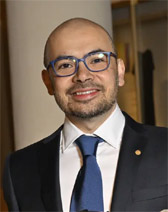
Demis Hassabis
Born on July 27, 1976
Age: 50
Profession: Computer Scientist, Artificial Intelligence Researcher, Entrepreneur
Place of Birth: London, England
Demis Hassabis is a British computer scientist, artificial intelligence researcher, and entrepreneur. He is the co-founder and CEO of Google DeepMind and Isomorphic Labs, and also serves as an artificial intelligence advisor to the United Kingdom Government.
Demis Hassabis was born on July 27, 1976, in London, England, to a Greek Cypriot father and a Singaporean mother.
Demis Hassabis began playing chess at the age of four as a child prodigy, and by the age of thirteen had reached master level with an Elo rating of 2300. He captained the England junior chess team on multiple occasions. In 1995, he represented the University of Cambridge in a chess match and earned half-blue distinctions in 1996 and 1997.
Between 1988 and 1990, Demis Hassabis attended Queen Elizabeth's School, Barnet, a boys’ grammar school in North London. He was later home-schooled by his family, during which time he purchased his first computer, a ZX Spectrum 48K, financed by his chess winnings, and taught himself programming through books. He then continued his education at Christ's College, Finchley, a state school in East Finchley, North London. He completed his A-level and S-level examinations two years early, at the ages of fifteen and sixteen respectively.
Asked by the University of Cambridge to take a gap year due to his young age, Demis Hassabis began his video game career at Bullfrog Productions. He initially worked on level design for Syndicate, and at the age of seventeen collaborated with Peter Molyneux as co-designer and lead programmer on the 1994 game Theme Park.
Demis Hassabis later left Bullfrog Productions to continue his education at Queens' College, Cambridge, where he completed the Computer Science Tripos and graduated in 1997 with double First-Class honors.
Early in his career, Demis Hassabis worked as a video game artificial intelligence programmer and designer, and was also an expert board game player.
After graduating from Cambridge, Demis Hassabis worked at Lionhead Studios, a company recently founded by Peter Molyneux, with whom he had previously collaborated at Bullfrog Productions. At Lionhead Studios, he served as lead AI programmer on the 2001 game Black & White.
In 1998, Demis Hassabis left Lionhead Studios and founded Elixir Studios, an independent game developer based in London. During this period, he signed publishing agreements with Eidos Interactive, Vivendi Universal, and Microsoft. Alongside managing the company, he served as lead designer on the BAFTA-nominated games Republic: The Revolution and Evil Genius.
The first game developed by Elixir Studios, Republic: The Revolution, was an ambitious and unconventional political simulation. Due to its broad scope, the game’s release was delayed; it featured an artificial intelligence simulation modeling the functioning of a completely fictional country. In April 2005, the intellectual property and technology rights of Elixir Studios were sold to various publishers, and the studio was closed.
In 2010, Demis Hassabis co-founded DeepMind, an artificial intelligence startup focused on machine learning, in London, alongside Shane Legg and Mustafa Suleyman. He met Shane Legg while both were postdoctoral researchers at the Gatsby Computational Neuroscience Unit, and knew Mustafa Suleyman through a family connection. Demis Hassabis also brought university friend and former Elixir partner David Silver into the team.
In 2014, Google acquired DeepMind for £400 million. While much of the company remained an independent London-based entity, DeepMind Health was later directly integrated into Google Health. Following the acquisition, the company achieved numerous major breakthroughs, most notably the creation of AlphaGo.
In 2024, Demis Hassabis was awarded a knighthood for his contributions to artificial intelligence. In the same year, he won the Nobel Prize in Chemistry together with John Jumper for their work on protein structure prediction. The two scientists used artificial intelligence to predict the structures of nearly all known proteins and developed a tool called AlphaFold2. The Nobel Prize was shared equally between them. The remaining half of the prize was awarded to David Baker for his achievement in constructing new proteins, described by the committee as an “almost impossible accomplishment.”
Ödülleri :
2024 - Nobel Prize in Chemistry
2023 - Breakthrough Prize in Life Sciences
2023 - Albert Lasker Basic Medical Research Award
2023 - Canada Gairdner International Award
2022 - BBVA Foundation Frontiers of Knowledge Award
2020 - Dan David Prize
Source: Biyografiler.com
Frequently asked questions about Demis Hassabis
Who is Demis Hassabis?, Demis Hassabis biography, Demis Hassabis life story, Demis Hassabis age, Demis Hassabis facts, Demis Hassabis birthplace, Demis Hassabis photos, Demis Hassabis videos, Demis Hassabis career
Related Biographies

Lamine Yamal
Professional footballer

Kylian Mbappe
Professional footballer

Erling Haaland
Professional footballer

Sam Altman
Entrepreneur, Investor, CEO

Austin Abrams
Actor

Bad Bunny
Rapper, Songwriter


Hongjoong
Singer, Rapper, Songwriter, Composer

Ludacris
Rapper, Actor

Kwon Eunbi
Singer

Sarah Wayne Callies
Actress, Screenwriter, Producer, Director

LaTavia Roberson
Singer, Actress, Entrepreneur

Pedro Sanchez
Politician

Adam Sandler
Actor

Cillian Murphy
Actor
Lamine Yamal
Professional footballer
Austin Abrams
Actor

Brad Pitt
Actor