
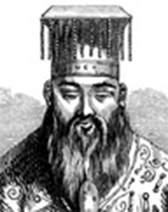
Confucius
The Great Sage and Supreme Teacher of China
Born on ?? ??, 0551
Died on 0497
Age at death: -54
Profession: Philosopher
Place of Birth: Lu State, Shandong region, ancient China
Place of Death: Qufu (K’iuh-fow), Lu State, ancient China
A wise teacher and a revolutionary thinker, Confucius developed a system of thought bearing his own name through the power of reason and moral virtue, placing it among the most solid and consistent teachings in human history. Although he died six centuries before Jesus Christ, his ideas and works have endured, keeping his memory alive across the ages.
Confucius was born in 551 BCE in the State of Lu, located in the Shandong region of ancient China. His father, Shuh-liang Heih, was the commander of the Tsow region and an influential figure. He had many daughters but no sons. At the age of seventy, he married again and finally had a male child.
As with many great figures of antiquity, numerous legends surround the birth of Confucius. His mother, Ching-tsai, prayed to God for a son. One night, God appeared to her in a dream and said, “You will have a son, but you must give birth to him in a mulberry tree.” Following this vision, Shuh-liang Heih took his wife to a hollow on a hill known as the “Empty Mulberry Tree” for the birth.
According to legend, dragons and forest spirits guarded the cave at the moment of birth. Ching-tsai heard a voice accompanied by music saying, “The birth of the sacred son has moved even the heavens; melodies are sent down to the earth for him.” The child bore forty-nine marks on his body, along with inscriptions declaring: “This child will bring principles to the world and correct the condition of humanity.” A spring emerged inside the cave, and from its waters appeared a stone bearing the words: “This child, born from the essence of water, will be a king without a crown.”
When Confucius was three years old, his father died, and the family fell into poverty. To survive, their only son had to work. Nevertheless, this hardship did not prevent him from learning, and by the age of thirteen, he had already reached the rank of the sages.
At nineteen, Confucius married and had one son and two daughters. However, his growing desire to become a learned man and a wise administrator weakened his attachment to family life. Shortly after marriage, he took an official post in a granary, and later was appointed to oversee gardens and livestock.
At the age of twenty-two, Confucius founded a school and began spreading the principles of “proper conduct and proper governance.” He gained fame both as an educator and as an administrator. As a ruler, he was known as a devoted revolutionary who opposed long-standing corruption. As a teacher, he was respected for his deep knowledge of history and philosophy, as well as for his moral principles.
In 517 BCE, Confucius taught the sons of the leading families of the State of Lu. Later, he traveled to the imperial capital, where he conducted historical research and studied music. Music held a special place in his thought; to Confucius, music was the key to balance, a concept he applied extensively in his teachings.
While in the capital, he met his contemporary Lao-tzu, the founder of Taoism, one of the three major religious-philosophical traditions of China. Lao-tzu was the complete opposite of Confucius in personality, yet his equal in greatness.
Though entirely different in character and appearance, Lao-tzu was an idealistic and mystical thinker who believed in a Supreme Being. He taught that to reach truth, one must renounce worldly desires and become conscious of the Tao, allowing it to penetrate the soul. Confucius, by contrast, was practical, skillful, and deeply engaged with worldly affairs. He never acknowledged a personal god. This encounter left Lao-tzu unaffected, but it left a lasting impression on Confucius.
At the age of fifty-two, Confucius was appointed governor of the city of Chungtu and soon became the highest judicial authority in the region.
He fed the poor, defined the duties of both the powerful and the weak with justice, constantly supervised prices, and used the state treasury to promote trade. He built roads and bridges to improve transportation and limited the power of the nobility to protect the people from oppression. Under his rule, all stood equal before justice.
Although these policies were popular with the public, they conflicted with the interests of the elite. As a result, Confucius was removed from office and exiled.
His term in office lasted only three years, yet it took thirteen long years before he was allowed to return to his homeland. Dreaming of realizing his ideal state, Confucius traveled from one country to another for thirteen years, hoping to find a prince who would entrust him with full authority. Each time, he returned empty-handed.
He spent the final five years of his life writing and teaching his students. During this period, he wrote his only known work, Spring and Autumn Annals. However, the true significance of Confucius lies not in this single book, but in the profound influence he exerted on China for centuries.
Two hundred years after his death, attempts were made to erase his influence: his works were burned, and scholars who followed his teachings were executed. Yet these efforts failed. The teachings of Confucius continued to spread, and the Chinese parliament even considered proclaiming him a god, despite his teachings having no connection to spiritual realms.
Confucius died in 479 BCE at the age of seventy-two. At his grave in the city of Qufu stands a marble statue and an inscription reading: “Here lies the most perfect teacher and the wisest king of China.”
Source: Biyografiler.com
Frequently asked questions about Confucius
Who is Confucius?, Confucius biography, Confucius life story, Confucius age, Confucius facts, Confucius birthplace, Confucius photos, Confucius videos, Confucius career

Lamine Yamal
Professional footballer

Kylian Mbappe
Professional footballer

Erling Haaland
Professional footballer

Sam Altman
Entrepreneur, Investor, CEO

Austin Abrams
Actor

Bad Bunny
Rapper, Songwriter


Hongjoong
Singer, Rapper, Songwriter, Composer

Ludacris
Rapper, Actor

Kwon Eunbi
Singer

Sarah Wayne Callies
Actress, Screenwriter, Producer, Director

LaTavia Roberson
Singer, Actress, Entrepreneur

Pedro Sanchez
Politician

Adam Sandler
Actor

Cillian Murphy
Actor
Lamine Yamal
Professional footballer
Austin Abrams
Actor

Brad Pitt
Actor