
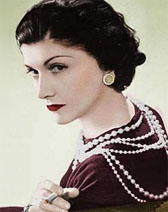
Coco Chanel
Founder of Chanel and pioneer of modern women’s fashion
Born on August 19, 1883
Died on January 10, 1971
Age at death: 88
Profession: Fashion Designer, Entrepreneur
Place of Birth: Saumur, France
Place of Death: Paris, France
Coco Chanel, born Gabrielle Bonheur Chanel, was a French fashion designer and the founder of the luxury fashion house Chanel. She is one of the most influential figures in fashion history, credited with liberating women from restrictive clothing, introducing trousers into women’s everyday wear, and redefining elegance through simplicity, comfort, and timeless design.
Early Life and Childhood
Gabrielle Bonheur Chanel was born on August 19, 1883, in Saumur, France, as the second child of the family. Her mother, Eugénie Jeanne Devolle, worked as a laundress, while her father, Albert Chanel, was a traveling salesman who moved between towns selling goods from a horse-drawn cart. She had two brothers and two sisters.
Chanel’s childhood was shaped by poverty and abandonment. Her parents married seven years after her birth. When her mother died of tuberculosis, Gabrielle was only twelve years old. Shortly afterward, her father left her and her siblings at the Catholic convent orphanage in Aubazine and never returned.
At the Aubazine convent, Chanel received a strict Catholic education and spent six formative years learning discipline, restraint, and sewing. During this period, she apprenticed with a tailor who produced uniforms for French officers, gaining early technical skills that would later influence her clean, structured approach to clothing.
The Origin of “Coco”
While working as a seamstress, Chanel encountered French cavalry officers who frequented the establishments near her workplace. Among them was wealthy officer and socialite Étienne Balsan. Through Balsan, she was introduced to café-concert venues such as Café Chantant.
Encouraged to perform on stage, Gabrielle sang the popular song “Qui qu’a vu Coco dans l’Trocadéro?”. The audience repeatedly shouted “Coco! Coco!”—a nickname that would soon replace her given name. From that evening onward, Étienne Balsan called her “Coco,” marking the symbolic birth of the woman who would later become a global icon.
Chanel became Balsan’s lover and lived at his château for several years. There she was introduced to aristocratic life, luxury, horses, pearls, champagne, and elite society. Through Balsan’s circle, she also encountered figures from the French upper class and artistic world.
Love, Patronage, and Independence
In 1908, Coco Chanel met Arthur “Boy” Capel, an English aristocrat and close friend of Balsan. Capel became the great love of her life and the most important patron of her early career. Their relationship lasted nine years and profoundly shaped her future.
Capel financed Chanel’s first Paris apartment and encouraged her independence as a businesswoman. Although Capel married Lady Diana Wyndham in 1918, his relationship with Chanel continued until his death in a car accident on December 21, 1919. Devastated, Chanel later erected a memorial at the site of the crash.
The Rise of the Chanel Fashion House
In 1910, at the age of 27, Coco Chanel opened her first boutique in Paris, selling hats financed by Boy Capel. Her understated designs quickly attracted attention from actresses and socialites. During the First World War, she began designing clothing that freed women from corsets, reflecting the changing roles of women whose husbands were at the front.
Her career took a decisive turn in 1912 when actress Gabrielle Dorziat wore Chanel hats on stage, bringing her widespread recognition. In 1913, Capel financed a boutique in Deauville, where Chanel introduced relaxed garments such as jersey jackets, sweaters, sailor blouses, and the iconic marinière.
By 1916, Chanel had opened a haute couture house. In 1917, she employed more than 300 seamstresses. In 1918, she acquired the entire building at 31 Rue Cambon in Paris, which became the headquarters of the Chanel empire. By 1919, the Chanel fashion house was firmly established.
Artists, Composers, and High Society
In the early 1920s, Chanel became romantically involved with Russian composer Igor Stravinsky, who was living in exile in Paris with his ill wife and four children. Their passionate relationship later inspired books and films exploring Chanel’s private life.
In 1923, Chanel met Hugh Richard Arthur Grosvenor, the Duke of Westminster. Their relationship lasted nearly ten years. The Duke purchased homes for her in London’s Mayfair district and land near Monte Carlo, where Chanel built a grand villa. Through Grosvenor, Chanel became closely connected to British aristocracy and figures such as Winston Churchill.
Chanel No. 5 and Worldwide Fame
In 1921, Coco Chanel launched her first perfume, the legendary Chanel No. 5, developed with perfumer Ernest Beaux. She named it after her lucky number and insisted on presenting collections on the fifth day of the month—a tradition still observed by the Chanel house.
By the mid-1920s, Chanel had become one of Europe’s most celebrated designers, dressing royalty, artists, and cultural figures across the continent.
Reinventing Women’s Fashion
Coco Chanel revolutionized women’s fashion by introducing trousers as everyday wear, borrowing elements from men’s clothing and redefining femininity. She transformed black—once associated solely with mourning—into a symbol of elegance through the little black dress.
She created the iconic tweed jacket inspired by English menswear, quilted handbags with chain straps, ballet flats, and bold costume jewelry. One of her most famous designs was worn by Audrey Hepburn in the 1961 film Breakfast at Tiffany’s.
Her influence extended beyond fashion. During the 1930s, under Mustafa Kemal ATATÜRK, Chanel was commissioned to design uniforms for the Turkish Armed Forces, designs that remained in use until the 1980s.
War, Controversy, and Comeback
In 1939, at the outbreak of the Second World War, Chanel closed her fashion house. During the occupation of Paris, she had a relationship with German diplomat Hans Günther von Dincklage. After the war, she was questioned regarding her activities and relocated to Switzerland in 1945.
In 1954, at the age of 70, Chanel returned to Paris and reopened her fashion house. Although initially criticized in France, her comeback collection was praised by Vogue and Harper’s Bazaar in the United States, which described it as “the return of coquetry.”
Later Life and Death
Despite relationships with some of the most powerful men of her era, Coco Chanel never married. She died on January 10, 1971, at the age of 88 in her suite at the Hôtel Ritz Paris.
Coco Chanel remains one of the most revolutionary figures in cultural history—an individual who reshaped how women dress, move, and define elegance, leaving a legacy that continues to influence fashion, art, and modern identity.
Selected Quotations
“Luxury must be comfortable, otherwise it is not luxury.” “Fashion fades, only style remains the same.” “Perfume is the invisible, unforgettable, ultimate accessory.” “A woman who does not wear perfume has no future.” “In order to be irreplaceable one must always be different.” “Elegance is refusal.”
Source: Biyografiler.com
Frequently asked questions about Coco Chanel
Who is Coco Chanel?, Coco Chanel biography, Coco Chanel life story, Coco Chanel age, Coco Chanel facts, Coco Chanel birthplace, Coco Chanel photos, Coco Chanel videos, Coco Chanel career
Related Biographies

Lamine Yamal
Professional footballer

Sam Altman
Entrepreneur, Investor, CEO

Kylian Mbappe
Professional footballer

Alice Weidel
Politician, Economist

Erling Haaland
Professional footballer

Giorgia Meloni
Politician, Journalist


Hongjoong
Singer, Rapper, Songwriter, Composer

Ludacris
Rapper, Actor

Kwon Eunbi
Singer

Sarah Wayne Callies
Actress, Screenwriter, Producer, Director

LaTavia Roberson
Singer, Actress, Entrepreneur
Sam Altman
Entrepreneur, Investor, CEO

Kaia Gerber
Model, Actress
Lamine Yamal
Professional footballer

Austin Abrams
Actor
Kylian Mbappe
Professional footballer

Zohran Mamdani
Politician, Musician