
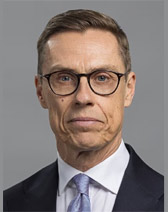
Alexander Stubb
The President of Finland known for his pro-European politics, international experience and security-focused foreign policy
Born on April 1, 1968
Age: 58
Profession: Politician, Academic, President
Place of Birth: Helsinki, Finland
Alexander Stubb is a Finnish politician, academic and author who has served as the 13th President of the Republic of Finland since 1 March 2024. His full name is Cai-Göran Alexander Stubb. Before becoming president, Alexander Stubb served as a member of the European Parliament, Minister for Foreign Affairs, Minister for European Affairs and Foreign Trade, Prime Minister of Finland, Minister of Finance and Vice-President of the European Investment Bank. His political identity has been shaped by strong support for European integration, transatlantic cooperation, international institutions and a Western-oriented security policy. :contentReference[oaicite:1]{index=1}
Early Life and Family Background
Alexander Stubb was born on 1 April 1968 in Helsinki, the capital of Finland. He grew up in the Lehtisaari neighbourhood in a bilingual Finnish-Swedish family. He spoke Finnish with his mother, Christel Stubb, and Swedish with his father, Göran Stubb. He also spoke Finnish with his brother, Nicolas Stubb. This bilingual upbringing allowed him to experience two of Finland’s principal linguistic and cultural traditions from an early age.
Alexander Stubb began his education at a Finnish-language primary school before transferring to a Swedish-language school in the fourth grade. His father, Göran Stubb, became a prominent figure in Finnish ice hockey administration. The family’s connection to sport and international environments influenced both the athletic interests and outward-looking worldview that later became visible in Alexander Stubb’s public life. :contentReference[oaicite:2]{index=2}
Education and International Formation
After completing upper secondary school and his military service, Alexander Stubb moved to the United States to attend Furman University in South Carolina. He studied political science and graduated with a Bachelor of Arts degree in 1993. During his university years, he was also an accomplished golfer and reached a level that allowed him to represent Finland in the sport.
In 1994, Alexander Stubb continued his education at Paris-Sorbonne University, where he received a diploma in French language and civilisation. He subsequently moved to Bruges, Belgium, to study at the College of Europe. He completed a Master of Arts degree in political science and European studies in 1995.
Alexander Stubb later pursued doctoral studies at the London School of Economics and Political Science. In 1999, he received a doctorate in international relations after defending a thesis on flexible integration within the European Union. His research examined how European countries could participate in different levels of political and institutional integration while remaining part of a common European framework. :contentReference[oaicite:3]{index=3}
His education in Finland, the United States, France, Belgium and the United Kingdom gave Alexander Stubb an unusually international academic background before he entered electoral politics. In addition to Finnish and Swedish, which he speaks at a native or bilingual level, he is fluent in English, French and German. His multilingual abilities became a significant advantage in diplomacy, European politics and international academic life. :contentReference[oaicite:4]{index=4}
Academic Career and Early Work in European Affairs
Alexander Stubb began his professional career as a researcher at the Ministry for Foreign Affairs of Finland between 1995 and 1997. He subsequently worked as a doctoral researcher at the Academy of Finland and as a researcher at Finland’s Permanent Representation to the European Union in Brussels.
His early academic and professional work concentrated on European institutions, international relations and the political development of the European Union. From 2000 to 2007, Alexander Stubb worked as a visiting professor at the College of Europe, where he taught subjects connected with European integration and institutional reform.
Between 2001 and 2003, Alexander Stubb served as an adviser to Romano Prodi, who was then President of the European Commission. He later worked as a counsellor at Finland’s Permanent Representation to the European Union. These positions placed him close to the institutions and decision-making processes of European politics before he became an elected representative. :contentReference[oaicite:5]{index=5}
Unlike politicians who build their careers through municipal government or domestic party organisations, Alexander Stubb entered public life through academic research, diplomacy and European institutions. His early career gave him a detailed understanding of how the European Union functions and reinforced his belief that Finland should actively participate in shaping European policies.
Member of the European Parliament
Alexander Stubb entered electoral politics in 2004 as a candidate for the centre-right National Coalition Party. He was elected to the European Parliament with the second-highest number of votes received by a Finnish candidate in that election.
During his term in the European Parliament, Alexander Stubb worked on issues involving European institutions, external relations, constitutional reform and common foreign and security policy. He developed a reputation as one of Finland’s most outspoken supporters of deeper European cooperation.
His pro-European position became a defining element of his political identity. Alexander Stubb argued that Finland should not view the European Union merely as a source of regulations or economic obligations. Instead, he maintained that Finland should seek influence by participating actively in European decision-making and building coalitions with other member states.
In April 2008, National Coalition Party chairman Jyrki Katainen invited Alexander Stubb to become Finland’s Minister for Foreign Affairs. He left the European Parliament after nearly four years to enter the Finnish government. :contentReference[oaicite:6]{index=6}
Minister for Foreign Affairs
Alexander Stubb served as Finland’s Minister for Foreign Affairs from April 2008 until June 2011. In this role, he represented Finland in international organisations and managed relations with the European Union, neighbouring countries, the United States and other global partners.
His ministerial term coincided with the global financial crisis, debates over the European Union’s international role and growing concerns about the security environment in Europe. Alexander Stubb supported close cooperation between Europe and the United States and promoted a more coordinated European foreign policy.
Although Finland was not yet a member of NATO during his time as foreign minister, Alexander Stubb was associated with the political movement that favoured closer cooperation with the alliance. He consistently presented Finland as a Western democracy whose security and prosperity were closely connected to European and transatlantic institutions.
In April 2011, Alexander Stubb was elected to the Parliament of Finland as a representative of the National Coalition Party. His move from European politics to the Finnish Parliament strengthened his position within national politics and prepared the way for further ministerial responsibilities. :contentReference[oaicite:7]{index=7}
Minister for European Affairs and Foreign Trade
In June 2011, Alexander Stubb was appointed Minister for European Affairs and Foreign Trade in the government led by Jyrki Katainen. He remained in the position until June 2014.
As minister, Alexander Stubb was responsible for Finland’s European policy and the promotion of international trade. His responsibilities included representing Finnish interests during the eurozone debt crisis, supporting Finnish companies in foreign markets and contributing to European discussions on economic governance.
His experience in Brussels made him a visible representative of Finland in European negotiations. He continued to argue that Finland’s national interests were best protected through active participation in the European Union rather than through political isolation or resistance to European integration.
Prime Minister of Finland
In 2014, Alexander Stubb stood again as a candidate in the European parliamentary election and received the highest number of votes among Finnish candidates. However, he did not take up his seat because he entered the leadership contest of the National Coalition Party.
In June 2014, Alexander Stubb was elected chairman of the party, succeeding Jyrki Katainen. He subsequently became Prime Minister of Finland on 24 June 2014 and led a five-party coalition government.
His premiership took place during a difficult period for Finland. The country was experiencing weak economic growth, pressure on public finances, declining industrial competitiveness and disputes over structural reforms. His government attempted to advance changes involving public administration, municipal services and the Finnish economy, but disagreements among the coalition parties restricted the implementation of several proposals.
The international security environment also became more unstable during this period. Russia’s annexation of Crimea and the conflict in eastern Ukraine increased concern about European security, particularly in Finland, which shares a long border with Russia. Alexander Stubb continued to support closer European and transatlantic cooperation in response to these developments.
Alexander Stubb served as prime minister until 29 May 2015. Although his premiership lasted less than a year, it placed him at the centre of Finland’s domestic economic debate and its response to a rapidly changing security environment. :contentReference[oaicite:8]{index=8}
Minister of Finance and Party Leadership Contest
Following the 2015 parliamentary election, Juha Sipilä formed a coalition government in which Alexander Stubb became Minister of Finance. He served in the position from May 2015 until June 2016.
As finance minister, Alexander Stubb became closely associated with efforts to reduce government expenditure, reform the labour market and improve Finland’s economic competitiveness. These policies generated significant political debate, particularly because proposed spending reductions affected public services and social programmes.
His political style also became a subject of discussion. Supporters regarded Alexander Stubb as energetic, multilingual, internationally experienced and highly effective in presenting Finland abroad. Critics sometimes described his communication style as overly optimistic, media-focused or disconnected from the daily concerns of ordinary citizens.
In June 2016, Alexander Stubb lost the leadership of the National Coalition Party to Petteri Orpo. He subsequently left the government but remained a member of the Finnish Parliament until July 2017. :contentReference[oaicite:9]{index=9}
European Investment Bank
In August 2017, Alexander Stubb became Vice-President and a member of the Management Committee of the European Investment Bank. He succeeded Jan Vapaavuori as Finland’s representative in the institution’s senior management.
His responsibilities included oversight of the bank’s operations in Finland, Sweden, Denmark, Estonia, Latvia and Lithuania, as well as activities in several countries outside the European Union. The position allowed Alexander Stubb to apply his political and European policy experience to investment, infrastructure, economic development and financial cooperation.
Alexander Stubb remained at the European Investment Bank until January 2020. His term at the institution marked a temporary departure from elected politics while keeping him closely involved with European economic policy and international affairs. :contentReference[oaicite:10]{index=10}
Return to Academia and International Governance
In May 2020, Alexander Stubb became Professor and Director of the School of Transnational Governance at the European University Institute in Florence, Italy. In this role, he worked on international governance, European affairs, diplomacy and the education of future policymakers.
His academic work examined changes in the international order, relations between major powers, European strategic autonomy and the future of democratic institutions. The position allowed him to combine his experience as a scholar, government minister, former prime minister and senior European official.
In 2017, former Finnish president and Nobel Peace Prize laureate Martti Ahtisaari invited Alexander Stubb to chair the board of the Crisis Management Initiative, an organisation specialising in conflict prevention and peace mediation. He remained chairman until February 2024.
Alexander Stubb took a leave of absence from the European University Institute in October 2023 after entering the Finnish presidential election. His tenure as director and professor formally ended in February 2024. :contentReference[oaicite:11]{index=11}
2024 Presidential Election
In 2023, Alexander Stubb announced his candidacy in the 2024 Finnish presidential election. He entered the contest as the candidate of the National Coalition Party and presented a political programme centred on an open, secure and internationally engaged Finland.
Foreign policy and national security dominated the campaign. Finland had recently joined NATO, Russia’s full-scale invasion of Ukraine was continuing, and the country was adapting to a fundamentally different European security environment. Alexander Stubb highlighted his experience in diplomacy, European institutions and international politics as qualifications for the presidency.
No candidate received an absolute majority in the first round. Alexander Stubb therefore advanced to a runoff against former Foreign Minister Pekka Haavisto. In the second round, held on 11 February 2024, Alexander Stubb received 51.6 per cent of the vote, while Pekka Haavisto received 48.4 per cent.
The confirmed result made Alexander Stubb the 13th President of the Republic of Finland. He succeeded Sauli Niinistö and formally assumed office on 1 March 2024. :contentReference[oaicite:12]{index=12}
President of Finland
Alexander Stubb’s presidency began during Finland’s first full year as a member of NATO. Under Finland’s constitutional system, the president leads the country’s foreign policy in cooperation with the government and serves as Supreme Commander of the Finnish Defence Forces. These powers have given foreign affairs, military preparedness and international security a central place in his presidency. :contentReference[oaicite:13]{index=13}
Alexander Stubb has supported the continued integration of Finland into NATO’s defence structures and has argued for stronger European defence capabilities. He has also emphasised the importance of maintaining close relations between Europe and the United States while strengthening cooperation among the Nordic and Baltic countries.
Russia’s invasion of Ukraine has been one of the defining issues of his presidency. Alexander Stubb has advocated sustained political, financial and military assistance for Ukraine and has supported security guarantees that would protect Ukrainian sovereignty and territorial integrity. He has also argued that decisions concerning Ukraine’s future membership in the European Union or NATO should not be controlled by Russia. :contentReference[oaicite:14]{index=14}
His foreign policy outlook combines values, national interests and an awareness of international power relations. Alexander Stubb has promoted democracy, human rights, the rule of law and multilateral cooperation while also arguing that European states must invest in military strength, economic resilience and strategic partnerships.
As president, Alexander Stubb has remained an active participant in international diplomacy. His meetings and speeches have addressed NATO integration, support for Ukraine, relations with the United States, European security, the transformation of the global order and the role of smaller states in international politics. His official activities continued throughout 2026, confirming his ongoing service as President of Finland. :contentReference[oaicite:15]{index=15}
Political Views and Public Image
Alexander Stubb is generally described as a liberal-conservative and strongly pro-European politician. He supports market-oriented economic policies, international trade, European integration and close cooperation with Western political and security institutions.
His supporters view him as a modern, multilingual and internationally experienced statesman with strong communication skills. His academic credentials and long experience in European institutions have strengthened his reputation as a specialist in foreign affairs and international security.
Critics have questioned some of the economic policies associated with his periods as prime minister and finance minister. His energetic and highly visible communication style has also attracted criticism from those who regard it as overly polished or elitist. Nevertheless, his ability to communicate directly in several languages and engage with international audiences has remained one of his most recognisable political strengths.
Academic Writing and Publications
Alexander Stubb has written or contributed to approximately twenty books dealing with international politics, the European Union, Finnish identity, political leadership and physical activity. His published work reflects the combination of academic analysis and personal observation that has characterised his public career.
He co-authored a biography with Karo Hämäläinen in 2017. Alexander Stubb has also written columns for publications including Helsingin Sanomat, Blue Wings, Apu, Dagens Industri and the Financial Times. :contentReference[oaicite:16]{index=16}
His academic and journalistic writing has allowed him to remain engaged in intellectual debates outside formal political office. Topics frequently associated with his work include the future of Europe, international power, globalisation, Finnish society and the relationship between physical endurance and personal discipline.
Sporting Interests
Alexander Stubb is widely known for his enthusiasm for sport and physical exercise. During different periods of his life, he has played ice hockey, football, handball and golf. He reached the Finnish national team level in golf before concentrating on his academic and political career.
In adulthood, Alexander Stubb became particularly associated with endurance sports. His activities have included running, cycling, swimming, skiing and triathlon. He has competed regularly in triathlon events and has incorporated physical training into his public identity.
His active lifestyle has distinguished him from many other European political figures. For Alexander Stubb, sport has functioned not only as recreation but also as a source of discipline, stress management and personal endurance. He is also an enthusiastic reader whose interests range from political philosophy to biographies. :contentReference[oaicite:17]{index=17}
Personal Life
Alexander Stubb married Suzanne Innes-Stubb in 1998. Born in Britain, she is a qualified lawyer and holds both British and Finnish citizenship. Her professional career has included work in European law, competition law, data protection, ethics and corporate compliance.
The couple have two children, Emilie Stubb, born in 2001, and Oliver Stubb, born in 2004. Their family also includes a cat named Milo. Suzanne Innes-Stubb shares her husband’s interest in endurance sports and has participated in running, cycling, swimming and triathlon events. :contentReference[oaicite:18]{index=18}
Alexander Stubb’s career has developed across academia, diplomacy, European institutions and national politics. His progression from researcher and European policy specialist to foreign minister, prime minister and president reflects the increasingly international character of contemporary Finnish political leadership. His presidency has been defined by Finland’s NATO membership, the transformation of European security and the effort to strengthen the country’s position within the Western alliance system.
Selected Offices and Positions
- 1995–1997: Researcher at the Ministry for Foreign Affairs of Finland
- 1997–1999: Doctoral Researcher at the Academy of Finland
- 1999–2001: Researcher at Finland’s Permanent Representation to the European Union
- 2000–2007: Visiting Professor at the College of Europe
- 2001–2003: Adviser to European Commission President Romano Prodi
- 2003–2004: Counsellor at Finland’s Permanent Representation to the European Union
- 2004–2008: Member of the European Parliament
- 2008–2011: Minister for Foreign Affairs of Finland
- 2011–2014: Minister for European Affairs and Foreign Trade of Finland
- 2011–2017: Member of the Parliament of Finland
- 2014–2015: Prime Minister of Finland
- 2014–2016: Chairman of the National Coalition Party
- 2015–2016: Minister of Finance of Finland
- 2017–2020: Vice-President of the European Investment Bank
- 2017–2024: Chairman of the Board of the Crisis Management Initiative
- 2020–2024: Professor and Director of the School of Transnational Governance
- 2024–present: President of the Republic of Finland
Source: Biyografiler.com
Frequently asked questions about Alexander Stubb
Who is Alexander Stubb?, Alexander Stubb biography, Alexander Stubb life story, Alexander Stubb age, Alexander Stubb facts, Alexander Stubb birthplace, Alexander Stubb photos, Alexander Stubb videos, Alexander Stubb career

Lamine Yamal
Professional footballer

Erling Haaland
Professional footballer

Sam Altman
Entrepreneur, Investor, CEO

Kylian Mbappe
Professional footballer

Giorgia Meloni
Politician, Journalist

Alice Weidel
Politician, Economist


Hongjoong
Singer, Rapper, Songwriter, Composer

Ludacris
Rapper, Actor

Kwon Eunbi
Singer

Sarah Wayne Callies
Actress, Screenwriter, Producer, Director

LaTavia Roberson
Singer, Actress, Entrepreneur

Elena Andreyevna Rybakina
Professional Tennis Player
Alice Weidel
Politician, Economist
Sam Altman
Entrepreneur, Investor, CEO

Lady Gaga
Singer, Musician, Songwriter, Actress, Producer

Vin Diesel
Actor, Producer, Screenwriter
Lamine Yamal
Professional footballer