
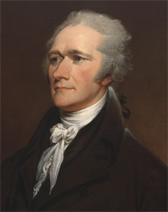
Alexander Hamilton
Founding Architect of American Finance and Federal Power
Born on January 11, 1757
Died on July 12, 1804
Age at death: 47
Profession: Statesman, Lawyer, Economist
Place of Birth: Nevis Island, British West Indies
Place of Death: Greenwich Village, New York City, United States
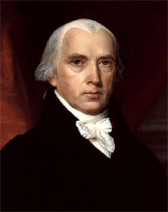
Alexander Hamilton was one of the leading figures of the Federalist movement, which argued that political unity in the United States could only be achieved through the establishment of a strong central government. He was born on January 11, 1757, on the island of Nevis in the British West Indies, as the child of an extramarital relationship between a Scottish-born father and a French-born mother. His father abandoned the family when Hamilton was still very young. In 1765, the family moved to the island of St. Croix in the Virgin Islands. At the age of eleven, Hamilton began working as a clerk in the accounting department of a commercial firm. Between the ages of twelve and thirteen, both he and his mother fell seriously ill; his mother died from the disease, leaving Hamilton orphaned at a young age.
In 1773, Hamilton traveled to America to pursue his education and enrolled at King’s College in New York, now known as Columbia University. With the outbreak of the American Revolutionary War in 1775, he left his studies to join the fight. He first served as a captain in the New York Artillery Company and later, between 1777 and 1781, held the rank of lieutenant colonel while serving as aide-de-camp to General George Washington. In 1781, Washington appointed him to command an infantry battalion. After the war ended, Hamilton completed his legal studies in Albany and became a practicing lawyer.
Between 1781 and 1782, Hamilton wrote a series of influential essays arguing that the new nation required a powerful central government to survive. In May 1787, he attended the Constitutional Convention in Philadelphia as a delegate from New York, where he consistently defended the necessity of strong federal authority. To promote ratification of the Constitution, he collaborated with James Madison and John Jay to publish a collection of eighty-five essays between October 1787 and May 1788 under the title The Federalist Papers. These writings played a decisive role in securing constitutional approval, particularly in key states such as New York.
Following the ratification of the Constitution, President George Washington appointed Hamilton as the first Secretary of the Treasury in 1789. In this role, Hamilton designed the financial foundations of the new federal government. He proposed plans for the repayment of public and state debts, the establishment of a national bank, and the use of protective tariffs to support emerging industries. He believed that the American economy should be based not on agriculture alone, but on industry and manufacturing. As debates over his policies intensified, political divisions deepened between advocates of strong federal power and those who opposed it.
To secure political support for his economic vision, Hamilton helped found the Federalist Party, the first political party in the United States. In opposition, Thomas Jefferson and James Madison led the formation of the Democratic-Republican Party, the predecessor of today’s Democratic Party. Between 1791 and 1792, Hamilton became involved in what he later described as an “illicit and improper” relationship with Maria Reynolds. In an effort to protect his political career and personal honor, he published a ninety-five-page pamphlet confessing to the affair, a decision that would have lasting consequences for his public reputation.
Hamilton sought the presidency in the elections of 1796 and 1800 but was unsuccessful in both attempts. The scandal surrounding the Reynolds affair contributed significantly to these defeats. In 1801, tragedy struck when Hamilton’s eldest son, Philip Hamilton, challenged George Eaker to a duel after Eaker refused to retract public statements criticizing Hamilton and his pamphlet. The duel ended with Philip’s death, a devastating blow to Hamilton and his family.
Hamilton resigned from government office in January 1795 and returned to the practice of law, though he continued to advise George Washington and remained influential in national politics. During the 1796 election, Federalists nominated John Adams for president and Thomas Pinckney for vice president. Due to personal conflicts with Adams, Hamilton attempted unsuccessfully to block Adams’s election. After Adams became president, Hamilton was appointed in September 1798 as Inspector General of the Army and Assistant Commander-in-Chief with the rank of brigadier general, with the support of Washington and his allies. He resigned from this position in 1800.
Hamilton’s hostility toward John Adams led him to support Republican candidate Thomas Jefferson in the election of 1800, a move that severely damaged the Federalist Party’s standing with the public. After 1801, his political influence steadily declined. His long-standing rivalry with Jefferson’s vice president, Aaron Burr, ultimately proved fatal. In 1804, Hamilton and Burr met in a politically motivated duel, during which Hamilton was mortally wounded.
Alexander Hamilton died on July 12, 1804, at the age of forty-seven in Greenwich Village, New York City. He is remembered as the first Secretary of the Treasury of the United States, the architect of the nation’s financial system, one of the principal Founding Fathers, and the founder and leading theorist of the Federalist Party.
Hamilton married Elizabeth Schuyler, and the couple had seven children together.
His legacy is honored on the United States ten-dollar bill.
Selected Works:
The Works of Alexander Hamilton (posthumous), edited by H. C. Lodge, 12 volumes, 1913.
Source: Biyografiler.com
Frequently asked questions about Alexander Hamilton
Who is Alexander Hamilton?, Alexander Hamilton biography, Alexander Hamilton life story, Alexander Hamilton age, Alexander Hamilton facts, Alexander Hamilton birthplace, Alexander Hamilton photos, Alexander Hamilton videos, Alexander Hamilton career
Related Biographies

Lamine Yamal
Professional footballer

Sam Altman
Entrepreneur, Investor, CEO

Kylian Mbappe
Professional footballer

Erling Haaland
Professional footballer

Alice Weidel
Politician, Economist

Giorgia Meloni
Politician, Journalist


Hongjoong
Singer, Rapper, Songwriter, Composer

Ludacris
Rapper, Actor

Kwon Eunbi
Singer

Sarah Wayne Callies
Actress, Screenwriter, Producer, Director

LaTavia Roberson
Singer, Actress, Entrepreneur
Lamine Yamal
Professional footballer

Austin Abrams
Actor

Eliezer Yudkowsky
Researcher, Writer

Charles Leclerc
Formula 1 Driver
Giorgia Meloni
Politician, Journalist

Recep Tayyip Erdogan
Politician