
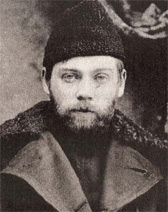
Aleksandr Bogdanov
Russian revolutionary thinker, physician, and science fiction writer who authored Red Star and developed Tektology, an early theory of organizational science. A former Bolshevik leader and intellectual opponent of Vladimir Lenin, he founded the world's first specialized blood transfusion research institute.
Born on August 22, 1873
Died on April 7, 1928
Age at death: 55
Profession: Physician, Philosopher, Political Theorist
Place of Birth: Sokółka, Grodno Governorate, Russian Empire (present-day Poland)
Place of Death: Moscow, Soviet Union
Aleksandr Bogdanov (August 22, 1873 – April 7, 1928), born Aleksandr Aleksandrovich Malinovsky, was a Russian physician, philosopher, economist, revolutionary activist, and science fiction writer. He participated in the formation of the Bolshevik movement alongside Vladimir Lenin before their political and philosophical disagreements led to his exclusion from the Bolshevik faction in 1909. His works included Empiriomonism, a philosophical study published between 1904 and 1906, Red Star (1908), a science fiction novel depicting a socialist civilization on Mars, and Tektology: Universal Organizational Science, which examined organizational principles shared by natural and social systems. He also contributed to the formation of the Proletkult cultural movement following the Russian Revolution of 1917. During his final years, Bogdanov concentrated on medical research and established the Institute of Blood Transfusion in Moscow in 1926. He died in 1928 following a severe adverse reaction during an experimental exchange transfusion.
Early Life and Education
Aleksandr Bogdanov was born on August 22, 1873, in Sokółka, then part of the Grodno Governorate of the Russian Empire. The town is now located in northeastern Poland.
His birth name was Aleksandr Aleksandrovich Malinovsky. He grew up in a family whose father worked as a schoolteacher.
After completing his secondary education in Tula in 1892, he entered Moscow University, initially studying in the Faculty of Physics and Mathematics.
During his university years, he became involved in revolutionary student activities. In 1894, he was arrested and expelled from Moscow University because of his participation in political demonstrations.
He was subsequently sent to Tula, where he continued his political education and began studying Marxist economic theory.
In 1895, he entered the medical faculty of Kharkiv University, continuing his education while maintaining contact with revolutionary organizations.
He graduated in 1899 with a medical qualification, after which he pursued both professional medical work and political activity.
Early Revolutionary Activities
During the 1890s, Aleksandr Bogdanov became involved in the Russian revolutionary movement, which operated under the restrictions imposed by the imperial government.
He participated in Marxist study groups and contributed to discussions concerning political economy, social organization, and revolutionary strategy.
His early writings examined economic and philosophical questions from a Marxist perspective.
In 1899, he published The Basic Elements of the Historical View of Nature, a work addressing the development of natural science and philosophical interpretations of the material world.
That year, he was arrested again by the imperial authorities. After a period of imprisonment, he was exiled to Vologda, where he continued his intellectual activities.
During his exile, he studied political economy, philosophy, and questions concerning scientific knowledge.
He also became acquainted with writers and revolutionaries, including Anatoly Lunacharsky and Nikolai Berdyaev.
Alliance with Vladimir Lenin and the Bolsheviks
In 1903, Aleksandr Bogdanov became associated with the Bolshevik faction of the Russian Social Democratic Labour Party (RSDLP).
He adopted Bogdanov as one of several political pseudonyms. Other names he used included Maximov, Ryadovoy, and Werner.
In 1904, he met Vladimir Lenin abroad, and the two developed a close political working relationship.
Bogdanov became a member of the Bolshevik leadership and participated in organizing revolutionary activities during the years preceding and following the Russian Revolution of 1905.
He was involved in the development of party organizations, political publications, and ideological discussions.
During this period, he was regarded as one of the principal Bolshevik intellectuals alongside Lenin.
Although they initially cooperated, their philosophical disagreements gradually became more pronounced.
Empiriomonism and Philosophical Thought
Between 1904 and 1906, Aleksandr Bogdanov published Empiriomonism, a three-volume philosophical work intended to develop an interpretation of Marxist philosophy in relation to contemporary scientific thought.
He attempted to combine elements of Marxism with philosophical ideas associated with Ernst Mach, Richard Avenarius, and Wilhelm Ostwald.
His approach emphasized human experience, the social organization of knowledge, and the relationship between collective activity and scientific understanding.
Bogdanov argued that knowledge should be examined as part of human practical activity rather than as a completely independent representation of an external world.
He also attempted to develop a consistent philosophical framework connecting the natural sciences, social relations, and historical development.
His ideas were discussed among Russian Marxists and influenced thinkers including Nikolai Bukharin.
These philosophical positions became a major source of disagreement with Lenin, who regarded them as departures from Marxist materialism.
Political Disagreements with Lenin
Following the defeat of the 1905 revolution, Aleksandr Bogdanov argued that the Bolsheviks should concentrate on underground revolutionary organization rather than participation in the limited parliamentary institutions of the Russian Empire.
He supported the position associated with the Otzovists, also known as the Recallists, who advocated withdrawing Social Democratic representatives from the State Duma.
Vladimir Lenin opposed this approach and maintained that participation in legal political institutions could be useful alongside clandestine revolutionary activity.
Their disagreements extended beyond political tactics to fundamental questions about materialism, experience, and the philosophy of science.
In 1909, Lenin published Materialism and Empirio-Criticism, a philosophical work attacking the ideas of Bogdanov and other thinkers influenced by Mach and Avenarius.
Lenin accused Bogdanov's philosophy of departing from dialectical materialism and moving toward philosophical idealism.
Bogdanov responded to the criticism in Faith and Science, published in 1910.
In June 1909, the Bolshevik faction formally excluded Bogdanov from its leadership at a meeting in Paris.
Capri School and the Vpered Group
After his exclusion from the Bolshevik leadership, Aleksandr Bogdanov continued political and educational activities with a group of revolutionary intellectuals.
He traveled to the Italian island of Capri, where Maxim Gorky maintained a residence frequented by Russian political exiles.
Alongside Anatoly Lunacharsky and other associates, Bogdanov helped establish a party school intended to provide revolutionary workers with education in political economy, philosophy, and organizational methods.
The school became associated with the Vpered Group, an opposition tendency within the Russian socialist movement.
The organizers subsequently transferred their educational activities to Bologna, where they continued until 1911.
Lenin and his supporters established a competing educational institution in France.
Over time, Bogdanov withdrew from direct factional politics and devoted increasing attention to philosophy, scientific research, and cultural theory.
Red Star and Science Fiction
In 1908, Aleksandr Bogdanov published Red Star, originally titled Krasnaya Zvezda, a science fiction novel set on the planet Mars.
The novel follows Leonid, a Russian revolutionary who travels to Mars and discovers an advanced socialist civilization.
Through descriptions of Martian society, Bogdanov examined collective ownership, technological development, industrial production, scientific education, and the organization of social life.
The fictional civilization has developed advanced transportation and industrial systems while attempting to coordinate economic activities through scientific planning.
The novel also considers problems of resource scarcity, population growth, and relations between different civilizations.
Bogdanov used science fiction to explore the possibilities and contradictions of socialist development.
Red Star was first published in Saint Petersburg in 1908 and was reissued in later years, including editions published after the Russian Revolution.
The novel circulated among Russian revolutionary and literary circles and was subsequently translated into other languages.
Its themes have been examined in studies of Russian science fiction and socialist utopian literature.
Bogdanov returned to the fictional world of Mars in Engineer Menni, published in 1913. The novel described an earlier period of Martian history and examined the social consequences of large-scale engineering and technological development.
The two novels have been discussed in relation to later Russian science fiction by writers including Alexei Tolstoy, Andrei Platonov, and Ivan Yefremov, although claims of direct influence require consideration of each author's work and historical context.
Tektology and Organizational Science
One of the principal intellectual projects of Aleksandr Bogdanov was Tektology: Universal Organizational Science, commonly known as Tektology.
The first part appeared in 1913, with subsequent volumes and revised editions published during the following decade.
Bogdanov attempted to identify organizational principles operating across different fields, including biology, economics, technology, and human society.
He argued that systems could be studied through the relationships among their components and the processes that maintain or transform their organization.
His approach examined cooperation, coordination, structural stability, adaptation, and the interaction of systems with their environments.
He also discussed organizational methods that could be applied to the study of economic institutions and collective human activity.
Later historians of science identified similarities between Tektology and ideas subsequently developed in general systems theory and cybernetics.
Although Bogdanov did not establish modern cybernetics, his writings anticipated several questions concerning systems, organization, and feedback that became prominent in twentieth-century scientific research.
His work has consequently been studied alongside the later theories of Ludwig von Bertalanffy and Norbert Wiener.
World War I and the Russian Revolution
During World War I, Aleksandr Bogdanov worked as a physician, providing medical services in the Russian military medical system.
He continued writing on philosophical, economic, and organizational subjects while remaining outside the central Bolshevik leadership.
Following the February and October Revolutions of 1917, he did not return to the Bolshevik Party.
Although he supported socialist transformation, he remained critical of the political centralization developing within the revolutionary movement.
He did not hold a principal organizational role in the October Revolution.
After the Bolsheviks came to power, he concentrated on education, economic theory, cultural development, and scientific research.
In 1918, he became associated with the newly established Socialist Academy of Social Sciences, later reorganized as the Communist Academy, where he taught and participated in academic work.
Proletkult and Proletarian Culture
Following the 1917 revolution, Aleksandr Bogdanov became one of the principal organizers and theorists of Proletkult, a movement devoted to developing forms of art, education, and culture associated with the working class.
He argued that socialist transformation required changes in cultural institutions and collective methods of thought as well as economic ownership.
Proletkult organizations established workshops, clubs, theaters, and educational institutions where workers could participate in literary and artistic production.
Bogdanov advocated the development of cultural practices based on cooperation and collective experience.
His ideas brought him into disagreement with Bolshevik leaders who favored stronger party supervision over cultural organizations.
In the early 1920s, the Soviet government reduced the organizational independence of Proletkult and brought much of its activity under state educational administration.
Bogdanov subsequently withdrew from its leadership and returned increasingly to scientific and medical work.
Arrest in 1923
In September 1923, Aleksandr Bogdanov was arrested by Soviet security authorities on suspicion of involvement with the opposition group Workers' Truth.
The organization criticized developments within Soviet political and economic life, particularly the growth of bureaucratic power.
Bogdanov was questioned for approximately five weeks.
He denied being a member of the group, and the authorities eventually released him without a criminal conviction.
After his release, he limited his involvement in political activities and devoted more time to research in medicine and physiology.
Blood Transfusion Research
Beginning in 1924, Aleksandr Bogdanov conducted experimental research involving blood transfusion.
He was interested in the possible effects of exchanged blood on physical health, recovery, and the processes associated with aging.
His approach extended beyond the established medical use of transfusion for treating blood loss.
Bogdanov believed that exchanging blood between individuals might influence physiological processes and possibly improve vitality.
He conducted a series of experimental transfusions, including procedures involving himself.
Some participants were reported to have experienced improvements in their health or general condition, but these observations did not establish that transfusions could reverse aging or provide the benefits Bogdanov proposed.
Among the individuals associated with the research was Maria Ulyanova, the sister of Vladimir Lenin.
Bogdanov also explored the social implications of blood exchange, interpreting it as a possible form of physiological cooperation between individuals.
These ideas reflected his broader interest in collective organization, although they were not supported by the standards of modern clinical research.
Institute of Blood Transfusion
In 1926, Aleksandr Bogdanov established the Institute of Blood Transfusion in Moscow, one of the earliest institutions dedicated specifically to the scientific and medical study of blood transfusion.
The institute conducted research into transfusion techniques, blood compatibility, and the physiological consequences of transferring blood between individuals.
It provided an institutional setting for experimental work at a time when blood typing and transfusion safety were still developing.
Bogdanov served as the institute's director and continued participating personally in experimental procedures.
His research was conducted before the establishment of many modern transfusion safety practices, including routine screening procedures and comprehensive testing for compatibility.
Death During a Blood Transfusion Experiment
On March 24, 1928, Aleksandr Bogdanov participated in an experimental exchange transfusion with a young student who had a history of malaria and tuberculosis.
Both participants experienced an adverse reaction following the procedure. The student survived, but Bogdanov developed severe complications.
Historical medical research identifies an acute hemolytic transfusion reaction as the principal cause of his fatal illness.
His condition deteriorated over approximately two weeks, with serious kidney complications developing after the transfusion.
Aleksandr Bogdanov died on April 7, 1928, in Moscow, Soviet Union, at the age of 54.
Although earlier accounts attributed his death directly to tuberculosis or malaria transmitted through the student's blood, later medical studies have emphasized the transfusion reaction and resulting organ failure.
He was buried at Novodevichy Cemetery in Moscow.
Selected Publications
1899 – The Basic Elements of the Historical View of Nature
1904–1906 – Empiriomonism (Three volumes)
1908 – Red Star (Science fiction novel)
1910 – Faith and Science
1913 – Engineer Menni (Science fiction novel)
1913–1922 – Tektology: Universal Organizational Science
1913 – The Philosophy of Living Experience
1914 – The Science of Social Consciousness
1918 – Questions of Socialism
1924–1925 – On Proletarian Culture
Selected Historical Dates
1873 – Born in Sokółka, Russian Empire
1892 – Entered Moscow University
1894 – Arrested and expelled from Moscow University for political activity
1899 – Graduated from Kharkiv University and qualified as a physician
1903–1904 – Became associated with the Bolshevik movement
1904 – Met Vladimir Lenin
1904–1906 – Published Empiriomonism
1908 – Published Red Star
1909 – Excluded from the Bolshevik faction
1910 – Published Faith and Science
1913 – Published Engineer Menni and the first part of Tektology
1917 – Became involved in the development of Proletkult
1918 – Began academic work at the Socialist Academy of Social Sciences
1923 – Arrested and questioned in connection with Workers' Truth
1924 – Began experimental blood transfusion research
1926 – Founded the Institute of Blood Transfusion in Moscow
1928 – Died following an experimental exchange transfusion
Source: Biyografiler.com
Frequently asked questions about Aleksandr Bogdanov
Who is Aleksandr Bogdanov?, Aleksandr Bogdanov biography, Aleksandr Bogdanov life story, Aleksandr Bogdanov age, Aleksandr Bogdanov facts, Aleksandr Bogdanov birthplace, Aleksandr Bogdanov photos, Aleksandr Bogdanov videos, Aleksandr Bogdanov career

Lamine Yamal
Professional footballer

Kylian Mbappe
Professional footballer

Brad Pitt
Actor

Erling Haaland
Professional footballer

Gadi Eisenkot
Politician, Military Commander

Leonardo DiCaprio
Actor

Martha Argerich
Pianist

Maya Angelou
Poet, Actress, Civil Rights Leader

Maya Hawke
Actress, Model

Maya Lin
Architect, Artist

Max von Sydow
Actor

Megan Rapinoe
Former Professional Footballer

Vince Gilligan
Screenwriter, Director, Producer
Erling Haaland
Professional footballer
Lamine Yamal
Professional footballer

Jensen Huang
Entrepreneur, CEO, Engineer

Scott Bessent
Politician, Investor

Ronaldinho
Professional footballer