
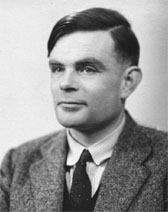
Alan Turing
Founding Father of Computer Science & Codebreaker of World War II
Born on June 23, 1912
Died on June 7, 1954
Age at death: 42
Profession: Mathematician, Cryptologist, Computer Scientist
Place of Birth: London, England
Place of Death: Manchester, England
Alan Mathison Turing made invaluable contributions to the team that broke German ciphers during the Second World War and is widely regarded as the founder of computer science. During World War II, while England and Germany were engaged in naval warfare, Britain’s success against Germany was significantly aided by Turing’s design of a machine capable of deciphering messages produced by the cipher device known as Enigma. This groundbreaking machine earned recognition as the world’s first computer.
Alan Mathison Turing was born on 23 June 1912 in London, the capital of England. His father, Julius Mathison Turing, was a British colonial civil servant working in Chatrapur, Orissa, India. His mother, Sara Turing, became pregnant there, but the family wished for their child to be born in England. They returned to London and settled in a house in Maida Vale, on the site where the Colonnade Hotel now stands. Turing had an older brother named John. At the age of six, he began attending St. Michael’s School. In 1926, at fourteen, he enrolled at the prestigious and expensive Sherborne School in Dorset, where his teachers quickly recognized his extraordinary intelligence.
While studying at Sherborne, Alan Mathison Turing formed a close friendship and romantic attachment with an older student, Christopher Morcom. Morcom’s death from tuberculosis shortly before graduation profoundly affected Turing, leading to the collapse of his religious beliefs and his adoption of atheism. After graduating, Turing attended King’s College, Cambridge, from 1931 to 1934. In 1935, immediately after completing his degree, he was elected a Fellow of King’s College.
On 28 May 1936, Alan Mathison Turing presented his seminal paper titled “On Computable Numbers, with an Application to the Entscheidungsproblem,” in which he demonstrated that any mathematical problem that can be expressed as an algorithm can be solved by a particular type of machine. He completed his doctoral thesis in June 1938 and earned the title of Doctor of Philosophy. From September 1938 onward, he also worked part-time for the Government Code and Cypher School (GCCS), the British codebreaking organization.
Following Britain’s entry into the war on 4 September 1939, Alan Mathison Turing was assigned to Bletchley Park, the wartime headquarters of the GCCS. He led Hut 8, the section responsible for decrypting German naval communications, and designed an electromechanical machine that greatly accelerated the breaking of Enigma codes. As a mathematician and cryptologist, his success in cracking German ciphers made him a wartime hero.
After the war, Alan Mathison Turing continued pioneering work in computer science and artificial intelligence. In 1948, before the existence of modern computers, he developed programs that placed him among the earliest innovators in the field. He became one of the greatest theoretical and practical pioneers of modern computing and information science. His influence extended deeply into mathematics—particularly cryptography and computability theory—and philosophy, especially the philosophy of artificial intelligence.
During his years at the University of Manchester, Alan Mathison Turing established the conceptual foundations of modern computers through the formal definition known as the Turing Machine. He also entered mathematical history through the Church–Turing Thesis, developed with his doctoral advisor Alonzo Church at Princeton. This hypothesis asserts that all effectively calculable functions can be reduced to a set of basic computational operations. Rather than a formal mathematical theorem, it remains an enduring and unrefuted hypothesis in the philosophy of mathematics.
In the spring of 1941, Alan Mathison Turing proposed marriage to his colleague and friend Joan Clarke at Hut 8. They became engaged, but the engagement was later broken off after Clarke learned of Turing’s homosexuality.
In 1948, Alan Mathison Turing was appointed Lecturer in the Mathematics Department at Manchester. In 1949, he became Deputy Director of the university’s computer laboratory and worked on software for one of the earliest true computers, the Manchester Mark 1.
At that time, homosexuality was illegal in England. In 1952, Alan Mathison Turing became involved with a man named Alan Murray. After Murray burglarized Turing’s home, police investigations revealed their relationship. Turing was prosecuted for gross indecency and sentenced to chemical castration through estrogen injections for one year. As a result of his conviction, his security clearance was revoked, and his consultancy work on highly classified cryptographic projects for GCHQ was terminated.
On 8 June 1954, Turing’s housekeeper found him dead in his Manchester home. It was officially reported that he died on 7 June 1954 from cyanide poisoning after consuming a cyanide-laced apple left by his bedside the night before. The circumstances surrounding his death remain shrouded in mystery.
Since 1966, in honor of Alan Mathison Turing, the Association for Computing Machinery has awarded the Turing Award, often described as the Nobel Prize of computer science, to individuals who have made outstanding technical contributions to the field.
On 23 June 2001, a bronze statue of Alan Mathison Turing was unveiled in Sackville Park, located between university buildings on Whitworth Street in Manchester. Today, it is also widely speculated that Apple’s iconic bitten-apple logo was inspired by Turing’s method of death.
Source: Biyografiler.com
Frequently asked questions about Alan Turing
Who is Alan Turing?, Alan Turing biography, Alan Turing life story, Alan Turing age, Alan Turing facts, Alan Turing birthplace, Alan Turing photos, Alan Turing videos, Alan Turing career

Lamine Yamal
Professional footballer

Kylian Mbappe
Professional footballer

Erling Haaland
Professional footballer

Sam Altman
Entrepreneur, Investor, CEO

Austin Abrams
Actor

Bad Bunny
Rapper, Songwriter


Hongjoong
Singer, Rapper, Songwriter, Composer

Ludacris
Rapper, Actor

Kwon Eunbi
Singer

Sarah Wayne Callies
Actress, Screenwriter, Producer, Director

LaTavia Roberson
Singer, Actress, Entrepreneur

Adam Sandler
Actor

Cillian Murphy
Actor

Pedro Sanchez
Politician
Lamine Yamal
Professional footballer
Austin Abrams
Actor

Brad Pitt
Actor