
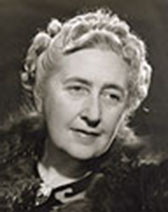
Agatha Christie
The Queen of Crime and Bestselling British Author of All Time
Born on September 15, 1890
Died on January 12, 1976
Age at death: 86
Profession: Novelist
Place of Birth: Torquay, Devon, England
Place of Death: Wallingford, Oxfordshire, England
Agatha Christie, born Mary Clarissa Miller and also known by the pseudonym Mary Westmacott, was one of the most influential and widely read writers in literary history. With her works translated into more than 113 languages and over a hundred publications to her name, she remains the best-selling British novelist of all time. As the creator of the iconic fictional detectives Hercule Poirot and Miss Jane Marple, Agatha Christie shaped the modern detective genre while also writing romantic fiction and children’s literature.
Early Life and Education
Agatha Christie was born on September 15, 1890, in Torquay, Devon, England, to Frederick Alvah Miller and Clarissa Miller. She was educated at home, where her mother strongly encouraged her creative imagination and writing abilities from an early age. This early literary encouragement proved decisive in shaping her future career.
At the age of sixteen, she was sent to Paris to study singing and piano. Although she initially pursued music, her ambitions gradually shifted toward literature. Her early exposure to European culture, combined with her vivid imagination, contributed to the atmospheric settings that later defined her novels.
Marriage and Early Writing Career
In 1914, Agatha Christie married Archibald Christie, an officer in the Royal Flying Corps. Their daughter, Rosalind, was born in 1919. During World War I, Christie worked in a hospital dispensary, gaining knowledge of poisons that would later play a crucial role in her detective fiction.
Her first detective novel, The Mysterious Affair at Styles, introduced the meticulous Belgian detective Hercule Poirot. Although initially rejected by several publishers, it was finally accepted by The Bodley Head and published in 1920. The character of Poirot would go on to appear in more than forty novels and numerous short stories.
Creation of Hercule Poirot and Miss Marple
Hercule Poirot, with his methodical reasoning and emphasis on his “little grey cells,” became one of the most famous fictional detectives in literary history. In contrast, Miss Jane Marple, introduced in The Murder at the Vicarage (1930), relied on intuition, empathy, and her understanding of human nature. Marple appeared in seventeen works, including Sleeping Murder, published in 1976.
Both Poirot and Miss Marple were widely adapted for film and television, further cementing Agatha Christie’s global legacy. Actors such as Peter Ustinov and David Suchet famously portrayed Poirot on screen, bringing her literary creations to international audiences.
Literary Masterpieces
Over a span of 56 years, Agatha Christie authored 66 detective novels. Among her most celebrated works are The Murder of Roger Ackroyd (1934), Murder on the Orient Express (1934), Death on the Nile (1937), and And Then There Were None (1939). These novels remain staples of crime fiction and have been adapted multiple times for cinema and television, including modern interpretations by filmmakers such as Kenneth Branagh.
In addition to novels, Christie wrote highly successful stage plays. The Mousetrap became the longest-running play in London’s West End, running continuously for over three decades. Her play Witness for the Prosecution won the New York Drama Critics' Circle Award for Best Foreign Play during the 1954–55 season.
Personal Turmoil and Second Marriage
In 1926, following her husband Archibald Christie’s admission that he had fallen in love with another woman, Nancy Neele, Agatha Christie experienced a personal crisis. The same year, she disappeared for eleven days, later being found registered at a Harrogate hotel under the name Mrs. Neele. The incident attracted national attention and remains one of the most discussed episodes of her life.
After her divorce was finalized in 1928, she later married archaeologist Max Mallowan, whom she had met during travels to the Middle East. Christie frequently accompanied Mallowan on excavations in Syria and Iraq, experiences that inspired novels such as Murder in Mesopotamia (1936) and Death on the Nile (1937). She recounted her archaeological adventures in her memoir Come, Tell Me How You Live (1946).
Mary Westmacott and Diverse Writing
Under the pseudonym Mary Westmacott, Agatha Christie published six psychological romance novels beginning in 1936. These works differed markedly from her detective fiction, exploring emotional depth and human relationships rather than crime and deduction.
Her productivity in the late 1920s and 1930s was extraordinary. During the 1930s alone, she published fourteen Hercule Poirot novels, multiple Miss Marple stories, Inspector Battle mysteries, Harley Quin tales, and stage plays. Her versatility demonstrated not only commercial brilliance but remarkable creative stamina.
Later Years and Honors
During World War II, Agatha Christie worked at University College Hospital in London, once again gaining pharmaceutical knowledge that enriched her fiction. In 1967, she became president of the Detection Club, an association of prominent crime writers that included figures such as Dorothy L. Sayers.
In 1971, she was appointed Dame Commander of the Order of the British Empire (DBE), one of the United Kingdom’s highest honors. She died on January 12, 1976, in Wallingford, Oxfordshire.
Cultural Legacy
Agatha Christie’s influence extends beyond literature into film, theatre, and global popular culture. Her works continue to be reinterpreted for modern audiences, ensuring her position as the “Queen of Crime.” With billions of copies sold worldwide, she stands alongside literary giants such as William Shakespeare in terms of enduring commercial and cultural impact.
Source: Biyografiler.com
Frequently asked questions about Agatha Christie
Who is Agatha Christie?, Agatha Christie biography, Agatha Christie life story, Agatha Christie age, Agatha Christie facts, Agatha Christie birthplace, Agatha Christie photos, Agatha Christie videos, Agatha Christie career
Related Biographies

Lamine Yamal
Professional footballer

Kylian Mbappe
Professional footballer

Erling Haaland
Professional footballer

Sam Altman
Entrepreneur, Investor, CEO

Austin Abrams
Actor

Bad Bunny
Rapper, Songwriter


Hongjoong
Singer, Rapper, Songwriter, Composer

Ludacris
Rapper, Actor

Kwon Eunbi
Singer

Sarah Wayne Callies
Actress, Screenwriter, Producer, Director

LaTavia Roberson
Singer, Actress, Entrepreneur

Pedro Sanchez
Politician
Lamine Yamal
Professional footballer

Adam Sandler
Actor

Cillian Murphy
Actor
Austin Abrams
Actor
Sam Altman
Entrepreneur, Investor, CEO