
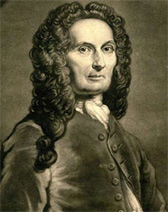
Abraham de Moivre
French mathematician known for De Moivre's formula, pioneering work in probability theory, and early mathematical studies of the normal distribution.
Born on May 26, 1667
Died on November 27, 1754
Age at death: 87
Profession:
Place of Birth: Vitry-le-François, Champagne, France
Place of Death: London, England
Abraham de Moivre (May 26, 1667 – November 27, 1754) was a French mathematician known for his contributions to probability theory, the mathematical identity known as De Moivre's formula, and his early work on the normal distribution. His research included methods for calculating probabilities, approximating binomial distributions, and evaluating life annuities. A frequently repeated story claims that he predicted his own death by calculating the gradual increase in his sleeping hours and correctly identified November 27, 1754, as the date he would die. However, the historical accuracy of this account has not been conclusively established.
Early Life and Family Background
Abraham de Moivre was born on May 26, 1667, in Vitry-le-François, in the Champagne region of France. His father, Daniel de Moivre, was a surgeon. He grew up in a Protestant Huguenot family during a period when religious divisions between Catholics and Protestants influenced education, employment, and civil rights in France.
Despite his family's Protestant background, Abraham de Moivre received his early education at a Catholic school in Vitry-le-François. His mathematical education subsequently developed through studies at Protestant academies and private instruction.
Education and Emigration to England
In 1678, Abraham de Moivre was sent to the Protestant Academy of Sedan, an educational institution that served French Protestant communities. Following the closure of the academy in 1681, he continued his education at the Protestant Academy of Saumur, where he studied logic and mathematics.
He later moved to Paris, pursuing further studies in mathematics and physics. His mathematical interests developed during a period when European scholars were making advances in algebra, geometry, calculus, and the mathematical treatment of physical problems.
In 1685, King Louis XIV revoked the Edict of Nantes, which had granted French Protestants certain religious and civil protections. The revocation intensified persecution of Huguenots and encouraged many Protestants to leave France.
Abraham de Moivre eventually left France for England and settled in London, where he spent the remainder of his life. His departure was part of the wider migration of French Huguenots seeking greater religious freedom outside France.
In London, he supported himself primarily by providing private mathematics lessons. Coffeehouses served as meeting places for scholars, merchants, mathematicians, and other members of the city's intellectual community. De Moivre participated in these circles, discussing mathematical problems and developing professional relationships with scientists.
Friendship with Isaac Newton and Edmond Halley
During the early 1690s, Abraham de Moivre became acquainted with mathematicians and scientists in London, including Edmond Halley and Isaac Newton. These relationships provided opportunities to discuss mathematical problems with members of the scientific community.
He studied Newton's Philosophiæ Naturalis Principia Mathematica, published in 1687, examining its mathematical arguments and methods. His familiarity with Newtonian mathematics contributed to his subsequent investigations in algebra, analysis, and probability.
De Moivre maintained a scientific friendship with Isaac Newton. According to a frequently cited historical account, Newton sometimes referred people who approached him with questions concerning probability to de Moivre, acknowledging his expertise in that subject. The precise wording and circumstances of these reported exchanges are not firmly documented.
Election to the Royal Society
Abraham de Moivre was elected a Fellow of the Royal Society of London in 1697. His membership placed him within an institution whose members included mathematicians, astronomers, physicists, and natural philosophers.
In 1712, he served on the committee established by the Royal Society to examine the dispute between Isaac Newton and Gottfried Wilhelm Leibniz over priority in the development of calculus. The controversy concerned the independent development of differential and integral calculus and the question of which mathematician had first established the relevant methods.
The committee's findings supported Newton's priority claims. De Moivre's participation placed him among the mathematicians involved in one of the major scientific disputes of the early eighteenth century.
Probability Theory and The Doctrine of Chances
Probability theory was one of the principal areas of research pursued by Abraham de Moivre. His investigations developed from mathematical questions involving games of chance, including the calculation of possible outcomes and the probability of particular events occurring.
In 1711, he published De Mensura Sortis, a Latin-language study of probability. The work presented mathematical methods for examining chance events and provided the foundation for his later book on the subject.
In 1718, Abraham de Moivre published The Doctrine of Chances: or, A Method of Calculating the Probability of Events in Play. The book presented methods for calculating probabilities associated with games, repeated trials, and combinations of possible outcomes.
The work expanded upon mathematical investigations undertaken during the seventeenth century by scholars including Blaise Pascal, Pierre de Fermat, and Christiaan Huygens. De Moivre developed analytical methods that helped organize probability problems into a more systematic mathematical framework.
The second, expanded edition of The Doctrine of Chances appeared in 1738. A third edition was published posthumously in 1756. The successive editions incorporated additional material and refinements to earlier calculations.
His methods were subsequently used and developed by mathematicians working on probability and statistics, including Pierre-Simon Laplace. The relationship between repeated random events, mathematical approximation, and probability distributions became a central subject of later statistical research.
Early Studies of the Normal Distribution
One of the mathematical contributions of Abraham de Moivre was his development of an approximation for the binomial distribution. His research examined the distribution of outcomes when an experiment involving chance was repeated many times.
He showed that, under appropriate conditions, the probabilities associated with a large number of repeated trials could be approximated using a bell-shaped curve. This result formed an early mathematical treatment of the distribution later known as the normal distribution.
De Moivre's approximation was particularly concerned with the symmetric binomial distribution, in which two possible outcomes have equal probabilities. His calculations provided a way to estimate probabilities that would otherwise require evaluating large binomial coefficients.
The mathematical result was later generalized and developed by Pierre-Simon Laplace. It became known as the de Moivre–Laplace theorem, an early form of the normal approximation to the binomial distribution and a precursor to later results in probability theory.
De Moivre's Formula
Abraham de Moivre also worked on the mathematical relationship between complex numbers and trigonometric functions. The identity bearing his name, De Moivre's formula, expresses powers of complex numbers written in trigonometric form.
For an integer n and a real angle x, the formula is written as:
(cos x + i sin x)n = cos(nx) + i sin(nx)
In this expression, i represents the imaginary unit, while cos and sin are the cosine and sine functions. The identity provides a method for raising complex numbers in polar form to integer powers.
The formula is also used in determining roots of complex numbers, simplifying trigonometric expressions, and solving problems involving periodic functions. It is commonly introduced in courses covering complex numbers, algebra, and mathematical analysis.
Although the identity is associated with de Moivre, related mathematical relationships had been investigated by earlier mathematicians. His name became attached to the formula through the subsequent development and teaching of complex-number theory.
Miscellanea Analytica and Stirling's Approximation
In 1730, Abraham de Moivre published Miscellanea Analytica de Seriebus et Quadraturis, a mathematical work dealing with infinite series, analytical methods, and problems connected with probability.
His investigations also included methods for approximating factorials of large numbers. Factorials, written as n!, are products of consecutive positive integers and arise frequently in probability calculations involving permutations and combinations.
De Moivre established the asymptotic form of a factorial approximation involving a constant that had not yet been fully determined. The Scottish mathematician James Stirling subsequently identified the constant, allowing the approximation to be expressed in its familiar form.
The result is commonly written as:
n! ≈ √(2πn) (n/e)n
This relation, known as Stirling's approximation, provides an estimate of the factorial function for large positive integers. It is widely used in mathematical analysis, combinatorics, probability theory, and statistical calculations.
The collaboration of mathematical results associated with de Moivre and Stirling explains why the approximation is sometimes described historically as the de Moivre–Stirling formula.
Actuarial Mathematics and Annuities upon Lives
Abraham de Moivre applied mathematical probability to questions involving mortality, life expectancy, and the financial valuation of life-contingent payments. These investigations formed part of the early development of actuarial mathematics.
In 1725, he published Annuities upon Lives, a work examining methods for calculating the value of payments dependent upon the survival of one or more individuals.
The calculations involved assumptions about human mortality and the relationship between life expectancy, payment periods, and financial value. De Moivre developed mathematical procedures that could be used to estimate the present value of life annuities.
His work was among the early applications of probability theory to financial arrangements involving uncertain lifespans. Such mathematical problems later became central to actuarial science, life insurance, pension calculations, and the valuation of annuities.
Membership in European Scientific Academies
In addition to his membership in the Royal Society, Abraham de Moivre was elected to scientific academies elsewhere in Europe.
He became a member of the Prussian Academy of Sciences in Berlin in 1735. In 1754, he was elected a foreign member of the French Academy of Sciences in Paris.
These appointments occurred despite his having spent most of his professional life in England, where he continued to depend largely on private teaching rather than holding a permanent university position.
The Story of Predicting His Own Death
One of the most frequently repeated anecdotes concerning Abraham de Moivre claims that he calculated the exact date of his death using a mathematical progression based on his sleeping habits.
According to the story, de Moivre noticed in old age that he was sleeping approximately fifteen minutes longer each night than he had on the preceding night. Assuming that this increase would continue at a constant rate, he calculated when his daily sleeping time would reach twenty-four hours.
The calculation allegedly produced November 27, 1754. The account states that de Moivre predicted he would die on that date and that the prediction proved correct.
However, this story should be distinguished from his documented mathematical work. No reliable contemporary evidence establishes that he made such a calculation before his death. The anecdote became associated with his biography through later retellings, and its historical accuracy remains uncertain.
The date of his death is documented, but the claim that he predicted it through a mathematical analysis of sleep has not been conclusively verified.
Death
Abraham de Moivre died on November 27, 1754, in London, England, at the age of 87. His eyesight had deteriorated considerably during the later years of his life.
He had spent most of his adult life in England after leaving France during the persecution of the Huguenots. Although he maintained relationships with members of European scientific institutions, he earned much of his living through private mathematics instruction.
His published research addressed probability, complex numbers, mathematical analysis, factorial approximation, and actuarial calculations. The de Moivre–Laplace theorem, De Moivre's formula, and his books on probability and annuities remain associated with his mathematical work.
Major Published Works
1711 – De Mensura Sortis (Study of probability and games of chance)
1718 – The Doctrine of Chances (Probability theory and the calculation of chance events)
1725 – Annuities upon Lives (Actuarial mathematics and the valuation of life annuities)
1730 – Miscellanea Analytica de Seriebus et Quadraturis (Mathematical analysis, infinite series, and probability)
1738 – The Doctrine of Chances, expanded second edition
1756 – The Doctrine of Chances, third edition, published posthumously
Source: Biyografiler.com
Frequently asked questions about Abraham de Moivre
Who is Abraham de Moivre?, Abraham de Moivre biography, Abraham de Moivre life story, Abraham de Moivre age, Abraham de Moivre facts, Abraham de Moivre birthplace, Abraham de Moivre photos, Abraham de Moivre videos, Abraham de Moivre career

Lamine Yamal
Professional footballer

Erling Haaland
Professional footballer

Keanu Reeves
Actor

Kylian Mbappe
Professional footballer

Austin Abrams
Actor

Bad Bunny
Rapper, Songwriter

Adewale Akinnuoye-Agbaje
Actor, Former Model

Adam Smith
Economist, Author

Adam Driver
Actor

Adam Baldwin
Actor

Acun Ilıcalı
Producer, TV Personality, Media executive, Businessperson

Achmed Sukarno
Former President, Politician

John Healey
Politician

Ursula von der Leyen
Politician, Physician

Leonardo DiCaprio
Actor

Oprah Winfrey
Television Host, Media executive, Actress
Lamine Yamal
Professional footballer

Abby Brammell
Actress