
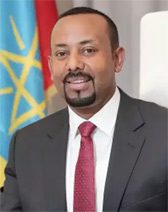
Abiy Ahmed Ali
Ethiopian Prime Minister since 2018 and recipient of the 2019 Nobel Peace Prize for his efforts to resolve the Ethiopia–Eritrea border conflict.
Born on August 15, 1976
Age: 50
Profession: Politician
Place of Birth: Beshasha, Oromia, Ethiopia
Abiy Ahmed Ali (born August 15, 1976) is an Ethiopian politician and former military officer who has served as Prime Minister of Ethiopia since April 2, 2018. He received the 2019 Nobel Peace Prize for his efforts to achieve peace and international cooperation, particularly his initiative to resolve the longstanding border conflict between Ethiopia and Eritrea. His premiership has included political and economic reforms, the establishment of the Prosperity Party, the 2020–2022 Tigray War, and renewed political and military tensions in northern Ethiopia.
Early Life and Family Background
Abiy Ahmed Ali was born on August 15, 1976, in Beshasha, a town in the Oromia region of Ethiopia. His father, Ahmed Ali, was a Muslim of Oromo ethnicity, while his mother, Tezeta Wolde, was an Orthodox Christian of Amhara background. He grew up in a large family and was his father's thirteenth child and the youngest of his mother's six children.
His childhood coincided with the rule of the Derg, the military government that controlled Ethiopia from 1974 until 1991. Political conflict and armed opposition to the government were widespread during the final years of that period. Abiy entered military and political activities while still young, eventually joining the armed movement opposing the Derg government.
Education and Military Career
Abiy Ahmed Ali became involved in the armed struggle against the Derg regime during his youth. Following the overthrow of the government in 1991, he served in the Ethiopian National Defense Force, eventually attaining the rank of lieutenant colonel.
During his military career, he participated in a United Nations peacekeeping mission in Rwanda. He also served during the 1998–2000 war between Ethiopia and Eritrea, which arose from a territorial dispute along the countries' shared border.
He specialized in information technology, communications, and military intelligence. His responsibilities included work involving communications systems, information security, and the development of Ethiopia's technological capabilities within its defense and intelligence institutions.
Alongside his military and government responsibilities, Abiy Ahmed Ali pursued higher education in leadership, management, business administration, and peace and security studies. He obtained a master's degree in transformational leadership and a Master of Business Administration (MBA). He subsequently completed a doctorate at the Institute for Peace and Security Studies of Addis Ababa University.
Information Network Security Agency
Abiy Ahmed Ali participated in establishing Ethiopia's Information Network Security Agency (INSA), an institution responsible for information security, cyber capabilities, and the protection of government communications infrastructure.
He held senior positions within the agency, including a leadership role as its director. His work connected military communications, technological administration, and national security responsibilities before he moved into senior political office.
Political Career
After his military and security career, Abiy Ahmed Ali became active in the Oromo People's Democratic Organization (OPDO), one of the constituent parties of the Ethiopian People's Revolutionary Democratic Front (EPRDF), the coalition that governed Ethiopia for nearly three decades.
He held organizational positions within the OPDO, including secretary-general, and served as deputy president of the Oromia regional government. His political responsibilities involved both regional administration and participation in the federal governing coalition.
From 2015 to 2016, he served as Ethiopia's Minister of Science and Technology. He subsequently returned to responsibilities within the Oromia regional administration.
During this period, Ethiopia experienced extensive anti-government protests, particularly in Oromia and Amhara. Demonstrators raised concerns over political representation, land policies, government accountability, and security-force actions. The protests placed increasing pressure on the governing EPRDF coalition.
In February 2018, Prime Minister Hailemariam Desalegn announced his resignation following years of political unrest. On March 27, 2018, Abiy Ahmed Ali was elected chairman of the EPRDF, placing him in a position to become the country's next prime minister.
On April 2, 2018, he took the oath of office before parliament and became the fourth prime minister of the Federal Democratic Republic of Ethiopia.
Early Reforms as Prime Minister
During his first months in office, Abiy Ahmed Ali introduced changes to Ethiopia's political institutions and public life. His government released political prisoners, allowed previously prohibited opposition organizations to return to the country, reduced certain restrictions on the media, and initiated reforms within state institutions.
Several opposition groups that had previously operated from exile were permitted to resume activities in Ethiopia. The government also announced changes involving the security sector and political organizations. These measures followed years of restrictions under the previous administration.
In October 2018, Abiy appointed a cabinet in which women held half of the ministerial positions. The appointments included senior responsibilities in government departments previously dominated by men.
That same month, Sahle-Work Zewde was elected Ethiopia's first female president. The presidency is primarily a ceremonial position under Ethiopia's constitutional system, while executive authority is exercised by the prime minister and federal government.
Ethiopia–Eritrea Peace Process
Ethiopia and Eritrea fought a border war between 1998 and 2000. Although the conflict formally ended through the Algiers Agreement in December 2000, the countries remained in a prolonged political and military standoff over the implementation of the border settlement.
In 2002, the Ethiopia–Eritrea Boundary Commission issued a decision concerning the disputed border, including the status of the town of Badme. Ethiopia did not fully implement the ruling, and diplomatic relations between the two countries remained severely restricted.
Following his appointment as prime minister, Abiy Ahmed Ali announced that Ethiopia was prepared to accept the boundary commission's decision. This decision provided the basis for renewed diplomatic negotiations with Eritrea.
In July 2018, he traveled to Asmara and met Eritrean President Isaias Afwerki. The two leaders agreed to restore diplomatic relations and reopen transportation, communication, and commercial connections between their countries.
Air services and telephone connections were restored, embassies reopened, and border crossings were initially opened. In September 2018, the two leaders signed an additional peace agreement in Jeddah, Saudi Arabia.
The diplomatic rapprochement ended the previous state of formal hostility, although the process of implementing border arrangements and normalizing relations remained incomplete. The countries later cooperated militarily during the Tigray conflict before bilateral tensions resurfaced.
2019 Nobel Peace Prize
On October 11, 2019, the Norwegian Nobel Committee announced that Abiy Ahmed Ali had been awarded the Nobel Peace Prize for his efforts toward peace and international cooperation, particularly his initiative to resolve the border conflict with Eritrea.
The committee also considered his involvement in regional peace and reconciliation initiatives in East and Northeast Africa. His acceptance of the boundary commission's decision and direct negotiations with President Isaias Afwerki formed the central basis of the award.
Abiy Ahmed Ali received the Nobel Peace Prize in Oslo, Norway, on December 10, 2019. He became the first Ethiopian prime minister to receive the award.
Formation of the Prosperity Party
In 2019, Abiy Ahmed Ali initiated a restructuring of Ethiopia's governing party system. Most parties within the EPRDF coalition merged to form the Prosperity Party, which officially emerged in December 2019.
The new organization replaced much of the previous coalition structure, which had been organized primarily around ethnically based regional political parties. Abiy presented the merger as part of his effort to establish a unified national political organization.
The Tigray People's Liberation Front (TPLF), which had previously exercised considerable influence within the EPRDF, refused to join the Prosperity Party. The disagreement widened the political division between the federal government and Tigray's regional leadership.
Disputes concerning constitutional authority, regional autonomy, the postponement of elections, and the distribution of political power intensified during 2020.
The Tigray War (2020–2022)
Political tensions between the federal government and the TPLF developed into armed conflict in November 2020. The government of Abiy Ahmed Ali announced a military operation in Tigray after accusing TPLF forces of attacking bases belonging to the Ethiopian National Defense Force's Northern Command. The TPLF disputed the federal government's account of the origins and circumstances of the fighting.
The Ethiopian military entered Tigray, and the conflict expanded to involve Eritrean forces and regional armed groups. Fighting spread across parts of northern Ethiopia, including areas of Amhara and Afar.
The war caused extensive civilian casualties, mass displacement, damage to infrastructure, and severe disruption to health services, agriculture, and humanitarian assistance. International organizations documented allegations of massacres, sexual violence, arbitrary detention, forced displacement, and other serious violations of international human rights and humanitarian law.
Investigations and reports by international human rights organizations identified allegations involving multiple parties to the conflict, including Ethiopian federal forces, Eritrean troops, Tigrayan forces, and regional militias. Responsibility for particular incidents remained the subject of investigations and competing accounts.
Abiy's government maintained that its military operations were necessary to preserve Ethiopia's constitutional order and territorial integrity. International human rights organizations and foreign governments criticized aspects of the military campaign, restrictions on humanitarian access, and the conduct of forces participating in the war.
The conflict also renewed international scrutiny of Abiy Ahmed Ali's receipt of the 2019 Nobel Peace Prize. The military campaign began approximately one year after he received the award for diplomatic efforts involving Eritrea, whose forces subsequently participated in the fighting in Tigray.
2021 General Election and Continuation in Office
Ethiopia's general election, originally scheduled for 2020, was postponed because of the COVID-19 pandemic. The decision contributed to constitutional and political disagreements, including disputes between the federal government and the Tigray regional authorities.
Elections were held in June 2021, although voting was delayed or not conducted in several constituencies because of security problems and other circumstances. The Prosperity Party, led by Abiy Ahmed Ali, obtained a parliamentary majority.
On October 4, 2021, Abiy was sworn in as prime minister for the new parliamentary term. His government continued to confront the war in northern Ethiopia, humanitarian emergencies, and disputes involving regional and federal authority.
2022 Pretoria Peace Agreement
After two years of fighting, representatives of the Ethiopian federal government and the TPLF participated in negotiations facilitated by the African Union in Pretoria, South Africa.
On November 2, 2022, the parties signed an agreement providing for a permanent cessation of hostilities, the disarmament of Tigrayan forces, restoration of federal authority, humanitarian access, and measures intended to support political normalization.
The agreement brought an end to the main phase of large-scale fighting between the federal government and TPLF. A transitional administration was subsequently established in Tigray.
Implementation remained contested. Outstanding issues included the return of displaced residents, the status of disputed territories, the demobilization of armed groups, the restoration of essential services, and the presence and activities of Eritrean forces.
Source: Biyografiler.com
Frequently asked questions about Abiy Ahmed Ali
Who is Abiy Ahmed Ali?, Abiy Ahmed Ali biography, Abiy Ahmed Ali life story, Abiy Ahmed Ali age, Abiy Ahmed Ali facts, Abiy Ahmed Ali birthplace, Abiy Ahmed Ali photos, Abiy Ahmed Ali videos, Abiy Ahmed Ali career

Lamine Yamal
Professional footballer

Erling Haaland
Professional footballer

Keanu Reeves
Actor

Kylian Mbappe
Professional footballer

Austin Abrams
Actor

Bad Bunny
Rapper, Songwriter

Adewale Akinnuoye-Agbaje
Actor, Former Model

Adam Smith
Economist, Author

Adam Driver
Actor

Adam Baldwin
Actor

Acun Ilıcalı
Producer, TV Personality, Media executive, Businessperson

Achmed Sukarno
Former President, Politician

John Healey
Politician

Ursula von der Leyen
Politician, Physician

Leonardo DiCaprio
Actor

Oprah Winfrey
Television Host, Media executive, Actress
Lamine Yamal
Professional footballer

Abby Brammell
Actress