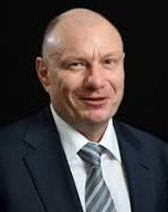
Vladimir Potanin
One of Russia’s most influential oligarchs shaped by post-Soviet privatization
Born on January 3, 1961
Age: 65
Profession: Businessperson, Investor
Place of Birth: Moscow, Soviet Union
Vladimir Potanin is a Russian billionaire businessman, investor, and former politician, widely regarded as one of the most influential oligarchs to emerge from the post-Soviet economic transformation. As the founder and president of Interros, a major investment holding with interests spanning mining, banking, technology, and tourism, Vladimir Potanin has built a vast business empire. His fortune was largely shaped during the controversial “loans-for-shares” privatization program of the 1990s, which redefined ownership of key state assets in Russia.
Early Life and Background
Vladimir Potanin, January 3, 1961 tarihinde Soviet Union’ın Russia’nın Moskova kentinde doğmuştur. His father worked as a Soviet trade representative abroad, while his mother was a physician. Due to his father’s diplomatic assignments, Vladimir Potanin spent part of his childhood in Türkiye, where he completed his early education before returning to Moscow.
He graduated with a gold medal from School No. 58 in Moscow and, in 1978, enrolled at the prestigious MGIMO University (Moscow State Institute of International Relations), one of the Soviet Union’s leading institutions for diplomacy and international economics. He graduated in 1983 with a degree in international economic relations, equipping him with the expertise that would later underpin his business career.
Career Beginnings
Following his graduation, Vladimir Potanin entered the Soviet foreign trade system, working at Soyuzpromexport and later as a senior engineer within the All-Union Foreign Economic Association. These roles provided him with critical exposure to global trade mechanisms and state-controlled economic structures.
During the period of Mikhail Gorbachev’s perestroika reforms, Vladimir Potanin transitioned into the private sector. In 1990, he founded Interros, initially focused on foreign economic consulting and investment activities. Shortly thereafter, he partnered with Mikhail Prokhorov to establish the International Finance Company (MFK Bank), marking his entry into banking.
In 1993, he became president of ONEKSIMbank, which rapidly grew into one of the largest private banks in Russia. This period marked the beginning of his rise as a major figure in the emerging post-Soviet financial elite.
Loans-for-Shares and Rise as an Oligarch
In 1995, Vladimir Potanin played a key role in designing the controversial “loans-for-shares” program, a defining moment in Russia’s economic transition. Under this system, private banks provided loans to the government in exchange for temporary control over shares in major state-owned enterprises. When the government failed to repay these loans, ownership of these strategic assets passed into private hands.
This mechanism enabled Vladimir Potanin and his associates to gain control of Norilsk Nickel, one of the world’s largest producers of refined nickel and palladium. The program remains one of the most debated episodes in Russian economic history, often associated with the rapid emergence of oligarchs and the concentration of wealth.
Political Career
Between August 14, 1996, and March 17, 1997, Vladimir Potanin served as First Deputy Prime Minister of Russia. During this time, he worked closely with President Boris Yeltsin and Prime Minister Viktor Chernomyrdin.
In government, he chaired several commissions related to fiscal and monetary policy and represented Russia in international financial institutions. His tenure reflected the close relationship between political authority and economic power during the country’s transition period.
Business Expansion and Investments
After leaving public office, Vladimir Potanin returned to business and significantly expanded the scope of Interros. The holding diversified into sectors including mining, banking, technology, tourism, and real estate. His most valuable asset remained Norilsk Nickel, where he served as chairman and maintained a dominant shareholding position for many years.
In the tourism sector, he invested heavily in the development of the Rosa Khutor ski resort near Sochi, contributing over $2 billion to the project. The resort became a key venue during the 2014 Winter Olympics, helping to position Russia as a destination for winter sports tourism.
His banking ventures also expanded significantly. In 2022, following the withdrawal of Société Générale from Russia after the Ukraine crisis, Vladimir Potanin acquired Rosbank. In the same year, he gained a substantial stake in TCS Group, the parent company of Tinkoff Bank, and became involved in projects linked to Yandex, reflecting his growing presence in the technology sector.
Philanthropy and Cultural Contributions
Vladimir Potanin is also known for his philanthropic initiatives. In 1999, he founded the Vladimir Potanin Foundation, which focuses on education, culture, and social development. The foundation has provided scholarships to thousands of students and supported numerous museum and cultural projects.
He has been actively involved in global cultural institutions, serving on the board of the Solomon R. Guggenheim Foundation and as chairman of the board of trustees of the State Hermitage Museum. His contributions include the acquisition and donation of Black Square by Kazimir Malevich to the Hermitage collection.
Vladimir Potanin is also a signatory of The Giving Pledge, joining figures such as Bill Gates and Warren Buffett in committing to donate at least half of his wealth to philanthropic causes.
Controversies and Criticism
Despite his success, Vladimir Potanin’s career has been marked by significant controversy. The loans-for-shares program has been widely criticized for enabling the transfer of valuable state assets into private hands at low prices, contributing to economic inequality in post-Soviet Russia.
Environmental concerns have also been raised regarding the operations of Norilsk Nickel, particularly in the Norilsk region, where industrial pollution has led to severe ecological damage.
He has also been involved in high-profile business disputes, notably with Mikhail Prokhorov and Oleg Deripaska over control of Norilsk Nickel. In 2012, Roman Abramovich acquired a stake in the company, helping to stabilize the conflict between competing shareholders.
Following Russia’s 2022 invasion of Ukraine, Vladimir Potanin was placed under sanctions by countries including the United States, United Kingdom, Canada, Australia, and New Zealand. Despite these restrictions, he remains one of the wealthiest individuals in Russia.
Personal Life
Vladimir Potanin was married to Natalia Potanina for nearly three decades, and the couple had three children: Anastasia Potanina, Ivan Potanin, and Vasily Potanin. Their divorce in 2014 became one of the most significant and high-profile asset division cases in Russian history. In the same year, he married Ekaterina Potanina.
He has a strong interest in sports, particularly ice hockey and skiing, and frequently participates in amateur hockey matches. Vladimir Potanin is also known for owning luxury yachts, including vessels named Anastasia, Nirvana, and Barbara, reflecting his status among the global elite.
Source: Biyografiler.com
Frequently asked questions about Vladimir Potanin
Who is Vladimir Potanin?, Vladimir Potanin biography, Vladimir Potanin life story, Vladimir Potanin age, Vladimir Potanin facts, Vladimir Potanin birthplace, Vladimir Potanin photos, Vladimir Potanin videos, Vladimir Potanin career
Related Biographies

Lamine Yamal
Professional footballer

Sam Altman
Entrepreneur, Investor, CEO

Kylian Mbappe
Professional footballer

Alice Weidel
Politician, Economist

Erling Haaland
Professional footballer

Giorgia Meloni
Politician, Journalist


Hongjoong
Singer, Rapper, Songwriter, Composer

Ludacris
Rapper, Actor

Kwon Eunbi
Singer

Sarah Wayne Callies
Actress, Screenwriter, Producer, Director

LaTavia Roberson
Singer, Actress, Entrepreneur
Lamine Yamal
Professional footballer

Xi Jinping
Politician, Statesman, Head of State

Austin Abrams
Actor

Pedro Sanchez
Politician

Claudia Sheinbaum
President, Politician, Scientist, Academic

Colman Domingo
Actor, Director, Producer